MiniMax-H3 scores 41.97% on new physical-world reasoning benchmark
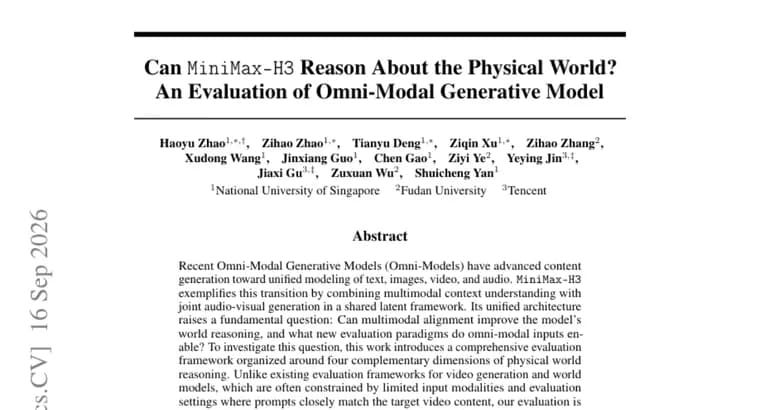
Omni-Modal Generative Models are moving content generation toward a unified handling of text, images, video and audio. MiniMax-H3 is presented as an example of that shift, combining multimodal context understanding with joint audio-visual generation inside a shared latent framework. That unified architecture raises a specific question: does aligning multiple modalities actually improve a model's reasoning about the physical world, and what new ways of testing does an omni-modal model make possible that a single-modality model does not?
To answer this, the work introduces an evaluation framework built around four complementary dimensions of physical-world reasoning. Existing benchmarks for video generation and world models are described as constrained: they use a limited set of input modalities, and their prompts tend to closely match the content of the target video, which the paper argues does not test genuine reasoning. This new framework is built instead to exploit the multimodal inputs an omni-model can take. It sets tasks that require integrating complementary information across modalities, split into four scenarios: implicit prompts paired with multiple frames, audio paired with a single image, prefix-videos, and audio paired with video. In every scenario, no single modality carries the full picture; each provides only partial evidence about the underlying event, so the model has to jointly reason over the different cues to infer the event's hidden state and how it develops.
Across 517 evaluation instances built this way, MiniMax-H3 reached an overall success rate of 41.97%. Results varied sharply by scenario: Video-based Decision Reasoning was the strongest category, at 56.00%, while Audio-based Disambiguation Reasoning was the weakest, at just 27.40%. The authors read this gap as evidence that effective multimodal integration, not just the presence of multiple modalities, remains the key obstacle to getting the full benefit of diverse inputs. The project's code is hosted publicly on GitHub.
Key facts
- A new evaluation framework tests MiniMax-H3's physical-world reasoning using four modality-combination scenarios: implicit prompts with multiple frames, audio-image, prefix-video, and audio-video.
- MiniMax-H3 reaches an overall success rate of 41.97% across 517 evaluation instances.
- Best result: Video-based Decision Reasoning, at 56.00% success.
- Worst result: Audio-based Disambiguation Reasoning, at 27.40% success.
- The authors conclude that effective multimodal integration, not just multimodal input, is what is still missing.
Why it matters
Omni-modal generative models are being built to unify text, image, video and audio generation, and MiniMax-H3 is offered here as an example: it combines multimodal context understanding with joint audio-visual generation in one shared latent framework. This paper asks whether that unification actually buys better reasoning about the physical world, rather than just more output modalities, and it builds a new evaluation paradigm specifically to test that, instead of reusing video-only benchmarks whose prompts tend to already match their target video.
Who it affects
Researchers and engineers building or evaluating omni-modal generative models, and anyone benchmarking MiniMax-H3 or comparable systems on physical-world or world-model reasoning. The source text does not name the authors or their institutions.
How to use it
The project's evaluation code is available in a public GitHub repository, so others can run the same four-scenario tests against their own omni-modal models. The source gives no pricing, licence or access terms for MiniMax-H3 itself.
How solid is it
The claim rests on a defined benchmark of 517 evaluation instances split across four reasoning scenarios, with a separate success rate reported for each rather than one blended number. The source text does not say how the 517 instances are divided among the four scenarios, and it gives no comparison to other omni-modal or world models tested on the same benchmark, so there is no way from this text alone to judge how MiniMax-H3's numbers stack up against alternatives.
Risks and caveats
The weakest category, audio-based disambiguation reasoning, succeeds only 27.40% of the time, meaning the model fails on most such cases, and the source gives no explanation for why audio-based reasoning proves harder than video-based reasoning. The overall success rate, 41.97%, is well under half, which the authors themselves read as showing that integrating multiple modalities effectively is still an open problem rather than something the architecture solves by default.
“These results indicate that effective multimodal integration remains key to fully exploiting the benefits of diverse input modalities.”
— the authors