LingBot-Touch unifies three tactile sensor types for dexterous manipulation
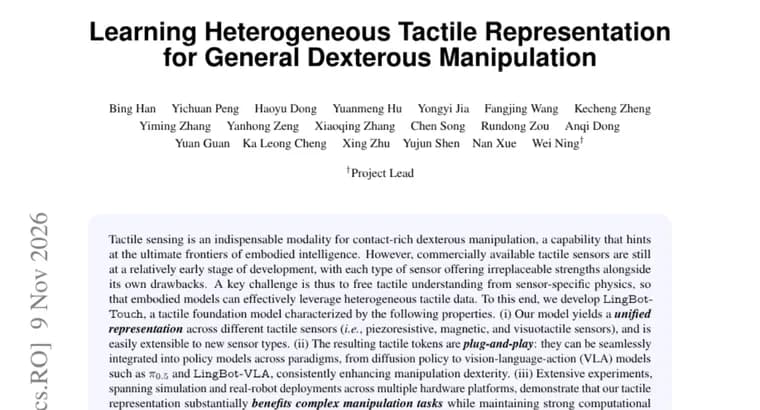
A paper on Hugging Face Papers introduces LingBot-Touch, a tactile foundation model built to handle touch data from different kinds of sensors in one common form.
The starting point is a problem the authors describe: tactile sensing is indispensable for contact-rich dexterous manipulation, but commercially available tactile sensors are still at a relatively early stage of development. Each type offers irreplaceable strengths alongside its own drawbacks. The authors argue that a key challenge is therefore to free tactile understanding from sensor-specific physics, so that embodied models can effectively use heterogeneous tactile data.
Their answer, LingBot-Touch, is described through three properties. First, the model yields a unified representation across piezoresistive, magnetic and visuotactile sensors, and the authors say it is easily extensible to new sensor types. Second, the resulting tactile tokens are described as plug-and-play. They can be integrated into policy models across paradigms, from diffusion policy to vision-language-action (VLA) models such as π_{0.5} and LingBot-VLA, and the authors say they consistently enhance manipulation dexterity. Third, the authors report extensive experiments in simulation and in real-robot deployments across multiple hardware platforms. They say these show the tactile representation substantially benefits complex manipulation tasks while maintaining strong computational efficiency.
The authors close by saying they believe the findings show the potential of using cross-sensor data to scale tactile learning, and offer encouraging insights for the design of future hardware and embodied models.
The abstract gives no quantitative results, so the size of the gains is not stated.
Key facts
- LingBot-Touch is a tactile foundation model that produces a unified representation across piezoresistive, magnetic and visuotactile sensors.
- The authors say it is easily extensible to new sensor types.
- Its tactile tokens are described as plug-and-play, integrating into policy models from diffusion policy to VLA models such as π_{0.5} and LingBot-VLA.
- Experiments in simulation and on real robots across multiple hardware platforms are reported to show substantial benefits for complex manipulation tasks with strong computational efficiency.
- No quantitative results are given: no success rates, improvement margins, task counts, or efficiency figures.
Why it matters
Commercial tactile sensors differ in physics and each has its own strengths and drawbacks, so touch data from one sensor type does not easily carry over to another. The authors frame the key challenge as freeing tactile understanding from sensor-specific physics. A shared representation would let embodied models use heterogeneous tactile data. The authors believe cross-sensor data can help scale tactile learning.
Who it affects
Robotics researchers working on contact-rich dexterous manipulation are the main audience. So are teams building policies on diffusion policy or VLA models, since the paper names π_{0.5} and LingBot-VLA as models the tactile tokens integrate with. The authors also say the findings offer insights for the design of future hardware and embodied models.
How to use it
According to the authors, the tactile tokens are meant to be added to an existing policy model: they can be integrated across paradigms, from diffusion policy to VLA models. The model also supports piezoresistive, magnetic and visuotactile sensors, and is said to extend to new sensor types. It is not stated whether code, weights, or data are released.
How solid is it
The claims come from the authors' own abstract. They report experiments in simulation and on real robots across multiple hardware platforms. No quantitative results are given: no success rates, improvement margins, task counts, or efficiency figures. No baselines are named for the comparisons, and the abstract does not name the specific robot hardware platforms, tasks, or simulation environments used. Words like "substantially" and "consistently" cannot be checked from this text.
Risks and caveats
Without numbers, baselines or task details, the size and breadth of the improvement are unknown. The abstract does not describe the model architecture or training method. No authors or institutions are named in the abstract. Claims of easy extension to new sensor types and plug-and-play use are the authors' own and would need confirmation in the full paper.
“A key challenge is thus to free tactile understanding from sensor-specific physics, so that embodied models can effectively leverage heterogeneous tactile data.”
— LingBot-Touch paper abstract