MaP-SQL beats R^3-SQL on BIRD-dev without any fine-tuning
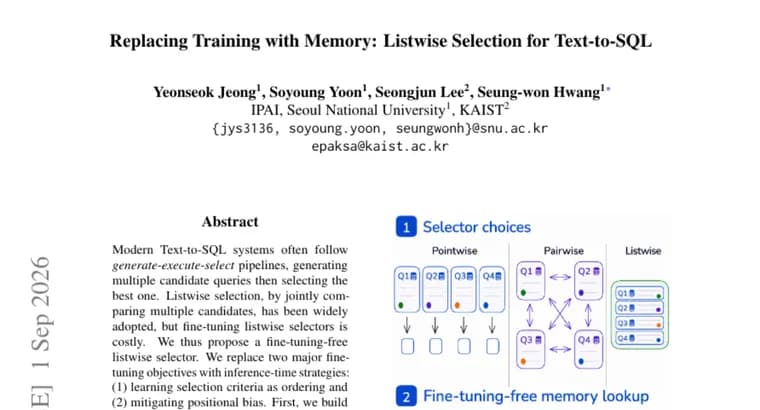
Text-to-SQL systems commonly follow a generate-execute-select pipeline: a model produces several candidate SQL queries for a question, then a separate step picks the best one. Listwise selection, which compares all the candidates against each other at once rather than judging them one by one, has become the standard approach for that final step, but training a listwise selector requires costly fine-tuning.
Researchers propose MaP-SQL, a listwise selector that needs no fine-tuning at all. It replaces the two objectives a selector would normally learn through training with strategies applied at inference time instead. First, rather than learning selection behavior as model parameters, MaP-SQL builds reusable structured memories distilled from training data. These memories encode how natural-language questions map to schema elements, SQL operations, and expected outputs, and they serve as explicit criteria the model uses to judge candidates. Second, to counter the positional bias that listwise selectors are prone to, where an answer's ranking depends partly on where it sits in the list rather than only its quality, MaP-SQL runs the comparison across multiple orderings of the same candidates and aggregates the resulting rankings. The extra inference cost that would add is kept down by leaning on execution results and pointwise scoring rather than rerunning every permutation from scratch.
On the BIRD-dev benchmark, MaP-SQL outperforms the previous state-of-the-art selector-based method, R^3-SQL, by 2.02 execution accuracy points on average, using the identical candidate sets, while consuming 2.92x fewer tokens. Across Text-to-SQL benchmarks more broadly, the authors report that their approach produces more stable selection than existing methods and needs fewer unnecessary comparisons, all without a fine-tuning step, and while staying compatible with existing large language models.
Key facts
- MaP-SQL is a fine-tuning-free listwise selector for ranking Text-to-SQL query candidates.
- It replaces learned selection criteria with reusable structured memories distilled from training data, mapping questions to schema elements, SQL operations and expected outputs.
- It counters listwise selectors' positional bias by aggregating rankings across multiple candidate-list permutations, with inference cost controlled via execution results and pointwise scoring.
- On BIRD-dev, it beats the prior state-of-the-art selector R^3-SQL by 2.02 execution accuracy points on average using the same candidate sets.
- It uses 2.92x fewer tokens than R^3-SQL in that same comparison.
Why it matters
Generate-execute-select pipelines depend on a selection step to pick the best SQL candidate out of several a model generates, and listwise selection, which judges all candidates together, has become the preferred way to do that. The catch is that fine-tuning a listwise selector is costly. MaP-SQL removes that cost by moving the selection criteria into a reusable memory built once from training data rather than into model weights that must be retrained, making listwise selection cheaper to set up and reuse.
Who it affects
Teams building Text-to-SQL or natural-language database query systems around a generate-execute-select pipeline, and anyone currently relying on a listwise selector that would otherwise require fine-tuning for each model it is paired with. The method is described as compatible with existing large language models, so it targets practitioners who want a selection step without training one.
How to use it
The source does not state a release timeline or whether code or a trained memory set is being made available, and it names no pricing or licensing terms. It describes the method as maintaining compatibility with existing large language models, meaning it is meant to slot into a pipeline as an inference-time selection step rather than requiring a new model to be trained.
How solid is it
The headline result, a 2.02-point execution accuracy improvement over R^3-SQL with 2.92x fewer tokens, is measured on the BIRD-dev benchmark using the same candidate sets for both methods, which makes it a like-for-like comparison against a named, specific baseline rather than a vague claim. The broader claim of more stable selection and fewer unnecessary comparisons is said to hold across Text-to-SQL benchmarks generally, but no benchmark beyond BIRD-dev is named for the quantified numbers.
Risks and caveats
The source gives no absolute execution-accuracy score for MaP-SQL itself, only its margin over R^3-SQL, so its standalone accuracy on BIRD-dev is not stated. No author names, affiliations or publication venue are given in the text, and there is no stated timeline for releasing code or the trained memories.