MC-Sparse paper reports 1.8x to 2.3x faster diffusion transformers, no training needed
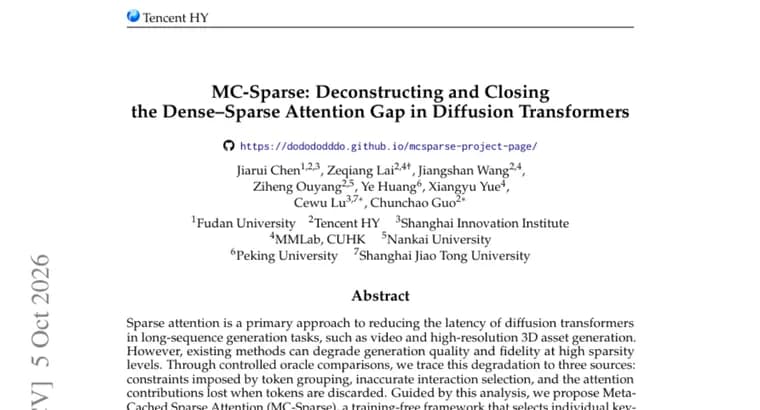
Sparse attention is a main way to cut the latency of diffusion transformers on long-sequence tasks such as video and high-resolution 3D asset generation. The paper behind MC-Sparse starts from a known weakness: existing sparse-attention methods can lose generation quality and fidelity once sparsity gets high.
The authors say they used controlled oracle comparisons to trace that degradation to three sources: constraints imposed by token grouping, inaccurate interaction selection, and the attention contributions lost when tokens are discarded.
Guided by that analysis, they propose Meta-Cached Sparse Attention (MC-Sparse), a training-free framework. It selects individual key-value (KV) tokens, while organizing similar queries into tile-aligned groups so the work still runs efficiently on GPUs. The metadata it builds comprises query groups, KV indices selected using exact attention probabilities, and residuals between dense and sparse attention outputs. That metadata is cached and reused across subsequent denoising steps.
Across video and 3D generation models, the paper says MC-Sparse achieves higher fidelity to dense-attention outputs and larger denoising speedups than existing sparse-attention baselines, without visible quality degradation. Relative to dense attention, it reports a 1.80x denoising speedup on Minimax-H3-Base and a 2.32x speedup on 3D asset generation, both with negligible quality loss.
Key facts
- MC-Sparse (Meta-Cached Sparse Attention) is a training-free sparse-attention framework for diffusion transformers.
- The authors trace quality loss in existing sparse methods to three sources: token grouping constraints, inaccurate interaction selection, and attention contributions lost when tokens are discarded.
- It caches query groups, KV indices chosen with exact attention probabilities, and dense-minus-sparse residuals, then reuses them across denoising steps.
- Reported speedups relative to dense attention: 1.80x denoising on Minimax-H3-Base and 2.32x on 3D asset generation, both with negligible quality loss.
Why it matters
Long-sequence generation such as video and high-resolution 3D assets is slow with dense attention, and sparse attention is a primary way to cut that latency. The catch is that existing methods can degrade quality and fidelity at high sparsity. MC-Sparse targets exactly that gap: it diagnoses three specific sources of degradation and builds the method around fixing them, rather than only pushing sparsity harder. The claimed result is closer agreement with dense-attention outputs together with larger speedups than existing sparse baselines.
Who it affects
The work is aimed at people building and serving diffusion transformers for long-sequence generation, in particular video and high-resolution 3D asset generation. Because the method is training-free, it is framed as applying to models as they are, without a new training run. The tile-aligned query groups are designed for efficient GPU execution, so GPU inference engineers are the natural readers.
How to use it
The abstract describes a method, not a product. The source does not mention a code or model release, so there is nothing to install or run from this text alone. Practitioners would need to implement the caching of query groups, selected KV indices and residuals themselves, and reuse them across denoising steps, following the full paper.
How solid is it
The claims come from the paper's own abstract and are the authors' reports. The headline numbers are clear: 1.80x denoising speedup on Minimax-H3-Base and 2.32x speedup on 3D asset generation, both relative to dense attention. The source gives no quality metric values, only the phrases "without visible quality degradation" and "negligible quality loss". The existing sparse-attention baselines it is compared against are not named, and the name of the 3D asset generation model is not given. The hardware, sequence length, resolution and sparsity level behind the speedups are not stated either.
Risks and caveats
The speedups are denoising speedups relative to dense attention; no end-to-end wall-clock figure is given. The 2.32x figure is stated as a speedup on 3D asset generation, without the word denoising attached to it in the sentence. Without named baselines and numeric quality scores, the size of the advantage over other sparse methods cannot be judged from this text. Results on two reported settings may not carry over to other models or sparsity levels.
“MC-Sparse achieves higher fidelity to dense-attention outputs and larger denoising speedups than existing sparse-attention baselines, without visible quality degradation.”
— MC-Sparse paper abstract