ME-World generates synchronized first-person video for multiple interacting agents
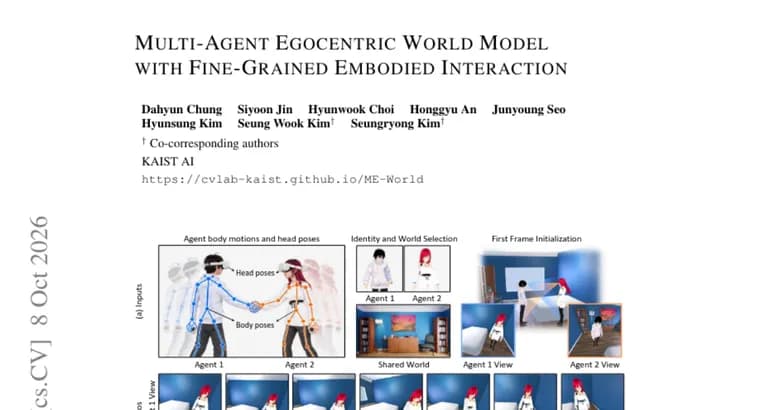
A paper on Hugging Face Papers proposes ME-World, short for Multi-agent Egocentric World Model. Egocentric world models predict first-person observations conditioned on an agent's actions, but most of them focus on a single agent. The authors point out that real embodied settings often involve several agents who act and interact within a shared environment.
They argue that existing multi-agent world models rely on coarse actions such as locomotion, camera control or discrete commands, which leaves fine-grained embodied interactions underexplored. The authors therefore formulate multi-agent egocentric world modeling as synchronized ego-stream generation: several agents interact through fine-grained actions in a shared world, and the model produces a matching first-person video stream for each of them. That task requires cross-view action consistency, shared-environment consistency, and consistent propagation of interaction-induced state updates.
ME-World handles this in three ways. It jointly denoises multiple ego streams in a shared token sequence, it conditions each stream on all agents' target-view poses, and it grounds generation with shared environment memory.
The authors train and evaluate on real and synthetic multi-agent data. They also introduce shared-world consistency metrics covering environment consistency, update consistency and identity consistency. Their experiments show, in their words, that ME-World improves shared-world consistency, action control, identity preservation and video quality over existing methods. The abstract gives no numerical results.
Key facts
- ME-World (Multi-agent Egocentric World Model) generates synchronized first-person video streams for multiple agents interacting in a shared world.
- The authors say existing multi-agent world models rely on coarse actions such as locomotion, camera control or discrete commands, leaving fine-grained interactions underexplored.
- The model jointly denoises multiple ego streams in a shared token sequence, conditions each stream on all agents' target-view poses, and uses shared environment memory.
- The paper introduces shared-world consistency metrics for environment, update and identity consistency, and trains and evaluates on real and synthetic multi-agent data.
- The authors report gains in shared-world consistency, action control, identity preservation and video quality over existing methods, without numbers in the abstract.
Why it matters
Most egocentric world models model one agent seeing the world from its own viewpoint. This work targets the case where several agents act on the same environment at once, so what one agent does has to show up correctly in what the others see. The authors frame that as a distinct problem with three requirements: cross-view action consistency, shared-environment consistency, and consistent propagation of interaction-induced state updates. They also argue that prior multi-agent work stays at coarse actions, and that fine-grained embodied interaction is the gap.
Who it affects
The work is aimed at researchers building world models and video generation systems for embodied settings with more than one agent. The authors motivate it with real embodied settings where multiple agents act and interact within a shared environment. The abstract does not state real-world deployment or robotics results; it only mentions real and synthetic multi-agent data.
How to use it
This is a research proposal rather than a product. The abstract mentions no code, model weights or release availability, so there is nothing to try yet. Researchers working on multi-agent video or world models can take from it the problem formulation (synchronized ego-stream generation) and the idea of measuring environment, update and identity consistency across views.
How solid is it
The claims come from the paper's own abstract and are self-reported. The abstract gives no numerical results, benchmark scores or percentage improvements, and it does not name the datasets, the baselines behind "existing methods", or the number of agents tested. It names no authors or institutions. The consistency metrics are introduced by the same authors who report the gains, so the comparison rests on their own yardstick.
Risks and caveats
Without numbers, baselines or dataset names in the abstract, the size of the improvement cannot be judged. No model size, compute budget or training details are stated. The mix of real and synthetic data is mentioned, but the abstract does not say how results split between the two. Treat the reported gains as a claim to check against the full paper.
“We formulate multi-agent egocentric world modeling as synchronized ego-stream generation for multiple agents interacting through fine-grained actions in a shared world.”
— ME-World paper abstract