Mechanist finds AI safety risk hidden in seemingly safe training data
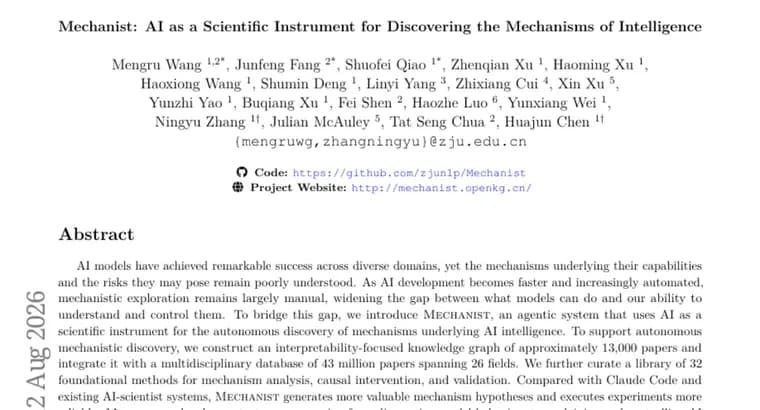
AI models keep getting more capable. But the reasons behind that capability, and the risks it might carry, are still poorly understood. Interpretability research, the work of figuring out what is actually happening inside a model, has stayed mostly manual even as model development itself becomes faster and more automated, so the gap between what models can do and what researchers understand about them keeps widening. Mechanist is a new agentic system built to close that gap by turning AI into the instrument that studies AI: it runs autonomous mechanistic research on its own, generating hypotheses about how models work and testing them experimentally rather than waiting for a human researcher to design and run each study.
To do this, Mechanist draws on an interpretability-focused knowledge graph built from about 13,000 papers, integrated with a much larger multidisciplinary database of 43 million papers spanning 26 fields, plus a curated library of 32 foundational methods for mechanism analysis, causal intervention and validation. According to the paper, Mechanist outperforms Claude Code and other existing AI-scientist systems at this kind of work, producing mechanism hypotheses the authors judge more valuable and running experiments more reliably; the text does not give a benchmark score or percentage behind that comparison, and it does not make clear whether Claude Code counts as one of the existing AI-scientist systems or as a separate point of comparison.
The system's first major result is a safety finding, and it runs counter to intuition: Mechanist showed that unsafe behavioral traits can transfer across modalities through training data that looks completely safe, a risk in scientific laboratories. Data that looks harmless is not always harmless. It can still carry an unsafe trait into a model operating in a different modality. The paper does not say which modalities or what kind of training data were involved, so the exact mechanics of the transfer are not spelled out.
Mechanist's second major result is a mechanism theory of belief: an account of how models represent knowledge about the world, form beliefs from it, infer what beliefs other agents hold, and how these mechanisms first emerge during pretraining. This moves the system from simply describing what models do toward explaining why they do it.
Finally, the paper reports that Mechanist turns these mechanistic findings into practical interventions: changes that improve model performance across a range of scenarios, and a method for steering scientific foundation models to generate DNA sequences with specified properties. The paper does not enumerate which scenarios or which DNA properties are involved, and it does not name the underlying model or LLM that powers Mechanist itself.
Key facts
- Mechanist is an agentic AI system built to autonomously discover the mechanisms behind AI models' capabilities and risks, rather than relying on manual interpretability research.
- It runs on an interpretability-focused knowledge graph of about 13,000 papers, linked to a 43-million-paper multidisciplinary database spanning 26 fields, plus a library of 32 methods for mechanism analysis, causal intervention and validation.
- The paper reports Mechanist outperforms Claude Code and other AI-scientist systems at generating valuable mechanism hypotheses and running experiments reliably, though no benchmark numbers back the comparison.
- Its first major finding: unsafe behavioral traits can transfer across modalities through training data that looks entirely safe, a risk in scientific laboratories.
- Mechanist also built a mechanism theory of belief covering how models represent world knowledge and infer other agents' beliefs, and used its findings to improve model performance and steer scientific foundation models toward generating DNA sequences with specified properties.
Why it matters
AI capability is advancing faster than the research needed to understand it: mechanistic interpretability, the work of tracing what is actually happening inside a model, has mostly stayed a manual, one-study-at-a-time process even as models themselves get built faster and more automatically. Mechanist is pitched as a way to close that gap by turning AI itself into the instrument that investigates AI, generating its own hypotheses about how models work and testing them experimentally rather than waiting on a human researcher to design each study. The paper reports that Mechanist beats Claude Code and other existing AI-scientist systems at this task, producing hypotheses the authors judge more valuable and running experiments more reliably. If systems like this hold up, they could let interpretability research scale closer to the pace at which model capability itself scales, instead of falling further behind it.
Who it affects
The direct audience is AI interpretability and safety researchers, plus teams building or evaluating agentic AI-scientist systems, who now have a new point of comparison. The safety finding, that unsafe traits can move between modalities through data that looks safe, matters to anyone training or auditing models on mixed or multimodal data, including in scientific-laboratory contexts. The DNA-sequence steering result also points to developers of scientific foundation models, since Mechanist's mechanistic insights were used to steer such a model toward generating sequences with specified properties.
How to use it
Mechanist is a research system: the paper introduces it as an agentic tool for autonomous mechanistic discovery, built from components that could plausibly be reused. It combines a knowledge graph and multidisciplinary database it can query, and a curated library of 32 methods for mechanism analysis, causal intervention and validation. The paper points to two concrete applications built from Mechanist's findings so far: interventions that improve model performance across a range of scenarios, and a method for steering a scientific foundation model to generate DNA sequences with specified properties. The paper does not enumerate which scenarios or which DNA properties were involved, so the practical scope beyond these two examples is not established from the text alone.
How solid is it
This account rests entirely on the paper's own description. The text does not name individual authors, their institutions, or where and when the paper was published, and it does not identify the underlying model or LLM that powers Mechanist itself. The central comparative claim, that Mechanist beats Claude Code and other AI-scientist systems at generating valuable hypotheses and running experiments reliably, is stated by the authors without an accompanying benchmark score or percentage in the text, and it is not clear whether Claude Code is counted as one of the existing AI-scientist systems the paper compares against, or treated as a separate baseline. The scale of the underlying resources, a roughly 13,000-paper interpretability knowledge graph, a 43-million-paper database across 26 fields, and 32 curated methods, is concrete and specific, which supports that Mechanist is a substantial engineering effort even where its headline performance claims are not yet independently quantified in the text available.
Risks and caveats
The paper's own headline finding is itself a caution: training data that looks safe can still carry an unsafe trait into a model across modalities, and the text does not say which modalities or what kind of training data were involved, so it is hard to judge how narrow or broad this risk actually is. The claim that Mechanist outperforms Claude Code and other AI-scientist systems comes from the same paper that introduces the system, and the text does not include a benchmark score or percentage behind it, which is worth weighing before treating the comparison as settled. The practical interventions described, general performance gains and steered DNA sequence generation, are not tied to enumerated scenarios or named properties in the text, so their real-world scope beyond these two examples is not established.