Σ-Mem tracks peer reliability in multi-agent LLM systems
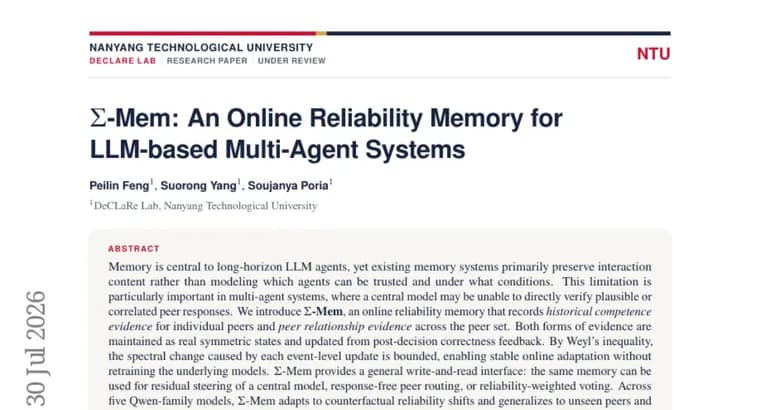
Researchers describe Σ-Mem, an online memory system built for multi-agent setups where one central LLM has to decide how much to trust answers coming from other peer agents. The authors' starting point is a gap in existing memory systems: those systems mostly store what was said in past interactions, not which agents tend to be right and under what conditions. That gap matters most when a central model cannot directly check whether a peer's plausible-sounding or mutually correlated answer is actually correct.
Σ-Mem addresses this by keeping two kinds of evidence as real symmetric matrices: historical competence evidence for each individual peer, and evidence about relationships between peers across the whole peer set. Both matrices update online, after each decision, based on whether the outcome turned out to be correct. The authors lean on Weyl's inequality to show that the spectral change from any single event-level update is bounded, which they say keeps the online adaptation stable without retraining the underlying language models.
The system exposes a general write-and-read interface, so the same stored memory can support three different uses: residual steering of a central model's own decisions, response-free routing of queries to peers without needing their answers first, or reliability-weighted voting across peers. In tests across five Qwen-family models, Σ-Mem adapted to reliability shifts that were deliberately introduced as counterfactuals, and it generalized to peers and task domains it had not seen during training. Reading directly from the memory outperformed both majority voting and the single best fixed peer across the full out-of-distribution evaluation set, and results kept improving as more correctness feedback accumulated over time.
The abstract does not name the paper's authors, their institution, specific benchmark tasks, or the magnitude of the reported improvements, and it does not mention any code or dataset release.
Key facts
- Σ-Mem is an online memory that records which peer agents in a multi-agent LLM system have historically been reliable, rather than just storing past interaction content.
- It maintains two real symmetric matrices, one for individual peer competence and one for relationships between peers, both updated after each decision based on correctness feedback.
- Stability during online updates rests on Weyl's inequality, which bounds the spectral change from each event-level update without retraining the underlying models.
- The same memory supports three uses through one interface: residual steering of a central model, response-free peer routing, and reliability-weighted voting.
- Tested across five Qwen-family models, Σ-Mem generalized to unseen peers and task domains and beat majority voting and the best fixed peer on the full out-of-distribution evaluation set.
Why it matters
Multi-agent LLM systems increasingly route work to multiple peer models, but a central model often cannot verify a peer's answer on its own, especially when several peers give plausible or correlated responses. Prior memory systems tracked what was said rather than which sources tend to be right, leaving that trust decision unmodeled. Σ-Mem targets exactly that gap by building a running record of peer reliability rather than just conversation history.
Who it affects
The work is aimed at people building or researching multi-agent LLM architectures, orchestration layers, or agent-routing systems where a central model coordinates several peer models and needs a principled way to weigh their input.
How to use it
Σ-Mem is described as a general write-and-read interface rather than a single fixed technique. The same underlying memory can be tapped three ways: to steer a central model's own residual decisions, to route queries to peers without first collecting their responses, or to weight votes across peers by reliability. The abstract does not mention a code or dataset release, so how to obtain or reproduce the system is unclear.
How solid is it
The authors evaluated Σ-Mem across five Qwen-family models, including deliberately introduced counterfactual shifts in peer reliability, and report that it generalized to peers and task domains not seen during training. Direct memory readouts beat both majority voting and the best fixed peer over the full out-of-distribution evaluation set, and performance kept improving as more correctness feedback came in, which the authors read as evidence the memory accumulates useful reliability information over time.
Risks and caveats
The abstract gives no author names, institutional affiliation, or publication date, and no specific numeric improvement over baselines, only that Σ-Mem 'outperforms' them. It does not describe which tasks or benchmarks make up the out-of-distribution evaluation set, and testing is confined to Qwen-family models, so how the approach generalizes to other model families is untested here.
“existing memory systems primarily preserve interaction content rather than modeling which agents can be trusted and under what conditions”
— the paper's authors