MemBodied gives robot vision-language-action models a fixed-size memory
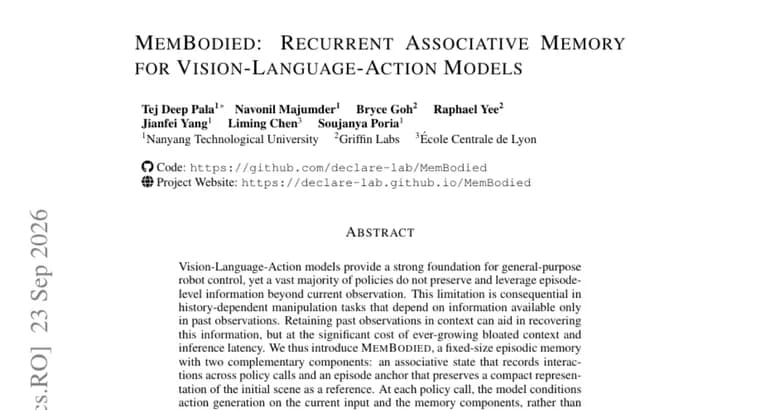
A paper describes MemBodied, a memory architecture for Vision-Language-Action (VLA) models, the class of AI systems used for general-purpose robot control. The authors note that most VLA policies only look at the current observation and do not retain information from earlier in an episode, which hurts performance on manipulation tasks that depend on something the robot saw earlier but is no longer looking at. One fix is to keep past observations in the model's context window, but the authors say this makes the context grow without bound and slows down inference. MemBodied instead uses a fixed-size episodic memory with two parts: an associative state that records interactions across successive policy calls, and an episode anchor that keeps a compact representation of the initial scene as a fixed reference point. At every policy call, the model conditions its action on the current input plus these two memory components, rather than on the raw history of past observations. On five RMBench tasks that specifically require memory, MemBodied reached 7.81 times the mean success rate of a stateless policy and 2.98 times that of a vanilla recurrent-memory baseline, and it beat the strongest memory-augmented baseline tested by 1.3 times while adding 10 times fewer parameters. On the fully observable LIBERO-Long benchmark suite, which does not require long-term memory, MemBodied still scored 90.6%, a 5.4% improvement over the stateless pi_0 policy. The authors present these results as evidence that MemBodied is a practical alternative to simply expanding a policy's context window for tasks where the robot needs to remember something from earlier in the episode.
Key facts
- MemBodied is a fixed-size episodic memory for VLA robot-control models, built from an associative state (records interactions across policy calls) and an episode anchor (a compact snapshot of the initial scene).
- On five memory-dependent RMBench tasks, MemBodied achieved 7.81x the mean success rate of a stateless policy and 2.98x that of vanilla recurrent memory.
- MemBodied outperformed the strongest memory-augmented baseline tested by 1.3x while using 10x fewer added parameters.
- On the fully observable LIBERO-Long suite, MemBodied scored 90.6%, a 5.4% improvement over the stateless pi_0 policy.
Why it matters
Most Vision-Language-Action robot-control policies act only on the current camera view and discard everything that came before, which fails on tasks where a robot needs to recall something it saw earlier in the episode but can no longer see. The usual fix, keeping the full history in the model's context, makes that context grow without limit and slows inference. MemBodied proposes a fixed-size memory instead, aiming to give a policy episode-level recall without the growing compute cost.
Who it affects
The work is aimed at researchers and engineers building general-purpose robot-manipulation policies, particularly for history-dependent tasks such as ones where an object or scene detail observed early in an episode needs to be recalled later.
How to use it
MemBodied is described as an architectural addition to a VLA policy: an associative state that accumulates interactions across policy calls, plus an episode anchor that fixes a compact representation of the initial scene, both of which condition each action-generation step instead of raw past observations. The source text does not give details on model size, training data, or whether code or data have been released.
How solid is it
The reported gains come from the paper's own evaluation on two benchmark suites, RMBench (five memory-requiring tasks) and LIBERO-Long, comparing MemBodied against a stateless policy, a vanilla recurrent-memory baseline, and the strongest memory-augmented baseline the authors tested. The primary source page was not fully accessible, so this account is based on the paper's abstract; it does not name the authors or their institutions.
Risks and caveats
The abstract text available does not identify the paper's authors or institutions, give a publication date, or state whether the model, code, or training data will be released, so independent verification and reuse are not yet possible from what is known. The performance figures are also drawn entirely from the authors' own benchmarking rather than third-party evaluation.
“Retaining past observations in context can aid in recovering this information, but at the significant cost of ever-growing, bloated context and inference latency.”
— the paper's authors