MemOnce memory architecture reportedly cuts Qwen3.5-4B cache 1313 times
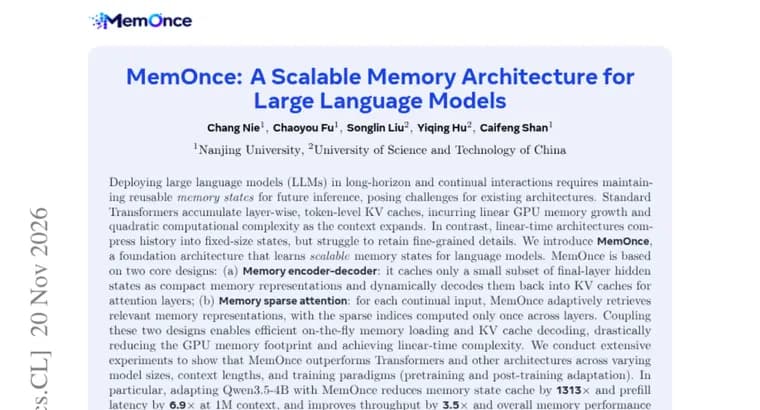
A paper on Hugging Face introduces MemOnce, a foundation architecture that learns scalable memory states for language models. It targets long-horizon and continual use, where an LLM has to keep reusable memory states for future inference.
The authors frame the problem as a trade-off between two existing families. Standard Transformers accumulate layer-wise, token-level KV caches, which brings linear GPU memory growth and quadratic computational complexity as the context expands. Linear-time architectures compress history into fixed-size states, but struggle to retain fine-grained details.
MemOnce rests on two designs. The first is a memory encoder-decoder: it caches only a small subset of final-layer hidden states as compact memory representations, then dynamically decodes them back into KV caches for the attention layers. The second is memory sparse attention: for each continual input, MemOnce adaptively retrieves the relevant memory representations, and the sparse indices are computed only once across layers. Together, the authors say, these enable efficient on-the-fly memory loading and KV cache decoding, drastically reduce the GPU memory footprint and achieve linear-time complexity.
On results, the authors say extensive experiments show MemOnce outperforming Transformers and other architectures across varying model sizes, context lengths, and training paradigms, covering both pretraining and post-training adaptation. The headline example is Qwen3.5-4B adapted with MemOnce: memory state cache falls by 1313 times and prefill latency by 6.9 times at 1M context, while throughput improves by 3.5 times and overall memory performance by +5.77%. The numbers appear in the source as "1313times", "6.9times" and "3.5times".
Finally, the authors report that MemOnce generalizes zero-shot to downstream representation tasks, achieving competitive results against specialized models.
Key facts
- MemOnce caches only a small subset of final-layer hidden states as compact memory and decodes them back into KV caches for attention layers.
- Its sparse attention retrieval computes the sparse indices only once across layers, and the authors claim linear-time complexity.
- Adapting Qwen3.5-4B with MemOnce is reported to cut memory state cache by 1313 times and prefill latency by 6.9 times at 1M context.
- The same adaptation is reported to improve throughput by 3.5 times and overall memory performance by +5.77%.
- The authors also report zero-shot generalization to downstream representation tasks, with results competitive against specialized models.
Why it matters
Long contexts are expensive because a standard Transformer's KV cache grows linearly in GPU memory and its compute grows quadratically with context. Fixed-size linear-time alternatives avoid that but lose fine-grained detail. MemOnce tries to sit between the two: keep a compact memory, rebuild the KV cache from it when needed, and attend sparsely. If the reported reductions at 1M context hold up, the approach would make persistent memory for long-running LLM interactions far cheaper to hold.
Who it affects
The paper is aimed at anyone deploying LLMs in long-horizon and continual interactions, where memory states must be kept and reused for later inference. That mainly means teams who run into KV cache memory and prefill latency limits, and researchers working on memory and long-context architectures.
How to use it
There is nothing to use yet from the source alone. No code, model release or licence is mentioned. The reported route is adapting an existing model: the headline experiment applies MemOnce to Qwen3.5-4B through post-training adaptation, and the authors also test pretraining.
How solid is it
This is a preprint abstract with self-reported results. The authors say the experiments are extensive and span model sizes, context lengths and both training paradigms, but the source gives results only for Qwen3.5-4B and names no competing architectures or benchmarks. No authors or institutions are named in the source text.
Risks and caveats
The source does not say what the 1313 times, 6.9 times and 3.5 times figures are measured against, or on what hardware. It does not say whether the throughput gain is measured at 1M context. The +5.77% for overall memory performance is not defined: the source does not say whether it is percentage points or a relative gain, or which benchmark measures it. Claims of outperforming Transformers and other architectures cannot be checked from the abstract.