Mendel Godel Machine adds evolutionary self-editing to coding agents
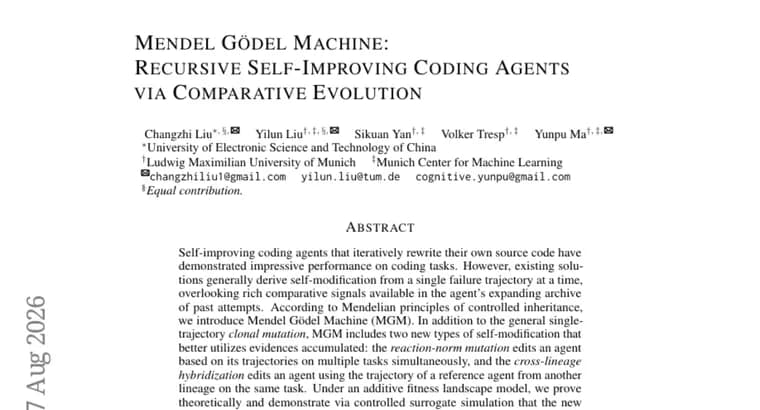
Self-improving coding agents that rewrite their own source code have already shown strong results on coding tasks, but the way they learn from failure has stayed narrow: most existing systems derive each self-modification from a single failed attempt at a time, ignoring the comparative signal buried in the agent's growing archive of past runs. Changzhi Liu and co-authors propose the Mendel Godel Machine (MGM) to close that gap, naming it for Mendelian principles of controlled inheritance. Alongside the standard single-trajectory clonal mutation used by prior systems, MGM adds two new ways for an agent to edit itself. Reaction-norm mutation edits an agent using its trajectories across multiple tasks at once rather than one task in isolation. Cross-lineage hybridization edits an agent using the trajectory of a separate reference agent from a different lineage, but on the same task, letting one line of agents borrow a successful move from another. The authors frame the whole process as an evolutionary one: agents form lineages, and self-modification acts like inheritance shaped by comparative evidence rather than a single isolated failure. Under an additive fitness landscape model, they prove theoretically, and confirm with a controlled surrogate simulation, that these two new strategies converge faster and reach better outcomes than single-trajectory baselines. They then test MGM on two established coding benchmarks, SWE-bench and Polyglot, reporting consistent improvement in performance, efficiency, and generalizability over the single-trajectory approach. The paper does not give numeric scores, percentages, or head-to-head benchmark tables in the available text, nor does it describe implementation details of the archive or the failure-trajectory mechanism.
Key facts
- The Mendel Godel Machine (MGM) is a self-improving coding agent that rewrites its own source code, extending prior single-trajectory self-modification with two new mutation types.
- Reaction-norm mutation edits an agent based on its trajectories across multiple tasks simultaneously, rather than one task at a time.
- Cross-lineage hybridization edits an agent using the trajectory of a reference agent from a different lineage on the same task.
- Under an additive fitness landscape model, the authors prove theoretically and show via controlled surrogate simulation that the new strategies converge faster and better than single-trajectory baselines.
- MGM is tested on the SWE-bench and Polyglot coding benchmarks, where the authors report consistent gains in performance, efficiency, and generalizability, though no specific scores are given in the available text.
Why it matters
Self-rewriting coding agents have so far learned from one failed attempt at a time, throwing away the comparative information sitting in their own archive of past runs. MGM is an attempt to make self-modification evolutionary in a fuller sense: not just mutating from the last failure, but comparing across tasks and across separate lineages of agents to decide how to edit code. That reframes agent self-improvement closer to how selection works across a population rather than a single lineage retrying in isolation.
Who it affects
The work targets builders of self-improving or self-editing coding agents, and researchers studying automated code generation and agent architectures. The two coding benchmarks used, SWE-bench and Polyglot, are established evaluation sets in that research community.
How to use it
The paper describes a method and theoretical model rather than a released product, tool, or priced service; no license, availability, or deployment details appear in the available text.
How solid is it
The authors back the approach with two forms of evidence: a theoretical proof under an additive fitness landscape model, and a controlled surrogate simulation, both said to show the new mutation strategies converge faster and better than single-trajectory baselines. They then run experiments on SWE-bench and Polyglot and report consistent improvement in performance, efficiency, and generalizability. The available text does not include the underlying numbers, so the size of the improvement cannot be assessed from what is here.
Risks and caveats
No numeric scores, percentages, or benchmark tables are given in the available text, and no author affiliations or publication date are stated either, so the claims of improvement cannot be independently sized or dated from this material alone. The theoretical guarantee is also scoped to an additive fitness landscape model, a simplifying assumption whose fit to real coding-agent behavior is not established in the available text.