Microsoft's CARE-X hits 94% accuracy on ReXVQA benchmark
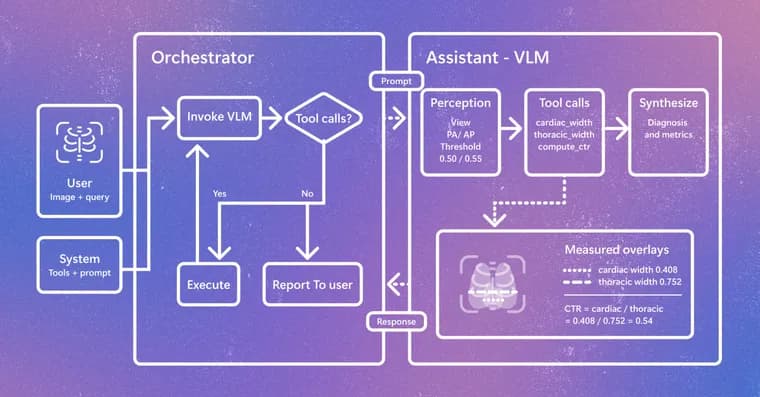
Microsoft Research introduced CARE-X, described explicitly as a research model rather than a product or medical device, aimed at unifying the many separate tasks radiologists ask of a chest X-ray system: writing findings and impressions, answering yes/no or location questions, checking device placement, and pinpointing where an abnormality sits in the image. The team argues existing vision-language models fall short in three ways: generative models produce free text but no calibrated confidence score clinicians can tune for sensitivity versus specificity; standard cross-entropy training penalizes a flipped "yes" or "no" the same as a harmless wording change, so models are not optimized for what actually matters clinically; and some findings, such as cardiomegaly, depend on measuring the cardiac and thoracic widths rather than visual approximation.
CARE-X is built on a SigLIP2-so400M vision encoder connected to a Phi-4-mini-instruct (3.8B) language model through a lightweight adapter. Task-specific auxiliary heads for classification and visual grounding are co-trained with the language-modeling objective, so a single forward pass can produce both a free-text response and a structured, confidence-scored prediction, an approach the team calls dual inference. Training runs through a three-stage supervised pipeline (vision pre-training, adapter and head training, LoRA adaptation) followed by DAPO, a reinforcement-learning method that rewards clinical reporting accuracy, diagnostic correctness, and spatial grounding quality.
On grounding tasks, the auxiliary head lifts localization well above plain generative decoding: mAP and mIoU rise by 28.2 and 6.2 percentage points on anatomical grounding (Chest ImaGenome), and by 24.6 and 14.1 percentage points on phrase grounding (PadChest). After DAPO training, CARE-X's generative output alone reaches 0.868 mAP on anatomy grounding, edging past the dedicated SFT detection head's 0.865, which the team reads as evidence that reward-aligned training can match structured prediction without needing auxiliary heads at inference time. Across four report-generation benchmarks, MIMIC-CXR, IU-Xray, CheXpert-Plus, and ReXGradient, CARE-X leads on most reported metrics, and a held-out severity-weighted metric called CRIMSON suggests the gains reflect real clinical improvements rather than reward-specific overfitting. On the ReXVQA benchmark, a set of 41,007 question-answer pairs across five clinically relevant categories, CARE-X reaches 94% overall accuracy, six percentage points above the next-best publicly reported model, and ranks first on the ReXrank RexVQA leaderboard as of August 2026.
In a separate experiment not part of CARE-X itself, Microsoft Research paired Qwen3-VL-4B-Instruct, unmodified and without task-specific training, with deterministic measurement tools that identify anatomical landmarks and compute clinical measurements. The model keeps visual access to the radiograph while calling these tools mid-inference, alternating between perception and exact computation before reaching a diagnosis. This tool-augmented pipeline substantially outperformed perception-only inference on every measurement-based condition tested, supporting the team's conclusion that for threshold-dependent diagnoses, direct computation beats visual approximation.
Both approaches were validated on de-identified retrospective data from Narayana Health in India, under institutional ethics approval. In the first study, CARE-X was tested on 1,047 chest radiographs covering five rare, high-acuity ICU conditions with prevalence between 2.6% and 5.2%, and achieved the highest sensitivity in three of the five conditions while keeping reasonable specificity. In the second study, on 122 outpatient cases with CT-confirmed mediastinal-widening conditions (aortic enlargement, hilar mass, pulmonary artery enlargement), the tool-augmented variant reached 94.26% recall, a 10.65-percentage-point gain over the best perception-only baseline, one of three inference modes the study compared: perception-only, overlay-assisted, and tool-augmented.
Key facts
- CARE-X pairs a SigLIP2-so400M vision encoder with a Phi-4-mini-instruct (3.8B) language model, adding auxiliary classification and grounding heads trained through a three-stage SFT pipeline plus DAPO reinforcement learning.
- Auxiliary grounding lifts mAP and mIoU by 28.2 and 6.2 percentage points on Chest ImaGenome and by 24.6 and 14.1 percentage points on PadChest phrase grounding, compared with plain generative decoding.
- CARE-X reaches 94% overall accuracy on the ReXVQA benchmark (41,007 question-answer pairs), six percentage points above the next-best publicly reported model, and ranks first on the ReXrank leaderboard as of August 2026.
- In a separate experiment, an unmodified Qwen3-VL-4B-Instruct paired with deterministic measurement tools reached 94.26% recall on CT-confirmed enlargement conditions, a 10.65-percentage-point gain over the best perception-only baseline.
- Both approaches were validated on retrospective data from Narayana Health in India: 1,047 radiographs for rare ICU conditions and 122 CT-confirmed cases for measurement-dependent findings.
Why it matters
Radiology vision-language models have generally forced a choice between fluent free-text reports and calibrated, threshold-adjustable diagnostic scores. CARE-X's dual inference, one forward pass producing both, plus auxiliary heads that are co-trained rather than bolted on, is aimed squarely at that gap. The team also targets a training-level problem: standard cross-entropy loss treats a flipped "yes"/"no" the same as a trivial wording change, so DAPO reinforcement learning is used instead to reward clinically correct outputs directly.
Who it affects
The intended audience is radiologists and clinicians who rely on chest X-rays across a mix of tasks: report writing, targeted questions, device-placement checks, and abnormality localization. The India-based validation, run on real de-identified data from Narayana Health under institutional ethics approval, points toward settings where CT or echocardiography access is limited and a widely available modality like chest X-ray carries more diagnostic weight.
How to use it
There is nothing to use yet. Microsoft Research states plainly that CARE-X is a research model, not a product offering or medical device: it has not been cleared or approved by any regulatory authority and is not intended for clinical diagnosis, screening, or patient care. The blog post does not say whether CARE-X's weights, training code, or the DAPO pipeline will be released, or give any figures for inference cost, latency, or hardware requirements. The classification head's tunable operating points, letting a clinician shift between high-sensitivity screening and high-specificity confirmation from one forward pass, describe a research capability rather than an available tool.
How solid is it
The results rest on multiple benchmarks: four standard report-generation datasets (MIMIC-CXR, IU-Xray, CheXpert-Plus, ReXGradient), a held-out severity-weighted metric called CRIMSON meant to catch reward-specific overfitting, a first-place ranking on the public ReXrank RexVQA leaderboard as of August 2026, and two retrospective studies on real hospital data from Narayana Health covering 1,047 and 122 cases respectively. The tool-augmented Qwen3-VL-4B-Instruct pipeline required no task-specific training yet still beat perception-only inference across every measurement-based condition tested, which the authors treat as evidence that direct computation, not visual estimation, is what threshold-dependent diagnoses need.
Risks and caveats
The source is explicit that these are retrospective research findings that do not establish CARE-X's safety, effectiveness, or suitability for clinical use, and that any workflow described is a future research direction, not an available capability. The post credits four named authors (Mercy Ranjit, Nikhilesh E, Abhyuday Kumara Swamy, Tanuja Ganu) plus a separate list of paper co-authors, though the body text itself is written throughout in the first person plural. No publication or training date is given beyond the August 2026 leaderboard snapshot, and no computational cost or latency figures appear for either CARE-X or the tool-augmented pipeline. Both validation studies draw on a single Indian hospital's data, and the measurement-dependent study compared three inference modes, perception-only, overlay-assisted, and tool-augmented, rather than a single two-way head-to-head test.