Microsoft Research introduces Quine, an AI system for biology
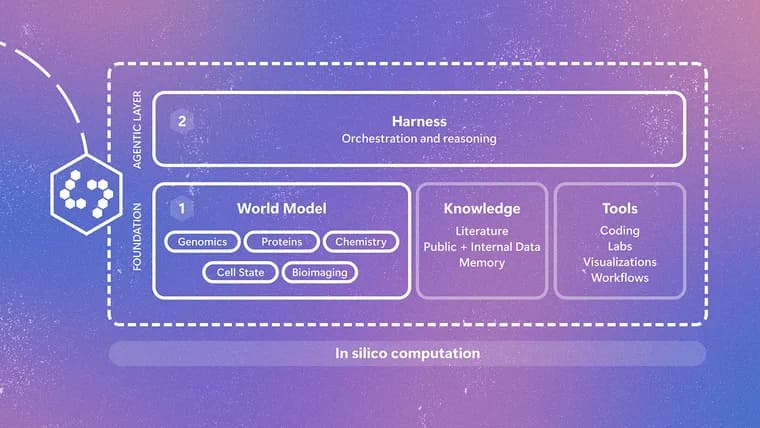
Microsoft Research has introduced Quine, a research effort to build a multimodal world model of biology together with an interactive harness that connects models, scientific tools, the literature, the wet lab and the researchers using them. Microsoft frames it as a first step toward a discovery system that evolves through scientific use, and says it has worked at the intersection of computation and biology for more than two decades.
The pitch starts from a constraint. Experiments are slow, iteration cycles are long, and many important questions involve combinatorial design spaces and downstream effects too large to explore in the lab alone. By a "world model", Microsoft means a system that can represent the state of a biological system, predict how that state evolves in response to interventions, and reason about the consequences several steps ahead. It is not meant to replace experiments; it is meant to explore, propose, rank and prioritize paths before scarce lab resources are committed.
Quine has two parts. The world model learns shared representations across sequence, structure, function, cellular state and imaging data. Training across these modalities jointly lets evidence from one inform predictions in another, which Microsoft contrasts with orchestrating separate single-domain specialist models. The company says it found that learning across connected representations strengthens performance rather than diluting it. The harness ties this model to orchestration and reasoning models, scientific tools, the literature and the teams using them. Microsoft also states that the world model does not need to be perfect, and will never perfectly model biology; it only needs to usefully inform experimental design.
The showcase example is pancreatic ductal adenocarcinoma (PDAC), the most common form of pancreatic cancer and one of the hardest to treat. With researchers at the Broad Institute of MIT and Harvard, Microsoft spent years developing and applying patient-derived ex vivo models to test a hypothesis: tumor behavior and drug response depend not only on genetics but also on transcriptional cell state. Using Quine, the team predicted and prioritized thousands of compounds by their potential to shift tumor cells between therapeutically relevant states. In wet-lab studies of the transition from classical to basal cell states, Quine's highest-ranked compounds produced the largest intended shifts across experimental assays. Microsoft says the whole process, from narrowing the compound search space to prioritizing a handful of candidates for lab validation, took one weekend, potentially saving months of experimental work and significant research costs. Some of the strongest effects came from compounds with unexpected mechanisms of action, which Microsoft calls early evidence that AI can uncover new opportunities for drug repurposing and discovery.
The reverse transition, from basal to classical, proved more difficult, though Quine had predicted that available compounds would have this weaker effect. The experiments also turned up something the team did not fully anticipate: Quine predicted that several compounds would consistently push cells toward a distinct third phenotype, and the lab observed it. That suggests the PDAC cell-state landscape is richer than a simple classical-basal axis. Continued work will use newly integrated RNA datasets and tasks to represent that landscape, strengthen state-transition predictions and add calibrated confidence estimates to help scientists choose which hypotheses to take to the wet lab.
Microsoft says it built Quine to improve its own science and embedded it in ongoing programs, including cancer biology, protein engineering, genomics and bioimaging. Access is deliberately narrow: initial availability is limited to a new Quine Fellows program, which will give a cohort of scientists access and a chance to give scientific feedback, plus select research collaborations. Microsoft describes a phased approach with ongoing internal review and built-in safeguards, and expects to widen access through products like Microsoft Discovery as the technology matures. It stresses that Quine is experimental research technology, not for clinical or medical use, and that its outputs may be incomplete or inaccurate and need review by qualified researchers and appropriate experimental validation.
Key facts
- Quine combines a multimodal world model of biology (sequence, structure, function, cellular state, imaging) with a harness linking models, scientific tools, literature and researchers.
- With the Broad Institute of MIT and Harvard, Microsoft used Quine to predict and prioritize thousands of compounds for shifting PDAC tumor cells between states; top-ranked candidates were validated across several wet-lab assays.
- The full pass from narrowing the search space to a handful of candidates took one weekend, Microsoft says; the reverse basal-to-classical shift was harder, and a third phenotype emerged that Quine had predicted.
- Initial access is limited to the Quine Fellows program and select research collaborations, with expansion expected through Microsoft Discovery.
- Microsoft labels Quine experimental research technology, not for clinical or medical use, with outputs that may be incomplete or inaccurate.
Why it matters
Microsoft is betting that a single model trained jointly across sequence, structure, function, cellular state and imaging data, wrapped in a harness with tools and literature, can do more than a set of separate specialist models stitched together. The PDAC result is its evidence: a model-driven ranking of thousands of compounds produced top picks that shifted cell states in the lab, including some with unexpected mechanisms of action that Microsoft frames as early evidence for drug repurposing. The company also argues that the real test is how the system performs when evidence is incomplete and questions are new, not benchmarks and leaderboards.
Who it affects
Most directly, the scientists who join the Quine Fellows program or a select research collaboration, since those are the only initial routes to the system. Cancer biologists working on cell-state approaches to PDAC are the closest audience for the findings, including the hint of a third phenotype. Microsoft says it also applies Quine across protein engineering, genomics and bioimaging. Everyone else is a spectator for now.
How to use it
There is no general release. Scientists can seek access through the Quine Fellows program, which offers a cohort access to the system and a chance to accelerate their own research while giving scientific feedback, or through select research collaborations. Microsoft expects to broaden access later through products like Microsoft Discovery. No launch date, application deadline, cohort size or pricing for the Fellows program is given, and no timeline is given for expanding access via Microsoft Discovery.
How solid is it
This is Microsoft Research describing its own work in a company blog post. The claim that top-ranked compounds produced the largest intended shifts in the classical-to-basal transition rests on wet-lab assays run with Broad Institute researchers, but no quantitative effect sizes, hit rates, benchmark scores or accuracy figures are given, nor the number of compounds tested in the lab or their names. No independent or peer-reviewed publication of the PDAC results is cited. No model size, architecture, training data volume or compute is stated. The one-weekend figure covers narrowing the search space and prioritizing candidates; the source does not state how long wet-lab validation took.
Risks and caveats
Microsoft itself says Quine is experimental research technology, intended only for research and not for clinical or medical use, and that its outputs may be incomplete or inaccurate and need review by qualified researchers and experimental validation. It also concedes the world model will never perfectly model biology. The reverse basal-to-classical shift was harder to achieve. Microsoft says it is taking a phased approach with ongoing internal review and built-in safeguards, and it links progress in AI and biology to safety, security and responsible stewardship.
“The protagonists are not the model or the platform. They are the scientists, the experiments, and the discoveries that follow.”
— Microsoft Research, Quine announcement post