Miles v0.1 ships as open-source RL stack for frontier post-training
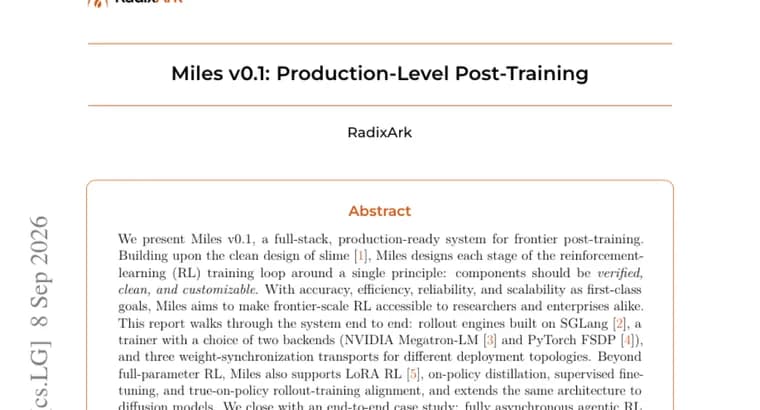
A team has released Miles v0.1, a full-stack, production-ready system for post-training large models with reinforcement learning (RL). Miles builds on the design of the existing slime framework and organizes every stage of the RL training loop around one principle: components should be verified, clean, and customizable. The stated goals are accuracy, efficiency, reliability, and scalability, with the aim of making frontier-scale RL accessible to both researchers and enterprises.
On the technical side, Miles pairs rollout engines built on SGLang with a trainer that offers a choice of two backends, NVIDIA Megatron-LM or PyTorch FSDP, plus three weight-synchronization transports for different deployment topologies. Beyond standard full-parameter RL, it also supports LoRA RL, on-policy distillation, supervised fine-tuning, and true-on-policy rollout-training alignment, and the same architecture extends to diffusion models.
The release includes an end-to-end case study: fully asynchronous agentic RL on a GLM-5.2 744B-A40B model running terminal-use coding tasks, executed on 64 NVIDIA GB300 GPUs. Over the first 30 measured steps, the run recorded a median step time of 263 seconds. Miles is open-sourced on GitHub under the radixark organization at github.com/radixark/miles, with a project website at miles.radixark.com. The source text does not name individual authors or affiliated institutions, give a publication date, or provide benchmark comparisons against slime or other RL post-training frameworks, so it is not stated whether the 263-second step time is considered fast or slow.
Key facts
- Miles v0.1 is a full-stack, open-source system for production-grade RL post-training, built on the design of the slime framework.
- It combines SGLang-based rollout engines with a trainer offering two backend choices, Megatron-LM or PyTorch FSDP, and three weight-synchronization transports.
- Beyond full-parameter RL, it supports LoRA RL, on-policy distillation, supervised fine-tuning, true-on-policy rollout-training alignment, and diffusion models.
- A case study ran fully asynchronous agentic RL on a GLM-5.2 744B-A40B model over terminal-use coding tasks on 64 NVIDIA GB300 GPUs, with a median step time of 263 seconds across the first 30 measured steps.
- The code is open-sourced at github.com/radixark/miles, with a project site at miles.radixark.com; no individual authors, institutions, or benchmark comparisons are given in the source.
Why it matters
Reinforcement-learning post-training is one of the main levers labs use to push frontier models beyond their base pretraining, but building a reliable, scalable RL training loop is its own systems-engineering problem. Miles packages that loop (rollout, training backend, weight synchronization) into a single open-source stack designed around verified, clean, customizable components, aiming to put frontier-scale RL infrastructure within reach of teams that are not building it from scratch.
Who it affects
The system targets researchers and enterprises doing RL-based post-training on large models, including teams running full-parameter RL, LoRA RL, on-policy distillation, supervised fine-tuning, or agentic RL on coding and terminal-use tasks. It also extends to teams working with diffusion models rather than just language models.
How to use it
Miles is open-sourced under the radixark organization at github.com/radixark/miles, with documentation and details on a project website at miles.radixark.com. Users choose between NVIDIA Megatron-LM and PyTorch FSDP as the trainer backend and pick from three weight-synchronization transports depending on their deployment topology; the source text gives no pricing or licensing terms beyond the code being open-sourced.
How solid is it
The report includes one concrete end-to-end demonstration: fully asynchronous agentic RL on a GLM-5.2 744B-A40B model over terminal-use coding tasks, run on 64 NVIDIA GB300 GPUs, with a median step time of 263 seconds measured over the first 30 steps. The source does not name individual authors or affiliated institutions, does not give a publication date, and does not report benchmark results or comparisons against slime or other RL post-training frameworks, so there is no independent baseline to judge the 263-second figure against.
Risks and caveats
Because the source provides only a single step-time measurement from one case study, with no comparison figures and no named authors or institutions to attribute the claims to, the broader performance, reliability, and scalability claims rest on the system's design description rather than on published benchmark evidence.