MIRA agent refines text-to-music prompts against rubrics of user intent
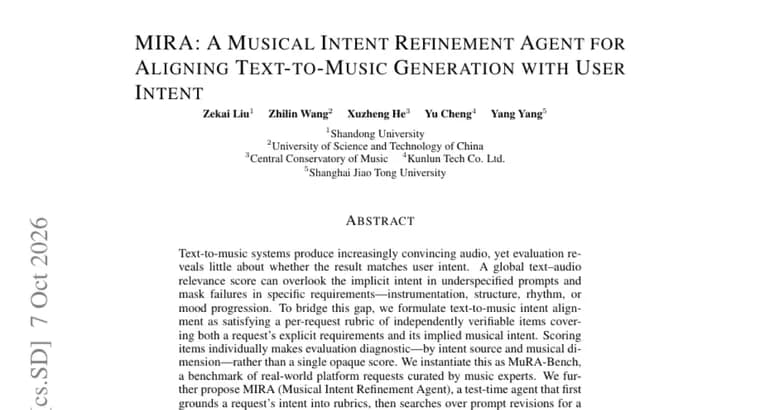
Text-to-music systems produce increasingly convincing audio, but the authors argue that evaluation says little about whether the result matches what the user actually wanted. A single global text-audio relevance score can overlook the implicit intent in underspecified prompts, and it can mask failures on specific requirements such as instrumentation, structure, rhythm or mood progression.
The paper reframes the problem. Intent alignment, the authors say, means satisfying a per-request rubric of independently verifiable items that cover both the request's explicit requirements and its implied musical intent. Because each item is scored individually, evaluation becomes diagnostic by intent source and musical dimension instead of producing one opaque number. The authors instantiate this idea as MuRA-Bench, a benchmark of real-world platform requests curated by music experts.
The second contribution is MIRA (Musical Intent Refinement Agent), a test-time agent. It first grounds a request's intent into rubrics. It then searches over prompt revisions for a black-box generator under a bounded budget: it generates music, verifies the result against the rubrics, and uses that feedback to guide a trajectory-aware tree search. The generator itself is not modified; only the prompt changes.
The authors report experiments across open-source and commercial backends. According to them, MIRA improves intent alignment, and this lets an open-source generator achieve performance comparable to representative commercial systems, with Suno and Mureka given as examples. The abstract gives no numerical results, so the size of the improvement cannot be read from it. A project page is linked at https://mirareview.github.io/.
Key facts
- The authors propose MuRA-Bench, a benchmark of real-world platform requests curated by music experts, scored with per-request rubrics of independently verifiable items.
- Rubrics cover both a request's explicit requirements and its implied musical intent, so scores break down by intent source and musical dimension rather than one opaque number.
- MIRA is a test-time agent: it grounds intent into rubrics, then runs a trajectory-aware tree search over prompt revisions for a black-box generator under a bounded budget.
- Per the authors' experiments across open-source and commercial backends, MIRA improves intent alignment and lets an open-source generator reach performance comparable to representative commercial systems such as Suno and Mureka.
Why it matters
The paper targets a gap between how text-to-music is measured and what users want. A global relevance score can look fine while the track ignores the requested instrumentation or mood progression. Turning each request into a checklist of verifiable items gives a way to see which part of the intent failed, and MIRA uses the same checklist as a feedback signal to improve the output without touching the generator. The headline claim is that an open-source generator can reach performance comparable to representative commercial systems (Suno and Mureka are the named examples) when wrapped in this loop.
Who it affects
Teams that build or evaluate text-to-music generators, since MuRA-Bench and the rubric approach offer a more diagnostic evaluation than a single relevance score. It also concerns people who write requests on music-generation platforms: the benchmark is built from real-world platform requests, and the agent is designed for prompts that leave intent implicit.
How to use it
The abstract points to a project page at https://mirareview.github.io/. Whether code, data or the benchmark are released is not stated beyond that link. Conceptually, MIRA sits in front of any generator treated as a black box: it needs only the ability to submit a prompt, receive music, and check it against rubrics, which is why the authors test it on both open-source and commercial backends.
How solid is it
This is a paper abstract, and the results are the authors' own experiments. The abstract gives no numerical results, scores, percentages or improvement margins. It does not name the open-source generator or the specific commercial backends tested beyond the examples Suno and Mureka, and it does not give the size of MuRA-Bench or the number of music experts. The claim of performance comparable to commercial systems is stated qualitatively.
Risks and caveats
The search runs under a bounded budget by repeatedly generating music and verifying it, but the abstract does not specify the number of iterations or generations. "Comparable" is not defined, and with no figures given, how close the open-source result comes to Suno and Mureka cannot be judged. The abstract names no authors or institutions and gives no publication date, so the claims rest on the paper's full text and the project page.
“Scoring items individually makes evaluation diagnostic by intent source and musical dimension, rather than a single opaque score.”
— Paper abstract, MIRA / MuRA-Bench (Hugging Face papers listing)