Mobius-v0 decouples knowledge and reasoning for 4x faster inference
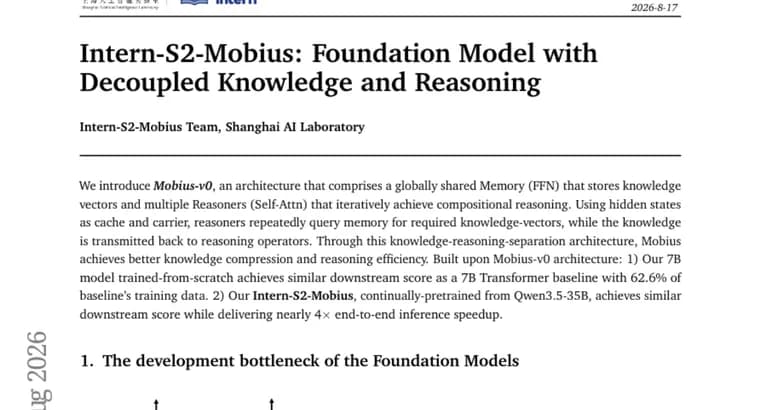
A paper introduces Mobius-v0, an architecture that pulls apart the two things a standard Transformer block normally does together. A globally shared Memory component, built from a feed-forward network, stores knowledge vectors. Separately, multiple Reasoner modules, built from self-attention, iteratively carry out compositional reasoning. The reasoners use hidden states as a cache and carrier: they repeatedly query the shared Memory for the knowledge vectors they need, and that knowledge is transmitted back into the reasoning operators as the computation proceeds. The authors call this a knowledge-reasoning-separation architecture and say it gives Mobius better knowledge compression and reasoning efficiency than a standard Transformer.
Two results are reported to back the claim. First, a 7B Mobius model trained from scratch reaches a similar downstream score to a 7B Transformer baseline while using only 62.6% of that baseline's training data, meaning less data was needed to get to the same point. Second, Intern-S2-Mobius, built by continually pretraining from Qwen3.5-35B, reaches a similar downstream score to its base model while delivering nearly 4x end-to-end inference speedup. Neither result specifies which downstream benchmarks were used, and no absolute latency or throughput figures are given, only the relative comparisons against each model's own baseline.
Key facts
- Mobius-v0 separates a globally shared Memory (built from a feed-forward network) that stores knowledge vectors from multiple Reasoner modules (built from self-attention) that iteratively perform compositional reasoning by querying that memory.
- A 7B Mobius model trained from scratch matches a 7B Transformer baseline's downstream score while using only 62.6% of the baseline's training data.
- Intern-S2-Mobius, continually pretrained from Qwen3.5-35B, matches its base model's downstream score while delivering nearly 4x end-to-end inference speedup.
- The authors state the knowledge-reasoning-separation design achieves better knowledge compression and reasoning efficiency than a standard architecture.
- The paper does not name the downstream benchmarks used for either comparison and gives no absolute inference latency or throughput numbers, only the relative 4x figure.
Why it matters
Standard Transformers store knowledge and perform reasoning inside the same stacked blocks, so the two are entangled. Mobius-v0 pulls them apart: one shared memory holds knowledge vectors, and separate reasoner modules pull from it as needed. The paper's own framing is that this separation is what lets a model reach the same downstream score with less training data, and lets a larger continually pretrained model run inference substantially faster, without a stated loss in score.
Who it affects
Teams that train or serve large foundation models stand to benefit most directly, since the reported gains are in training-data efficiency and inference speed rather than in a new capability. Anyone running large models in production would feel a genuine 4x inference speedup as lower serving cost and latency, if the result holds up outside the paper's own tests.
How to use it
The text gives no release date, and it does not say whether code or model weights are made available. There is nothing here to install, run, or license yet.
How solid is it
The evidence is two head-to-head comparisons from the paper itself: a 7B Mobius model against a 7B Transformer baseline, and Intern-S2-Mobius against its Qwen3.5-35B base. Both are reported as reaching a 'similar downstream score,' but the source does not say which benchmarks were used to measure that, and the speed and data-efficiency figures are relative to each model's own baseline rather than tied to an absolute measurement.
Risks and caveats
These are self-reported results from a single paper, with no independent benchmarking described. 'Similar downstream score' is not defined against a named benchmark, so it is not possible to judge how tight or loose that similarity is. No absolute latency or throughput numbers are given, only the relative 4x figure, and it is unclear whether code or weights will be released for outside verification.
“Through this knowledge-reasoning-separation architecture, Mobius achieves better knowledge compression and reasoning efficiency.”
— the authors