ModularRSI splits agent harness self-improvement into five modules
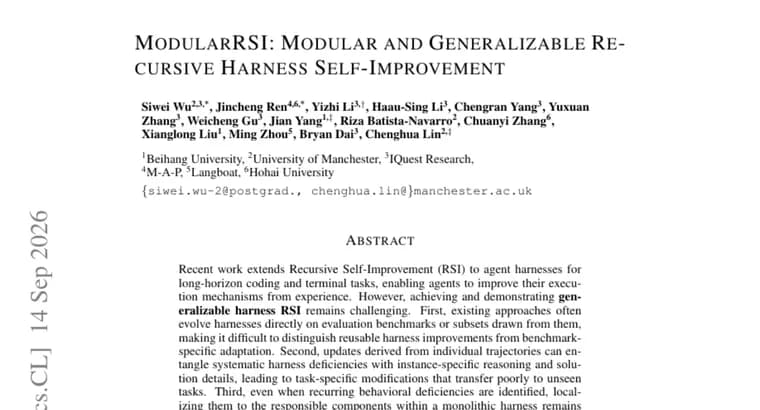
A paper proposes ModularRSI, a framework for recursive self-improvement (RSI) of AI agent harnesses, the execution scaffolding that lets agents run long-horizon coding and terminal tasks. The paper argues that making harness RSI generalize beyond a single benchmark is hard for three reasons: evolving a harness directly on evaluation benchmarks or their subsets makes it difficult to tell a reusable improvement from an adaptation that only helps on that benchmark; updating a harness from a single trajectory can mix up a systemic flaw in the harness with details specific to that one task, producing changes that transfer poorly to new tasks; and trying to pinpoint a recurring behavioral flaw inside a harness treated as one monolithic block is difficult, since optimizing the whole harness at once tangles together unrelated mechanisms and makes it hard to attribute or validate any single change. ModularRSI addresses this by contrasting successful and failed trajectories on the same task and aggregating that evidence across many tasks to identify deficiencies that recur rather than one-off mistakes. It splits the evolvable harness into five functional modules: Agent Loop, Tool Use, Observation Management, Context Management, and Task Completion Detection. Each module is evolved independently within a restricted scope of allowed modifications, and an integration stage then combines the evolved modules back into a single harness and resolves any conflicts between them. To keep the evolution process separate from the benchmarks used to measure it, the authors curated 2,000 executable evolution tasks from external sources that do not overlap with the downstream evaluation benchmarks. Tested on TB2.0 and SWE-Bench Verified, the resulting harness shows consistent improvements on tasks it was not trained on, both within the same domain and across domains, and the evolved harness also transfers when paired with different foundation models. The text does not give a magnitude for these improvements, name the specific foundation models used for the transfer test, state a compute or time budget for the process, or identify the paper's authors or institution.
Key facts
- ModularRSI decomposes an AI agent harness into five functional modules: Agent Loop, Tool Use, Observation Management, Context Management, and Task Completion Detection.
- Each module evolves independently within a restricted modification scope, then an integration stage merges the evolved modules and resolves conflicts.
- The method contrasts successful and failed trajectories on the same task and aggregates evidence across tasks to find recurring behavioral deficiencies, rather than benchmark-specific fixes.
- The authors curated 2,000 executable evolution tasks from external sources, kept disjoint from the downstream evaluation benchmarks used to test the result.
- On TB2.0 and SWE-Bench Verified, the evolved harness shows consistent improvements on unseen in-domain and cross-domain tasks, and transfers across different foundation models.
Why it matters
Recent work has extended recursive self-improvement to agent harnesses, the execution mechanisms that let agents handle long-horizon coding and terminal work, but making those improvements generalize beyond one benchmark has been an open problem. ModularRSI targets three specific failure modes: benchmark-specific adaptation getting mistaken for a real improvement, single-trajectory updates conflating a systemic harness flaw with one-off task details, and whole-harness optimization tangling unrelated mechanisms together so a single change is hard to attribute or validate.
Who it affects
The work targets researchers and teams building or evolving agent harnesses for coding and terminal-task agents, where the goal is a harness that keeps working on tasks and models it was not tuned on.
How to use it
ModularRSI is a research method, not a released product: it decomposes a harness into the five named modules, evolves each within a restricted modification scope, then runs an integration stage to merge the modules and resolve conflicts. The paper does not state a price, license, or how to obtain the code or the 2,000 curated evolution tasks.
How solid is it
The paper appears on Hugging Face's papers listing from independent researchers; the source text gives no author names, institutional affiliation, or publication date, and reports only qualitative 'consistent improvements' on TB2.0 and SWE-Bench Verified without stating the magnitude of the gain.
Risks and caveats
Several specifics are missing from the source: no numeric improvement figures, no named foundation models for the cross-model transfer test, no compute or time cost for curating the 2,000 tasks or running the evolution process, and no detail on what each module's 'restricted modification scope' actually allows or forbids.