Multiverse Computing tunes LLMs to refuse harmful prompts, not entire topics
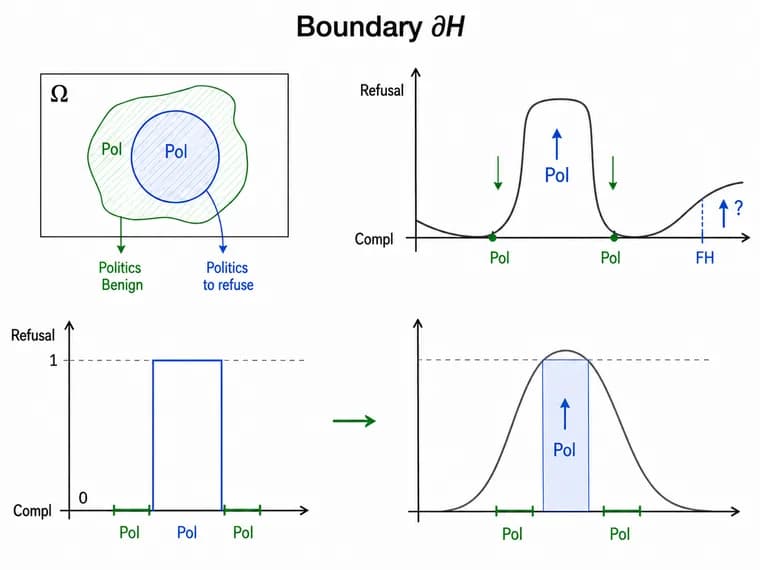
Multiverse Computing has published a blog post on Hugging Face presenting its paper "Safety for Whom? Boundary-Aware Self-Distillation for Controlled LLM Safety Refusal." The paper argues that most safety guardrails work at the level of a whole topic, so a model either refuses a subject or answers it, when real deployments need a split inside the same topic: a civics tutor and a public-sector assistant can share a base model yet need opposite behaviour on politics, both answering factual questions about an election while only one refuses a request to write targeted political manipulation. LlamaGuard-3 is cited as an example of a guard too blunt for this: it covers elections only as "factually incorrect information about electoral systems and processes," a definition that excludes both persuasion and manipulation and the factual prompts a deployment still needs to answer.
The authors use political persuasion as their test case and formalise the target behaviour as a sharp step inside a topic universe: refuse the harmful subset, answer the benign complement. A trained model never hits that sharp step; cross-entropy training that raises refusal on harmful prompts tends to push refusal outward into nearby benign prompts as well. The paper frames this as a boundary problem and builds training pairs that share a topic anchor but differ in intent, one prompt meant to be refused, one meant to be answered.
Starting from the standard self-generation recipe used by methods like ThinkSafe, steering the target model toward a refusal and keeping the traces a guard model verifies as genuine, the authors identify and fix three weaknesses. First, a coverage gap: single-shot generation drops 19.88% of prompts in the audited pool, 8,009 of them, silently discarding what may be the hardest examples; an escalating retry strategy that resamples the same prompt with progressively stronger steering cuts the residual failure rate to 0.20% (79 prompts), leaving 40,293 harmful training prompts instead of thousands fewer. Second, false positives: safety tuning tends to produce false refusals on benign prompts that merely look dangerous, so the authors build 11,955 verified surface-dangerous benign prompts across 18 semantic types as in-distribution training data. Third, measurement: ordinary harmful/benign splits do not capture the shape of the boundary, since a model can raise its harmful-refusal score simply by refusing more of the nearby benign prompts too; the authors add 1,539 held-out harmful-benign pairs per side to score both directions at once.
On Qwen3-8B, the escalated-coverage training raises in-distribution political refusal from 9.47% to 84.75%, and the mean unsafe-response rate across three broader benchmarks, HarmBench, StrongREJECT and WildJailbreak, scored by LlamaGuard-3, falls from 26.26% to 0.14% in the strongest configuration. Read alone, those numbers look like a clean safety win. At the same checkpoint, however, over-refusal on XSTest rises from 2.00% to 74.00%: the configuration with the lowest harmful-response rate is also the one that refuses nearly three quarters of plainly safe prompts. Two of the paper's data components pull that back down without giving up the safety gain. Replacing externally adopted compliance responses with responses the target model generates itself lowers XSTest over-refusal from 15.20% to 5.20% under single-shot generation, at a modest harmfulness cost. The held-out boundary pairs do the most precise work: adding the benign boundary data cuts over-refusal on the comply-worthy side of those pairs from 32.94% to 4.16%, while refusal on the harmful side drops only slightly, from 91.88% to 87.72%. Across the paper's ablation runs (Figure 6), configurations that include the benign boundary data land at 0.03 to 0.08 over-refusal on the comply-worthy side, versus a rise toward 0.49 without it.
The authors' conclusion is that safety tuning should not be judged by the harmful-refusal rate alone, since the same training move that raises it can make a model uselessly over-cautious on the legitimate prompts sitting right next to the boundary. They describe coverage repair, in-distribution benign data and boundary pairs as the levers that control this trade-off, and say the same generation pipeline extends to topics beyond politics, though the post does not report results for any topic other than politics.
Key facts
- Multiverse Computing's paper trains LLMs to refuse a harmful subset of a topic (political manipulation) while still answering the benign rest of the same topic (factual political questions), rather than refusing or allowing the whole topic.
- Single-shot self-generated safety data drops 19.88% of prompts (8,009 of them); an escalating retry strategy cuts that to 0.20% (79 prompts), keeping 40,293 harmful training prompts.
- On Qwen3-8B, the escalated-coverage model raises in-distribution political refusal from 9.47% to 84.75% and cuts mean unsafe-response rate across three benchmarks from 26.26% to 0.14%, but at that same checkpoint over-refusal on XSTest jumps from 2.00% to 74.00%.
- Adding 11,955 in-distribution benign prompts and 1,539 held-out harmful-benign boundary pairs per side lets the authors measure and fix over-refusal, cutting it on the comply-worthy side of the boundary pairs from 32.94% to 4.16% while harmful-side refusal drops only from 91.88% to 87.72%.
- The paper's headline argument: a model that refuses more is not automatically safer, so safety tuning has to be scored on both the harmful-refusal rate and the over-refusal rate together, not the first alone.
Why it matters
Most safety guardrails, the post argues, work at the level of a whole topic: a model either refuses politics or does not. Real deployments need finer control, since a civics tutor and a public-sector assistant can run on the same base model yet need opposite behaviour within politics, both answering factual election questions while only one refuses requests for targeted political manipulation. The paper's contribution is a method for training and measuring that finer, boundary-level split rather than a topic-level one, and a demonstration that getting the training data composition wrong at that finer grain silently produces a model that is technically safer on paper but useless in practice because it also refuses the benign prompts sitting next to the boundary.
Who it affects
Teams building or fine-tuning deployment-specific guardrails on top of a shared base model, especially for products (civics tools, enterprise assistants, public-sector services) that need different refusal behaviour on the same topic depending on the deployment's policy. It also matters to anyone evaluating a safety-tuned model's benchmark numbers: a reported drop in harmful-response rate, taken alone, does not show whether the model became safer or simply more evasive.
How to use it
The post describes, without releasing code or a dataset in the article itself, three concrete fixes to the standard self-generation safety-tuning pipeline: an escalating retry strategy that resamples a prompt with progressively stronger steering when the first attempt fails to produce an accepted refusal; a set of in-distribution benign prompts that look surface-dangerous (11,955 of them, across 18 semantic types) so the model is trained, not just tested, on safe-but-scary-sounding requests; and held-out harmful-benign boundary pairs (1,539 per side) used specifically to score over-refusal near the boundary rather than relying on ordinary topic-level harmful/benign splits. The post points readers to the full paper and to contacting Multiverse Computing's team for deployment-specific safety work; no price, license or product is mentioned.
How solid is it
The numbers come from the authors' own experiments on a single model, Qwen3-8B, evaluated against public benchmarks (HarmBench, StrongREJECT, WildJailbreak, XSTest) scored by LlamaGuard-3, and against the authors' own held-out boundary pairs. The blog post does not name individual authors, credits only the company Multiverse Computing, and does not give a publication date or a direct link to the paper itself beyond "Read the full paper." The self-generation baseline it compares against, the ThinkSafe-style recipe, is the authors' own reference implementation rather than an independently reproduced one, and all reported gains are on political-persuasion data with a single base model.
Risks and caveats
The paper's own headline result is also its main caution: optimising only for lower harmful-response rate produced, in one configuration, a model with a 74.00% over-refusal rate on XSTest, up from a 2.00% baseline, underscoring the paper's own point that a model that refuses more is not automatically safer. This is presented as a company research post rather than a peer-reviewed publication as far as the article states, the results are specific to the political-persuasion domain and to Qwen3-8B, and while the post says the pipeline extends to topics beyond politics, no results for any other topic are reported in the article.
“A model that refuses more is not automatically safer.”
— Multiverse Computing, project blog post