New 26K-sample benchmark tests if AI steering mirrors human values
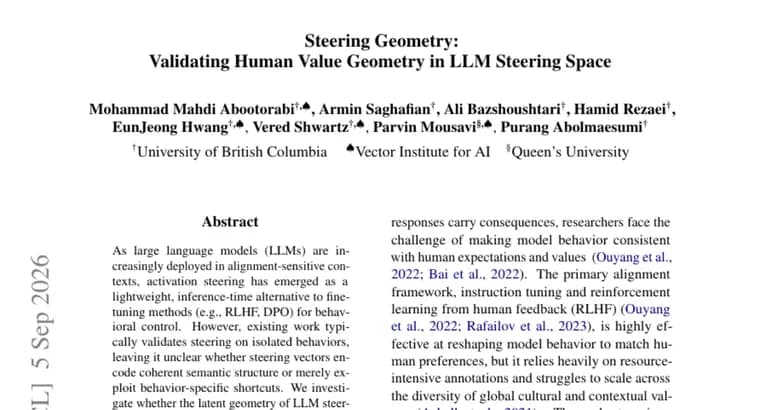
Activation steering has become a popular lightweight alternative to fine-tuning methods like RLHF and DPO for controlling LLM behavior at inference time. But prior work has mostly tested steering on isolated behaviors one at a time, so it has stayed unclear whether steering vectors capture a genuinely coherent semantic structure or simply exploit shortcuts tied to a specific behavior. A new paper investigates this directly by asking whether the geometry of steering vectors matches theory-specified structure in human values and morality. The researchers use Schwartz's Theory of Basic Human Values, a psychological framework describing relationships among distinct value types, as their reference structure. To test it, they build a 26,000-sample benchmark spanning 20 human values and use it to evaluate two families of steering approaches: distribution-driven methods such as CAA, SphericalSteer and ODESteer, and behavior-centric methods such as COLD-Steer and BiPO, across a range of model families and sizes. The distribution-driven methods recover a value topology that lines up with the theoretical predictions, reaching a Spearman correlation of up to 0.51 with strong statistical significance (p < 10^-13). The behavior-centric methods steer behavior about as effectively but their internal geometry shows little correlation with the expected value structure. The paper also reports that this geometric fidelity gets stronger as model scale increases, but weakens after instruction tuning. Finally, methods with better geometric alignment show more human-consistent transfer effects: steering a model toward one value correctly also lifts values that are compatible with it and suppresses ones that conflict with it, mirroring how the values are meant to relate to each other under the theory. Code and data for the benchmark are released on GitHub under DeepRCL/Steering_Geometry.
Key facts
- The paper introduces a 26,000-sample benchmark covering 20 human values, built on Schwartz's Theory of Basic Human Values, to test the geometry of LLM steering vectors.
- Distribution-driven steering methods (CAA, SphericalSteer, ODESteer) recover a value topology aligned with theoretical predictions, reaching Spearman rho up to 0.51 (p < 10^-13).
- Behavior-centric methods (COLD-Steer, BiPO) achieve comparable steering performance but show little correlation with the expected value geometry.
- Geometric fidelity improves with model scale but drops after instruction tuning.
- Better geometric alignment produces more human-consistent transfer: correctly steering one value also lifts compatible values and suppresses opposing ones.
Why it matters
Activation steering is pitched as a cheap, inference-time substitute for fine-tuning methods like RLHF and DPO when controlling model behavior. This paper addresses a question those methods usually skip: whether steering actually captures a coherent structure of human values, or whether it just finds a shortcut that moves the target behavior without any principled underlying representation. Distinguishing the two matters for anyone treating steering as a genuine tool for behavioral alignment rather than a narrow behavioral patch.
Who it affects
The direct audience is researchers and engineers building or evaluating activation-steering methods for alignment-sensitive deployments, since the paper offers both a benchmark and a way to check whether a given steering method's internal geometry is trustworthy rather than coincidental. It is also relevant to anyone deciding which family of steering technique to adopt, since the paper distinguishes two different families with different geometric properties despite similar surface-level steering performance.
How to use it
The benchmark, code and data behind the paper are released publicly on GitHub at DeepRCL/Steering_Geometry, so a team building or comparing steering methods can run the same 20-value, 26,000-sample evaluation rather than validating on isolated behaviors alone. Based on the paper's findings, distribution-driven methods such as CAA, SphericalSteer or ODESteer are the better starting point when the goal is a steering approach whose behavior generalizes coherently across related values, rather than one tuned narrowly to a single target behavior.
How solid is it
The claims rest on a purpose-built 26,000-sample benchmark spanning 20 values and are backed by a statistically significant correlation (Spearman rho up to 0.51, p < 10^-13) tested across multiple model families and sizes, which is a reasonably broad evaluation setup for this kind of interpretability claim. That said, the available text does not name the specific model families or sizes tested, nor does it give individual numeric results for each of the five named methods beyond the single aggregate correlation figure, so the strength of any one method beyond the two broad categories cannot be checked from the abstract alone.
Risks and caveats
The reported correlation, while significant, tops out at 0.51, a moderate rather than a near-perfect match to the theoretical value structure, and behavior-centric methods show a real dissociation between effective steering and coherent value geometry, which is itself a caution against assuming any method that moves the target behavior is doing so for principled reasons. The paper also reports that geometric fidelity drops after instruction tuning without stating by how much, so the practical scale of that regression is not established here.