nanoMuse report presents open-source counterpart to Meta's Muse agent
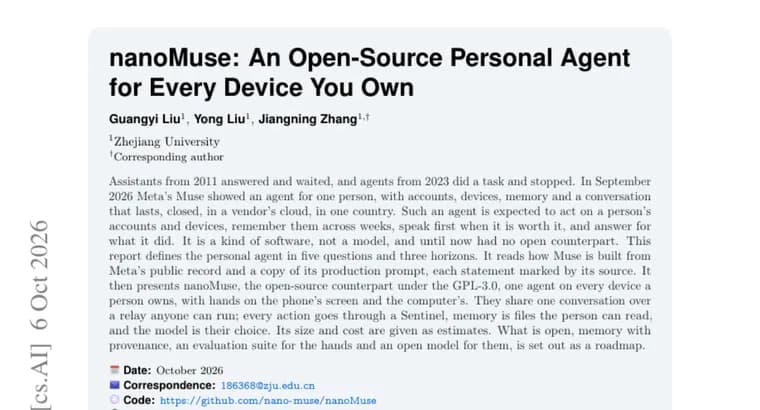
The report opens with a short history. Assistants from 2011 answered and waited; agents from 2023 did a task and stopped. In September 2026 Meta's Muse showed an agent for one person, with accounts, devices, memory and a conversation that lasts. The report describes Muse as closed, running in a vendor's cloud, in one country.
An agent of this kind, the report says, is expected to act on a person's accounts and devices, remember them across weeks, speak first when it is worth it, and answer for what it did. It calls this a kind of software, not a model, and says it had no open counterpart until now.
The report does three things. First, it defines the personal agent in five questions and three horizons. Second, it reads how Muse is built from Meta's public record and a copy of Muse's production prompt, with each statement marked by its source. Third, it presents nanoMuse, the open-source counterpart under the GPL-3.0.
nanoMuse is one agent on every device a person owns, with hands on the phone's screen and on the computer's. The devices share one conversation over a relay that anyone can run. Every action goes through a component called a Sentinel. Memory is files the person can read, and the model is the person's choice.
The report gives nanoMuse's size and cost as estimates. What remains open is set out as a roadmap rather than as delivered work: memory with provenance, an evaluation suite for the hands, and an open model for them.
Key facts
- The report defines the personal agent in five questions and three horizons, and treats it as a kind of software, not a model.
- It reads how Meta's Muse is built from Meta's public record and a copy of Muse's production prompt, with each statement marked by its source.
- nanoMuse is presented as the open-source counterpart to Muse, under the GPL-3.0: one agent across every device a person owns, with hands on the phone's and the computer's screen.
- Devices share one conversation over a relay anyone can run; every action passes through a Sentinel; memory is files the person can read; the model is the person's choice.
- Size and cost are given only as estimates, and memory with provenance, an evaluation suite for the hands and an open model for them are roadmap items, not delivered.
Why it matters
The report frames the personal agent as a new generation after the 2011 assistants that answered and waited and the 2023 agents that did one task and stopped. In its account, Meta's Muse (September 2026) showed an agent for one person with accounts, devices, memory and a lasting conversation, and it is closed, hosted in a vendor's cloud, in one country. nanoMuse is offered as the first open counterpart, under the GPL-3.0, so the same kind of agent need not live inside one vendor's service.
Who it affects
The target is an individual with several devices, since nanoMuse is one agent across every device a person owns, acting on the phone's screen and the computer's. It also concerns anyone who wants to read how a closed personal agent like Muse is put together, because the report sets out that reading from Meta's public record and a copy of its production prompt.
How to use it
The design choices point to how a person would run it: the model is their choice, memory is plain files they can read, and the relay that keeps the devices in one conversation can be run by anyone. The code is under the GPL-3.0. No repository link, release date or installation details are given in the text, so a reader cannot yet tell how to install it from this source alone.
How solid is it
This is a report that combines a definition, an analysis of Muse and a system proposal. The analysis of Muse rests on Meta's public record and a copy of its production prompt, each statement marked by its source. The text names no authors or institutions behind the report or nanoMuse. No benchmark results or measured size and cost figures are given; size and cost are only said to be estimates.
Risks and caveats
Parts of the open stack are a roadmap rather than a product: memory with provenance, an evaluation suite for the hands and an open model for them, with no timescale given and none stated as released. Size and cost are estimates. The source does not say what the Sentinel checks or how it decides, even though every action goes through it, and it does not say how the copy of Muse's production prompt was obtained. It also does not say which model nanoMuse uses by default or which models are supported.
“It is a kind of software, not a model, and until now had no open counterpart.”
— The report, on the personal agent