NASA tests Claude and generative AI to give spacecraft more autonomy
IEEE Spectrum describes a run of recent experiments in which generative AI is being tried out in space. Last December, NASA's Jet Propulsion Laboratory used Anthropic's Claude models to help plan two Mars drives for the Perseverance rover, with human planners checking and adjusting the route before upload. In May, NASA and IBM put a compressed AI model on the International Space Station and a satellite to identify things like floods and clouds from orbit; the article calls it the first model of its kind demonstrated in space. In July, astronauts on the ISS tested a large language model to see whether it could help with questions on maintenance procedures.
The article reads these as a larger shift. For decades, engineers on Earth decided what a machine in space would do, and the machine did exactly that. Now researchers are testing whether nondeterministic systems such as generative AI can give spacecraft more flexibility to interpret their surroundings, plan tasks and, one day, make decisions themselves. The technology is still far from trustworthy enough to hand over control of a spacecraft, the piece says, but engineers are starting to ask whether they can afford not to as missions become more complex, distant and numerous.
Why is autonomy needed, and why has it been resisted? Spacecraft have operated autonomously for decades, but never as the dominant model, partly because engineers prize predictable behavior. Robert Ambrose, the former chief of NASA's Software, Robotics, and Simulation Division, explains: autonomy often has no deterministic outcome, so how a system got into a situation changes its behavior. Come into the same situation by different paths and the outcome could differ, "and so engineers hate that." Ambrose worked on autonomy for the Orion spacecraft, NASA's deep space and lunar orbiter spacecraft, and Robonaut 2, a humanoid robot designed to work alongside astronauts that went to space in 2011. On Orion he saw the testing problem multiply, because engineers had to consider not only what the spacecraft might do but all the ways it could have reached a decision. Ambrose says engineers found ways to manage that complexity, including automating the testing itself: "We fought the challenges of autonomy using autonomy. That actually works."
Distance makes the case stronger. Ambrose points to a possible mission to Europa, Jupiter's ice-crusted moon, where a spacecraft could dive through a water plume erupting from beneath the surface. The plume could appear too quickly for engineers on Earth to direct the spacecraft into it. "It's up to the spacecraft to make a decision, and we'll be watching what happened an hour ago," he says. A mission like that, he added, is "totally impossible" without real autonomy.
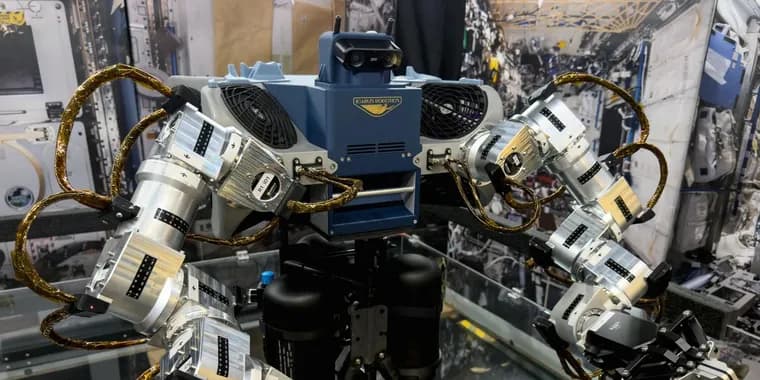
The article then turns to robotics in orbit. A commercial space boom is opening opportunities for AI and robotics, but what works on Earth does not necessarily work in space. Icarus Robotics is developing what it calls a robotic labor force for space, including Joy, a free-flying robotic system. Joy recently finished zero-gravity testing in Canada ahead of a planned deployment to the ISS, where one of its first tasks would be moving cargo bags between modules. The company plans to start with teleoperation and use that data to eventually train the robots to work on their own. Jamie Palmer, Icarus's cofounder and CTO, says the rollout will probably begin with partial autonomy, "so you still have human supervision in the loop at all times."
Palmer says a robot trained on Earth learns from Earth physics, and in orbit the physics is entirely different. A robot learns that an object pushed off a table falls; in orbit it keeps moving. "If you take the newest Gemini robotics model, or you take the newest physical intelligence model, and you put it in zero-g there, it's just going to fail immediately," he says. That leaves Icarus with a more extreme version of a problem terrestrial robotics also has: very little real-world data from the environment where its robots will work. The company is combining demonstrations from its robots in microgravity with simulations and tests on Earth to build its own dataset. Ethan Barajas, the company's cofounder and CEO, wishes there were a dataset to download, "But there's not today, not in a meaningful way."
The last section is about risk. Ufuk Topcu, an engineering professor at the University of Texas at Austin and the director of the Center for Autonomy, calls it mind-boggling how little autonomy there is in space applications, since space is where human involvement is extremely hard, the stakes are high and speed matters. He says the goal cannot be to guarantee that autonomous systems never do anything wrong. They are most useful in situations humans cannot anticipate, so researchers should start with restricted applications, learn how the systems behave, and gradually expand where and how they are used. The real question, in his view, is how well deployment risk is managed, not whether it can be fully eliminated. That matters more as the industry changes: for most of the space age a small number of government agencies designed missions that could take decades, while commercial companies now put more spacecraft into orbit and develop missions much faster. Topcu says space used to think of a mission concept and spend 10 or 15 years on it, and "It's not like that anymore."
Key facts
- Last December, NASA's Jet Propulsion Laboratory used Anthropic's Claude models to help plan two Perseverance drives; human planners checked and adjusted the route before upload.
- In May, NASA and IBM put a compressed AI model on the ISS and a satellite to spot floods and clouds from orbit, described as the first model of its kind demonstrated in space; in July, ISS astronauts tested an LLM for maintenance-procedure questions.
- Ambrose says a possible Europa plume-diving mission would be "totally impossible" without real autonomy, because engineers on Earth would be watching what happened an hour ago.
- Icarus Robotics finished zero-gravity testing of its free-flying robot Joy in Canada ahead of a planned ISS deployment, and plans to start with teleoperation and partial autonomy under human supervision.
- Topcu says the aim cannot be guaranteeing autonomous systems never err; start with restricted uses and expand gradually, judging how well risk is managed.
Why it matters
Space engineering has long relied on machines doing exactly what Earth told them to do. The article argues that this model is under pressure as missions become more complex, distant and numerous. Ambrose's Europa example makes it concrete: a plume that appears too quickly for engineers on Earth to react to leaves the decision to the spacecraft. What is new here is that generative AI, a nondeterministic technology, is now being tried in real space operations, from route planning for Perseverance to an AI model running on the ISS. Topcu adds that commercial companies now develop missions much faster than the decade-plus cycles of the past.
Who it affects
Mission engineers and planners at NASA and JPL, who are testing tools that draft plans for humans to review. Astronauts on the ISS, who tried an LLM for maintenance questions. Commercial robotics firms such as Icarus Robotics, which plans to put Joy on the ISS to move cargo bags between modules. Researchers on autonomy and testing, such as Topcu's Center for Autonomy at the University of Texas at Austin. Longer term, it touches any deep-space mission where signal delay makes real-time control from Earth impractical.
How to use it
This is a survey of experiments, not a product, so there is nothing to download or buy. The practical pattern in the article is staged trust. JPL kept human planners checking and adjusting the Claude-assisted route before upload. Icarus plans to start with teleoperation, collect that data, and only later train robots to work on their own, with partial autonomy and human supervision at all times at first. Topcu's advice is to start with restricted applications, learn how the systems behave, and gradually widen where and how they are used. Ambrose's testing lesson is to automate the testing of autonomy itself.
How solid is it
The piece is a feature in IEEE Spectrum built on named, attributed interviews: Ambrose (former chief of NASA's Software, Robotics, and Simulation Division), Palmer and Barajas of Icarus Robotics, and Topcu. The three experiments are stated as facts in the article's own voice. The source gives no figures for cost, accuracy or failure rates of any of the AI systems. It does not say how the route compared with human-planned ones or whether Claude-planned drives were actually driven, and it does not report the outcome of the ISS LLM test. The Europa mission is a hypothetical, and the Icarus deployment is planned, not done.
Risks and caveats
The article says the technology is still far from trustworthy enough to hand over control of a spacecraft. Ambrose notes that nondeterminism is exactly what engineers dislike: the same situation reached by different paths can produce different outcomes, and testing multiplies accordingly. Palmer warns that current terrestrial robotics models would fail immediately in zero-g, and that real-world training data from orbit is scarce. Topcu says risk cannot be eliminated, only managed. Most of the examples so far keep humans in the loop, so they show assisted planning, not autonomous decision-making.
“It has been mind-boggling to me how little autonomy we have in space applications”
— Ufuk Topcu, engineering professor at the University of Texas at Austin and director of the Center for Autonomy