NAVA-WAM pretrains a robot action policy on videos without action labels
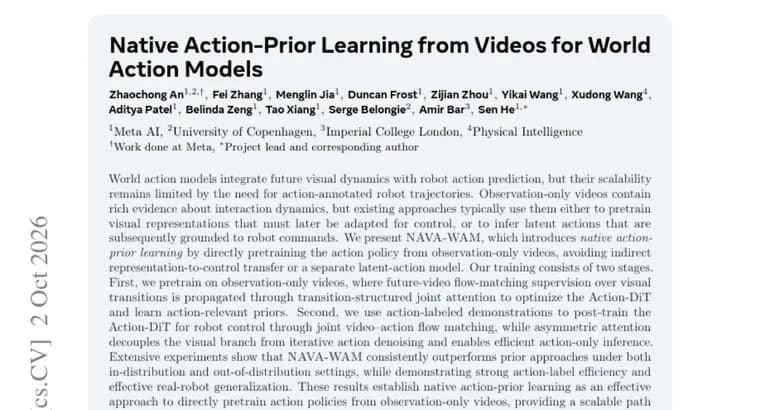
World action models combine predictions of future visual dynamics with robot action prediction. The paper behind NAVA-WAM starts from their main bottleneck: scalability is limited by the need for action-annotated robot trajectories, which are costly to collect.
Observation-only videos, the authors note, contain rich evidence about how interactions unfold. But existing approaches typically use them in one of two indirect ways. Either they pretrain visual representations that must later be adapted for control, or they infer latent actions that are then grounded to robot commands.
NAVA-WAM takes a different route, which the authors call native action-prior learning: the action policy itself is pretrained directly from observation-only videos. That avoids both the indirect representation-to-control transfer and a separate latent-action model.
Training has two stages. In the first, the model is pretrained on observation-only videos. Future-video flow-matching supervision over visual transitions is propagated through transition-structured joint attention to optimize the Action-DiT, the action component of the model, so that it learns action-relevant priors. In the second stage, action-labeled demonstrations are used to post-train the Action-DiT for robot control through joint video-action flow matching. Asymmetric attention decouples the visual branch from iterative action denoising, which enables efficient action-only inference.
The authors report that extensive experiments show NAVA-WAM consistently outperforms prior approaches under both in-distribution and out-of-distribution settings, with strong action-label efficiency and effective real-robot generalization. From this they conclude that native action-prior learning is an effective way to pretrain action policies directly from observation-only videos, providing a scalable path beyond action-labeled robot data. The source is the paper's abstract on Hugging Face Papers; it gives no numbers for the results.
Key facts
- NAVA-WAM is a world action model whose action policy is pretrained directly from observation-only videos, with no separate latent-action model.
- Training has two stages: pretraining on observation-only videos, then post-training on action-labeled demonstrations.
- In stage one, future-video flow-matching supervision is propagated through transition-structured joint attention to optimize the Action-DiT.
- In stage two, joint video-action flow matching and asymmetric attention enable efficient action-only inference.
- The authors report consistent gains over prior approaches in in-distribution and out-of-distribution settings, plus strong action-label efficiency and real-robot generalization.
Why it matters
Robot learning is held back by the cost of action-annotated trajectories. Observation-only video is far easier to come by, but current methods reach it indirectly: through visual representations that must be adapted for control, or through latent actions that must be grounded afterwards. NAVA-WAM claims to skip those detours by training the action policy itself on video, which the authors present as a scalable path beyond action-labeled robot data.
Who it affects
Mainly researchers working on world action models and robot policy learning, who face the same shortage of action-labeled data. Teams that hold large collections of unlabeled interaction video are the natural audience for the approach, since the method is built to use exactly that kind of data in pretraining.
How to use it
The abstract describes a recipe rather than a product. First pretrain on observation-only videos so the Action-DiT learns action-relevant priors through future-video flow matching. Then post-train on action-labeled demonstrations with joint video-action flow matching. At inference, asymmetric attention lets the model run action-only, without iterating on the visual branch. No code or weights release is mentioned in the source.
How solid is it
The claims come from the authors' own abstract and rest on experiments the text calls extensive. The source gives no quantitative results: no success rates, benchmark names, or margins over baselines, and it does not name the baselines or prior approaches compared against. No authors or institutions are named in the text. The headline results are therefore stated but cannot be checked from this source alone.
Risks and caveats
The source states no limitations or failure cases. It gives no details on which real robots or real-world tasks were used, no dataset names or sizes, and no model size, compute budget or inference speed figures. Words like "consistently" and "strong" are the authors' own and are not backed by numbers in the text, so how large the gains are and how well they carry over to other robots remains open.
“These results establish native action-prior learning as an effective approach to directly pretrain action policies from observation-only videos, providing a scalable path beyond action-labeled robot data.”
— From the paper's abstract