New audit exposes causality leaks that attention-mask checks miss
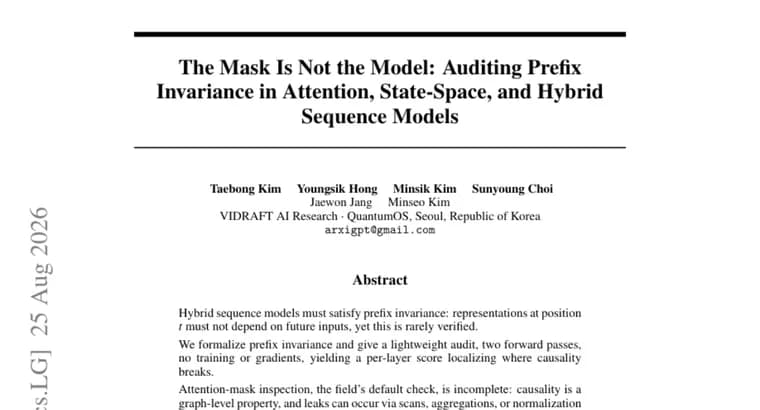
A new paper formalizes a property called prefix invariance: a model's representation at position t must not depend on any input that comes after it. That is the basic guarantee behind causal, autoregressive sequence models. The authors argue that the standard way of checking it, inspecting the attention mask, is incomplete. A mask can look correct while a leak still happens through other parts of the architecture, such as scans in state-space layers or normalization steps, letting future information reach earlier positions anyway. To catch this, they built a lightweight audit that needs only two forward passes and no training or gradient computation, and that pinpoints exactly where in the model causality breaks down. They tested it by injecting 192 faults across eight model checkpoints spanning attention-based, state-space, and hybrid architectures. Attention-mask inspection alone caught none of the 192 injected faults. The new audit localized all 192 of them. Applied beyond the synthetic test set, the same audit also turned up a genuine, previously undetected defect in the Zamba2 and Nemotron-H checkpoints. The text does not specify what that defect consists of, nor does it name the paper's authors, institutions, venue, or any released code or benchmark.
Key facts
- The paper defines 'prefix invariance': representations at position t must not depend on future inputs, the core causality guarantee for sequence models.
- It introduces an audit requiring only two forward passes, no training or gradients, that localizes exactly where causality breaks.
- Across 192 injected-fault trials on eight checkpoints, attention-mask inspection alone found none of the faults; the new audit localized all 192 of 192.
- The audit also surfaced a real, previously undetected defect in the Zamba2 and Nemotron-H checkpoints.
- The method covers attention-based, state-space, and hybrid sequence model architectures alike.
Why it matters
Causal sequence models, whether built on attention, state-space layers, or a hybrid of both, are supposed to guarantee that a token's representation cannot see the future. That guarantee is what makes autoregressive generation and left-to-right training valid in the first place. This paper shows the common way of verifying it, checking that the attention mask is correct, is not sufficient: a correct mask can coexist with a real leak introduced elsewhere in the architecture, such as in scan operations or normalization layers. That is a blind spot in how causal correctness gets checked across the field.
Who it affects
Anyone building, auditing, or relying on causal sequence models, including state-space and hybrid architectures such as Zamba2 and Nemotron-H, which the audit flagged as having an actual defect. It is directly relevant to teams who currently treat attention-mask inspection as sufficient proof that a model respects causality.
How to use it
The audit is lightweight by design: it runs in two forward passes and needs no training or gradient computation, so it can be applied to existing checkpoints without retraining or special instrumentation, and it pinpoints exactly where in the model a causality violation occurs rather than just flagging that one exists.
How solid is it
The evidence is a controlled comparison: 192 faults were deliberately injected across eight checkpoints, and attention-mask inspection alone caught zero of them while the new audit localized all 192. That is a stark contrast on a test the authors designed themselves. The text does not mention peer review, a publication venue, or any released code or benchmark, so the method's reliability outside this controlled test cannot be independently confirmed from what is available here.
Risks and caveats
The source text does not describe what the defect actually found in Zamba2 and Nemotron-H consists of, nor does it give the authors' names, institutional affiliations, a publication date, or any comparison against prior detection methods beyond mask inspection. No code or benchmark release is mentioned, so the audit's reproducibility cannot be assessed from the material at hand.
“Attention-mask inspection is incomplete: leaks can occur via scans or normalization despite correct masks.”
— the paper's abstract