New benchmark maps 45 failure patterns in AI research agents
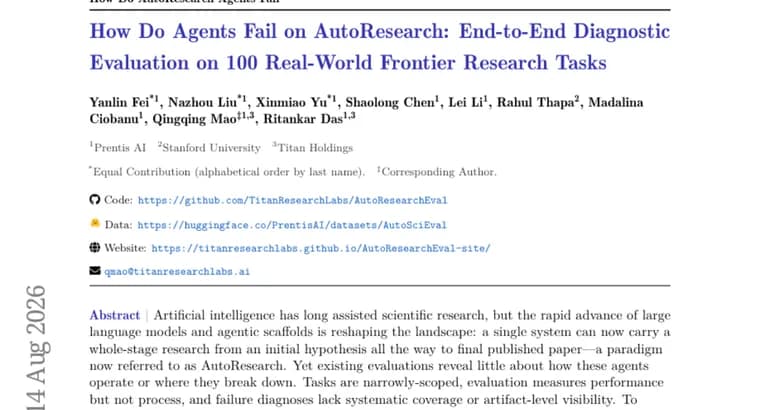
Researchers introduce AutoResearchEval, a benchmark of 100 tasks grounded in published frontier science across 7 scientific domains, covering the full research lifecycle from ideation and retrieval through execution, analysis, writing and review. The paper argues that as LLM-based agentic systems increasingly carry a whole research stage end to end, from an initial hypothesis to a finished paper (a paradigm the authors call AutoResearch), existing evaluations say little about how these agents actually work or where they break down, because tasks are narrowly scoped and scoring measures final performance rather than the process that produced it.
To fix that, the team ran 8 different harness-model combinations on the 100 tasks, producing 800 full agent trajectories with process-level annotation rather than pass/fail scores alone. A human-calibrated agent-as-a-judge pipeline then inspected these complete trajectories and their intermediate artifacts to attribute failures at a fine-grained level. From this analysis the authors built the AutoResearch Failure Taxonomy (ARFT), a framework of 45 empirically grounded failure patterns.
The central finding is that these 45 patterns converge on one overarching limitation: current agents lack a metacognitive loop, meaning the ability to check what they produced against what they actually found, revise their work when it does not hold up, and question whether the approach they took was sound in the first place. Crucially, the same failure patterns showed up across all 8 harness-model combinations, including the strongest models tested, which the authors say locates the deficit at the level of the underlying models rather than in any one agent scaffold or orchestration design. The paper explicitly leaves open whether orchestration-level interventions could close this gap, since it does not test that question. AutoResearchEval and ARFT are being released publicly to support further work on autonomous scientific discovery.
Key facts
- AutoResearchEval covers 100 tasks grounded in published frontier science across 7 scientific domains, spanning the full research lifecycle: ideation, retrieval, execution, analysis, writing and review.
- Evaluating 8 harness-model combinations produced 800 full agent trajectories, annotated at the process level rather than scored only on final output.
- A human-calibrated agent-as-a-judge pipeline inspected complete trajectories and intermediate artifacts to attribute failures in fine-grained detail.
- The analysis yields the AutoResearch Failure Taxonomy (ARFT), a framework of 45 empirically grounded failure patterns.
- All 8 combinations, including the strongest models tested, showed the same failure patterns, pointing to a metacognitive-loop deficit at the model level rather than in any particular scaffold.
Why it matters
AI systems are increasingly asked to carry an entire stage of scientific research on their own, from an initial hypothesis to a finished, publishable paper, a paradigm the authors call AutoResearch. Until now, evaluations of these systems mostly graded final output and said little about how the agents got there or where the process actually broke. AutoResearchEval and its accompanying failure taxonomy give the field a process-level, artifact-grounded way to see where autonomous research agents go wrong, rather than just whether they succeeded or failed on a task.
Who it affects
The work is aimed at people building and evaluating agentic systems for scientific research: teams developing AI research assistants, and researchers and labs who test frontier models on end-to-end, autonomous R&D tasks and need a way to diagnose failures rather than just measure a pass rate.
How to use it
The authors are publicly releasing both the AutoResearchEval benchmark and the ARFT failure taxonomy so others can build on the evaluation and the diagnostic framework. This is a research benchmark and taxonomy, not a commercial product, and the text gives no pricing, access tiers or usage limits.
How solid is it
The benchmark spans 100 tasks across 7 scientific domains, grounded in published frontier science and covering the whole research lifecycle rather than a single narrow step. The authors tested 8 different harness-model combinations, generating 800 full agent trajectories, and used a human-calibrated agent-as-a-judge pipeline to inspect complete trajectories and intermediate artifacts for fine-grained failure attribution. The fact that the same 45 failure patterns recurred across all 8 combinations, including the strongest models evaluated, is the paper's main evidence that the problem sits at the model level rather than being an artifact of any one scaffold.
Risks and caveats
The paper stops short of testing whether orchestration-level changes, rather than the underlying models, could close the metacognitive-loop gap; it flags this explicitly as an open question. The available text does not name the specific models or agent harnesses used in the 8 combinations, does not enumerate the 7 scientific domains, and gives no breakdown of the 45 failure patterns by category or frequency, so how the findings map onto any particular product or setup is not spelled out.
“Failure patterns converge on a single overarching limitation, namely that current agents lack a metacognitive loop, which entails the ability to check what they produced against what they found, revise when it does not hold up, and question whether the path they took was sound.”
— the authors