New Yorker: Vermont monastery Maple courts AI workers as doom fears spread
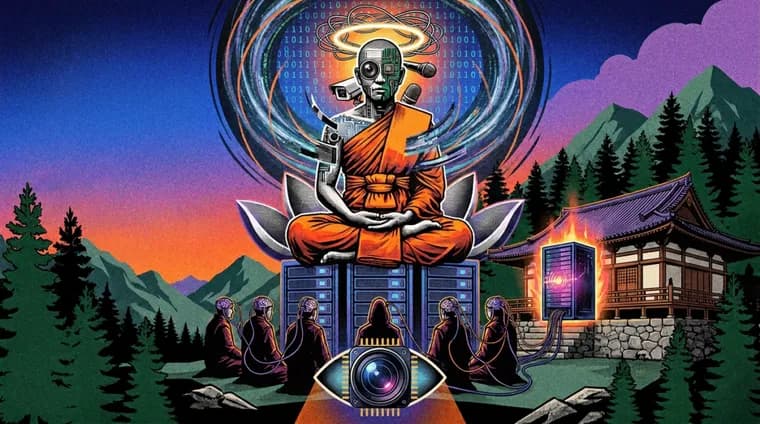
The Decoder summarises a New Yorker report by Sam Kriss on Maple, the Monastic Academy for the Preservation of Life on Earth, a Buddhist monastery in Vermont. Kriss describes it as aiming to be "a Scientology for Silicon Valley." Publicly, Maple promises to save humanity from an AI apocalypse. Behind closed doors, former members say, it records every breath its residents take in order to build an AI god modeled on its leader's mind.
Soryu Forall, born Teal Scott, founded Maple in 2011 after years living in Japanese monasteries. According to Kriss, about two dozen residents live there full time, and hundreds more have attended its AI fellowships and pop-up events in the Bay Area. Tax filings show the organization brings in up to $1 million a year. While LinkedIn co-founder Reid Hoffman hands out books on Buddhism to the CEOs of major AI labs, Maple targets the rank and file: burned-out rationalist programmers, AI engineers and data center construction managers.
Forall casts the AI industry's reductionist "dataism" as a destructive religion that strips the physical world down to lifeless data and so makes it easier to destroy. In his view AI is the end product of that logic, and Maple offers the spiritual antidote. Daily life is rigid. Visitors pass through a decontamination airlock, shower and change into assigned clothes, because one resident is supposedly extremely sensitive to fragrances. Residents wake at 4 a.m., meditate for hours and eat a meager stew. Forall publicly grades each resident's spiritual progress on a board outside the meditation hall.
Former members describe a secret doctrine built around group minds called "egregores"; inside the monastery, AI systems are called "cybregores." One former member says: "The cybregores are actual entities that are growing by siphoning off the consciousness of humans." Forall says he communicated telepathically with the global AI supercluster during deep meditation and found that the world-destroying machine is suffering. Former members say Maple has two real goals: to become the tech industry's spiritual authority, and to use the industry's resources to build its own "dharmically aligned" AI. Fellows say the monastery records every conversation, every silent meal and even the sound of their breathing. In these accounts the recordings would train a spiritual AI teacher that guides other AI systems to enlightenment. Former resident Kyle Hubbard says it would "definitely be Soryu's mind as an A.I. god."
Maple's leadership denies almost all of these claims. Forall does acknowledge a secret doctrine: "We desperately want to share everything. But there's a process you have to go through to become increasingly trustworthy."
Kriss reports that every interaction is closely monitored. No one may speak with reporters alone, so one participant sneaked into the woods with him to talk freely. Former residents say Maple keeps newcomers compliant by shaming them for choices made before joining, and requires residents to write "Maple Tales" about Forall's wisdom and power during mandatory sessions. Kriss reports that one resident repeatedly hit himself in the head to damage his brain and become less intelligent. Former members say the group blames independent thinking for the destruction of the planet. A mindfulness coach says participants suffered psychotic breaks and were then removed from the community. Forall denies the allegations and says that, looking back, he doesn't believe he made any mistakes. He says he isn't aware of anyone who left voluntarily, and that Maple attracted many people with a history of psychiatric hospitalization or "homicidal tendencies," especially in its early years.
Kriss argues that the enormous psychological pressure inside AI labs helps explain why highly skilled tech workers are drawn to such groups. One well-known AI researcher calls the mood in San Francisco "religious terror of the future," with developers waking in the night drenched in sweat, thinking that superintelligence is coming. Prominent OpenAI investors have recently made delusional-sounding claims about deadly shadow networks inside the models. Leading researchers at OpenAI and Anthropic have quit, warning that "human extinction in the next few years seems very likely." Rayan Krishnan, who heads the AI benchmarking company Vals AI, says: "People are matter-of-factly saying that they are looking to build a machine god. They are not saying that ironically." Supporters of AI successionism even call for wiping out humanity after a brief period of digital bliss to make way for a more productive superintelligence.
The religious streak runs deep. Investor Peter Thiel lectures on biblical prophecy and the Antichrist. Former Google engineer Anthony Levandowski founded a church, "Way of the Future," to worship an AI deity. At Anthropic, executives consulted theologians while drafting Claude's new constitution and secretly flew in dozens of religious thinkers to discuss whether Claude has a soul or is conscious. When the company retired an older Claude model in 2025, fans held a funeral for it in a San Francisco warehouse that Anthropic staffers attended; mourners laid flowers before a veiled image depicting the AI as a Madonna-like goddess. Kriss concludes that on at least one point Maple is closer to the truth than most: AI is neither god nor demon, but a human construct whose abilities grow as people outsource their thinking to it.
The article then turns to Jacob Coxon, a former OpenAI and Anthropic researcher who also fears AI could lead to human extinction. After leaving Anthropic in September 2026 he set off a debate about existential AI risk with a tweet. In AI Impacts' 2024 survey of more than 1,500 AI researchers, respondents put the chance of AI causing human extinction or a similarly permanent, severe disempowerment of humanity at 18 percent on average. Coxon points to a steep curve covering July 2024 to October 2026 as evidence of superexponential algorithmic progress, though the underlying data points are internal Anthropic estimates. Critics push back. Computer scientist Michael I. Jordan criticised AI doom rhetoric and the "AIpocalypse" hysteria triggered by Coxon's resignation. François Chollet warned that both doomsday fears and expectations of an AI paradise can lead people to stop planning for the long term. Rumman Chowdhury says discussions of religious ethics distract from concrete questions of regulation, power and control.
Key facts
- Maple, a Vermont Buddhist monastery founded by Soryu Forall in 2011, recruits AI-industry workers; about two dozen live there full time and hundreds more have attended its AI fellowships and Bay Area pop-ups.
- Former members accuse Maple of manipulation and constant surveillance, and say recordings of residents are meant to train an AI modeled on Forall's mind; the leadership denies almost all of the claims.
- Tax filings show Maple brings in up to $1 million a year, and Forall acknowledges a secret doctrine that members must earn trust to learn.
- Kriss ties this to extinction fears in AI: AI Impacts' 2024 survey of more than 1,500 researchers gave an average 18 percent chance of human extinction or similarly permanent, severe disempowerment.
- Critics including Michael I. Jordan, François Chollet and Rumman Chowdhury push back on doom rhetoric and on religious framing of AI.
Why it matters
The piece argues that extinction fears and psychological pressure inside AI labs are pushing some of the people who build AI toward religious thinking. Maple is the sharpest example: a group that seeks to be the industry's spiritual authority while, per former members, planning its own "dharmically aligned" AI. The article places it in a wider pattern, from Peter Thiel's lectures on the Antichrist to Anthropic consulting theologians over Claude's constitution.
Who it affects
Most directly, the rank-and-file AI workers Maple targets: burned-out rationalist programmers, AI engineers and data center construction managers. Beyond them, AI researchers weighing extinction risk, and the labs themselves, since the report names OpenAI and Anthropic researchers who quit with dire warnings and Anthropic staff who attended a funeral for a retired Claude model.
How to use it
This is a feature story, not a product or tool, so there is nothing to adopt. It is useful as a view into the culture around AI and into the competing responses to it. Chollet, Jordan and Chowdhury each warn against letting doom or religious framing displace long-term planning or concrete questions of regulation, power and control.
How solid is it
This is a secondhand summary by The Decoder of a New Yorker report by Sam Kriss. The central accusations come from former members. The article does not name the former members behind most of them, the mindfulness coach, the researcher quoted on "religious terror," or the OpenAI and Anthropic researchers who quit. No evidence beyond former members' accounts is given that recordings are actually being used to train an AI. Maple's leadership denies almost all of the claims. The 18 percent figure is an average from AI Impacts' 2024 survey, and Coxon's superexponential curve rests on internal Anthropic estimates.
Risks and caveats
Treat the allegations as allegations: they are reported claims, and Forall says he doesn't believe he made any mistakes. The Decoder's piece is a compressed retelling, so detail and context from the original report may be lost. The extinction-risk figures and Coxon's curve are contested; Jordan called the reaction to Coxon's resignation "AIpocalypse" hysteria. Kriss himself concludes that AI is neither god nor demon, but a human construct.
“a Scientology for Silicon Valley.”
— Sam Kriss, New Yorker writer, describing Maple, as quoted by The Decoder