NVIDIA introduces Kumo Relational, a no-training model for relational databases
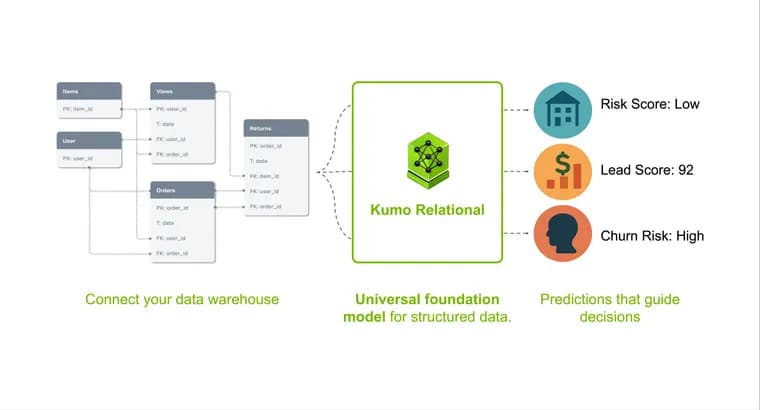
NVIDIA, working with the Kumo team, has introduced Kumo Relational, a pre-trained relational foundation model that makes predictions directly on a database. You connect a database, describe what to predict, and get an answer in a single forward pass. According to the Hugging Face blog post, it needs no task-specific training, no feature engineering and no flattening of tables into one row per entity.
The model works through in-context learning. Given a predictive query, it gathers up to 10,000 historical examples as context. Each example pairs a local subgraph around an entity at a point in time with its known outcome, such as "this user churned" or "this item sold 142 units". Tasks are written in Predictive Query Language (PQL), a declarative interface where you state what to predict rather than how. For temporal tasks the system replays historical database states: it samples subgraphs up to an anchor timestamp, computes each target from events after that timestamp, and serves the model only data from before it. The authors say this prevents data leakage.
The architecture has two stages. A lightweight network processes each table on its own, alternating column attention and row attention. A larger network then spreads the row embeddings across the relational structure using graph attention over primary-key and foreign-key links, interleaved with cross-sample attention across context examples. Because this stage works on row embeddings rather than every cell, the authors say it avoids quadratic cost and scales to large contexts and deeper subgraphs.
Pre-training uses entirely synthetic relational data, since diverse relational databases are rarely public. The generator builds on PluRel (Kothapalli et al., ICML 2026), which extends single-table data generators to full relational databases; members of the Kumo team helped develop PluRel and co-authored that paper. PluRel builds each database in three stages: a schema, foreign-key links between rows that cluster as they do in real data, and column values from Structural Causal Models with temporal trends and cross-table dependencies. Pre-training proceeds in stages, from single tables to more complex relational structures. The model can also be fine-tuned on a specific dataset and task when maximum accuracy matters.
The authors evaluated it on 41 benchmarks across 15 relational databases from RelBench V1 and V2, SAP SALT and 4DBInfer, covering e-commerce, medical, enterprise, social and academic domains. They say none of these datasets were seen in pre-training, and that the model outperforms the strongest supervised models in both classification and regression, including relational deep learning models and expert-engineered tabular ensembles. The post calls it the first few-shot foundation model to outperform supervised machine learning on common relational benchmarks.
The headline numbers: on RelBench V1 classification tasks it beats gradient-boosted trees on expert-engineered features by nearly 4 AUROC points on average. On SAP SALT it beats XGBoost on engineered features by 7 MRR points out of the box and 13 MRR points after fine-tuning. Against AutoGluon ensembles on SAP SALT it leads by 8% in mean reciprocal rank (16% after fine-tuning), and it leads recent tabular foundation models by about 25%. On the RelArena-α leaderboard (RelBench V1) it sits on the accuracy-efficiency Pareto front out of the box, at about 17 seconds median inference time per 1,000 samples and Elo 1,842. The top-scoring entry, rt-plurel, reaches Elo 1,878 but at about 7,300 seconds, roughly 430 times slower. The post adds that the model performs well with as little as 0.2% of the training data as context, stays stable when up to 75% of foreign-key links are removed, and barely degrades when many noisy columns are added.
The post concedes limits. The model does best on data with meaningful relationships and temporal dynamics, such as user behaviour over time. On tasks with very large training sets, task-specific supervised models may still edge out in-context predictions (the benchmarks used at most 10,000 context examples), and fine-tuning is meant for that case. Predictive signals must be reachable within a limited number of hops, so the authors suggest starting with a focused query over a few relevant tables and expanding the graph as needed.
On deployment, Kumo Relational runs in memory, through database and warehouse connectors, or through a custom graph engine that handles 500B+ rows via memory-mapped I/O at up to 5 GB/s. It is available in NVIDIA's open-source, GPU-native structured-data-models library (pip install structured-data-models), which downloads the weights from the Hugging Face Hub on first use. The code sample loads sdm.models.KumoRelational on a CUDA device and passes context tables, query entities and related tables. Alternatively it can be deployed as an NVIDIA NIM, with the open-source structured-data-models-client sending PQL queries such as "PREDICT COUNT(orders.*, 0, 30, days) FOR EACH users.user_id". The post links a paper (arXiv 2604.12596) and documentation at docs.nvidia.com/sdgm/rfm/overview.
Key facts
- Kumo Relational is a pre-trained relational foundation model that predicts directly on a database via in-context learning, using up to 10,000 historical examples as context, with no task-specific training or feature engineering.
- The authors report it beats supervised relational deep learning models and expert-engineered gradient-boosted tree pipelines across 41 tasks on 15 databases; none of the datasets were seen in pre-training.
- On SAP SALT it beats XGBoost on engineered features by 7 MRR points out of the box and 13 after fine-tuning, and leads AutoGluon ensembles by 8% in MRR (16% after fine-tuning).
- On the RelArena-α leaderboard it runs in about 17 seconds per 1,000 samples at Elo 1,842; the top entry reaches Elo 1,878 but is roughly 430 times slower.
- It is available through NVIDIA's open-source structured-data-models library, with weights pulled from the Hugging Face Hub, or as an NVIDIA NIM.
Why it matters
Most foundation models for structured data work on a single flat table, while business data sits in linked tables: users, orders, products, all changing over time. Flattening them by hand into aggregates such as "average order value in the last 30 days" takes weeks of work and loses structural signal. Kumo Relational works on the database itself, respecting tables, foreign keys and timestamps. The post argues that structured-data models can repeat what LLMs did for language: beat task-specific pipelines, simplify production, and let agents anticipate outcomes such as which customer will churn. NVIDIA says it is the first few-shot foundation model to beat supervised machine learning on common relational benchmarks.
Who it affects
ML teams that maintain per-task pipelines for churn, demand or fraud prediction on relational data are the main audience. The post says a new prediction becomes a query instead of a project, so teams could take on use cases that were too laborious before. It also targets agent builders: the model is built to be called by agents, with PQL as the interface for predictive questions. Teams running production XGBoost pipelines are named directly, since the authors say the results make a compelling case for replacing them.
How to use it
Two routes are described. First, install the open-source structured-data-models library, load sdm.models.KumoRelational on a CUDA device, and pass context tables with targets, query entities and related tables; the weights download from the Hugging Face Hub on first use. The library's relational examples cover complete RelBench and SAP SALT pipelines. Second, deploy the model as an NVIDIA NIM and point the structured-data-models-client at it; you write the task in PQL and the client gathers context examples and related tables. It can be fine-tuned when maximum accuracy matters. The authors advise starting with a focused query over a few relevant tables and expanding the graph as needed. The visible text gives no release date, price or licence terms for the model weights or the NIM.
How solid is it
The claims rest on a paper (arXiv 2604.12596) and documentation, and the evaluation covers 41 benchmarks on 15 public and enterprise databases, with the authors stating none were seen in pre-training. But the results are the authors' own: the benchmarks are run by the authors themselves, and the text cites no independent replication. The 8% MRR lead over AutoGluon is not defined as relative or absolute. The leaderboard position comes from RelArena-α on RelBench V1 only. Phrases such as "first" and "compelling case for replacing" are NVIDIA's own framing.
Risks and caveats
The authors list limits themselves. Task-specific supervised models may still edge out in-context predictions on tasks with very large training sets, where fine-tuning is the intended answer. Predictive signals must be reachable within a limited number of hops, and the model does best on data with meaningful relationships and temporal dynamics. Pre-training is entirely on synthetic data, so performance on a given real database is something to test rather than assume. The visible text does not give parameter counts, model size or hardware requirements beyond a CUDA device in the code sample.
“A new prediction becomes a query instead of a project”
— NVIDIA blog post on Hugging Face