Nvidia's Huang unveils DSX Pod, a modular data center ready in 14 days
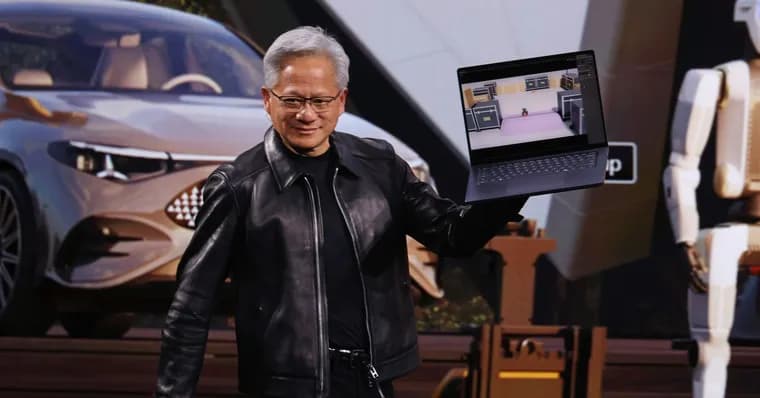
Jensen Huang set out Nvidia's vision for Europe at the company's GTC conference in Berlin on a Wednesday, speaking for 90 minutes to a crowd of about 4,000. Wired summarises the plan as robotics, AI agents and modular data centers, with Nvidia powering all of it. His core pitch to the audience: "To be part of this AI economy, you don’t want to just be consuming the AI. You want to be producing the AI," and "We can do all of that here in Europe."
The first big announcement was the DSX Pod, a modular "AI factory" and a "plug-and-play" way to build AI data centers. Everything arrives already assembled in a large metal container, packed with Nvidia's latest Vera Rubin compute racks. Wired reports it can be brought online in 14 days, instead of the months or years a conventional build takes, and notes that could suit Europe, where infrastructure projects are notoriously slow. Huang said the pod would also cut the time compute sits idle in a data center, because it comes online sooner. "This is a complete transformation," he said.
On robotics, Huang called humanoids the "next great industry" and argued Europe is well placed to lead because of its manufacturing heritage. Physical AI, he said, goes well beyond robots: even telecom operators are adding Nvidia GPUs to their cell towers. He announced partnerships with European carmakers VW and Mercedes on autonomous vehicles. Nvidia is also launching a full-stack robotics platform meant to standardize configuration, and plans to release a preconfigured reference robot, Agile One, in the first quarter of next year to help developers start building physical AI systems. "This is your great opportunity," Huang told them.
On models, Huang predicted that "Every company in the future will use both closed models as well as open models that you customize." He showed Nvidia's own open-source models as reaching frontier performance once customized on an organization's proprietary data. He also predicted agents will mean more users of software tools than ever, and said agents' reasoning, iteration and tool use are pushing token consumption, and demand for computing and Nvidia GPUs, higher.
Wired contrasts this with the previous GTC, held in San Jose in March, which was about AI inference and more efficient compute; seven months later the focus has moved to power, agents and physical AI. The Berlin show was staged at the Tempodrom, which Wired describes as a circus-tent-inspired venue with a gamer's-den look. The speech veered between selling laptops and sweeping predictions. Microduck robots made by Hugging Face, described as a recent Nvidia acquisition, did Huang's bidding at the end. Two Greenpeace protesters stood and unfurled a banner reading "Clean up your dirty business"; Huang told his security team to "Go easy" as they were marched out. The speech closed with an AI-generated Eurovision song summarising the announcements.
Key facts
- Nvidia's DSX Pod is a prefabricated, plug-and-play AI data center that arrives assembled in a large metal container, packed with Vera Rubin compute racks.
- Wired reports a DSX Pod can be brought online in 14 days, against months or years for a conventional build; Huang said it would also reduce idle compute time.
- Nvidia announced a full-stack robotics platform to standardize configuration, plus a reference robot, Agile One, due in the first quarter of next year.
- Huang announced partnerships with VW and Mercedes on autonomous vehicles and said telecom operators are adding Nvidia GPUs to cell towers.
- Huang predicted companies will use both closed models and customized open models, and said agents are driving token consumption and GPU demand higher.
Why it matters
The DSX Pod is Nvidia's answer to a bottleneck Wired singles out for Europe: slow infrastructure projects. A container-shipped data center that can be online in 14 days, versus months or years, changes the timeline for anyone who wants AI compute on the continent. Huang framed the bigger goal as producing AI in Europe rather than only consuming it. The keynote also marks a shift in emphasis: the March GTC in San Jose focused on inference and efficient compute, while Berlin centred on power, agents and physical AI.
Who it affects
Organizations that want to build AI data centers in Europe are the obvious audience for the DSX Pod. Developers of physical AI systems are the target of the robotics platform and the Agile One reference robot. VW and Mercedes are named as partners on autonomous vehicles, and telecom operators are cited as adding Nvidia GPUs to cell towers. Companies choosing between closed and open models are addressed by Huang's claim that customized open models can reach frontier performance.
How to use it
Nothing in the DSX Pod announcement tells a buyer how to order one: no price, customers or order terms are given. Developers interested in robotics can look to the full-stack robotics platform and the Agile One reference robot, which Nvidia plans to release in the first quarter of next year, preconfigured to help developers start building physical AI systems. No launch timeline is given for the robotics platform itself.
How solid is it
This is Wired's account of a keynote, so most claims are Nvidia's own and Huang's own predictions. The 14-day figure and the idle-time benefit come from the announcement itself, with no independent check or customer example. The source gives no detail on how many racks or how much compute a pod holds, or on its power draw. Details of the VW and Mercedes partnerships go no further than 'on AVs', and the claim that Nvidia's open models reach frontier performance after customization is a showcase claim, not a measured result.
Risks and caveats
Treat the sweeping predictions as a sales pitch: Wired notes the speech veered between selling laptops and grand forecasts, with Nvidia cast as the fundamental provider to every industry. The 14-day deployment is a headline number with no price, scale or power figures attached. Agent-driven demand growth is a prediction that happens to favor Nvidia's own GPUs. The Greenpeace protesters who unfurled a banner reading 'Clean up your dirty business' were marched out; the source does not say more about their concerns or how the matter ended.
“To be part of this AI economy, you don’t want to just be consuming the AI. You want to be producing the AI”
— Jensen Huang, GTC Berlin