Nvidia made $65.3 billion in a quarter, and its interim CEO says it's business as usual
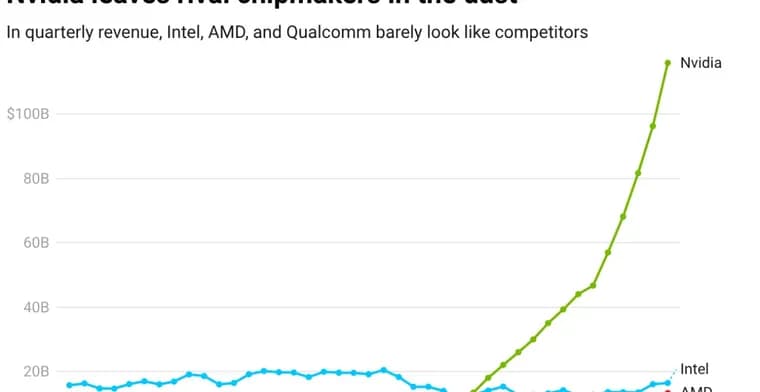
The Verge published a data-visualization piece on Nvidia's rise, prompted by the resignation of cofounder and CEO Jensen Huang. The article describes Huang as a visionary founder CEO who was lost to a series of scandals. Its argument is that Nvidia is so profitable that it will do everything it can not to rock the boat. The opening illustration: Nvidia now makes about $8,300 in pure profit every second, so by the time a reader finishes the first paragraph it will likely have cleared $45,000 and change.
The piece comes with an interactive chart, where desktop readers can mouse over each dot, and a horizontal bar graph that sets Nvidia's revenue growth beside its profits and the world events that made it a star. The author's summary: the crypto boom and the great GPU shortage have nothing on the AI boom. In those earlier periods Nvidia's profits briefly peaked at $1.24 billion and $3 billion a quarter respectively. The rise of data centers has driven them to $65 billion per quarter, with no sign of stopping. The most recent quarter's profit was $65.3 billion. The author also says rivals AMD, Intel and Qualcomm now barely qualify as competition.
The article then puts the money in perspective. Nvidia's market cap fell from around $5 trillion at the start of November to "only" $3.6 trillion now, yet the company is raking in $700 million in profit a day on average. The author says Nvidia could give a $1 million bonus to each of its 42,000 employees every three months without running out of cash. It adds, half-jokingly, that at over $200 billion in pure profit a year Nvidia could end world hunger or provide clean water for everyone. For investors, $1,000 put into Nvidia 10 years ago is now worth over $67,000, and $15,000 would be worth over $1 million.
On the November 17th earnings call, the first since Huang's resignation, interim CEO and CFO Colette Kress said: "Going forward, we intend to return all excess free cash flow net of strategic uses to shareholders." The author notes that this is more than the 50 percent baseline Huang promised five months ago. Asked how things might change under new management, Kress said it would not: "From a business perspective, it's business as usual." She added that the company has secured the backing of customers and suppliers including TSMC, which fabricates Nvidia's chips, and said: "Our momentum is real, our demand is accelerating, our supply is growing. Our customers and partners are with us, and employees are committed. We've got this."
Nvidia claims it will earn even more next quarter, with projected revenue of $130 billion. Profit may be proportionally smaller because gross margins are estimated to drop to 71 to 72 percent, compared with nearly 75 percent now. Kress said Nvidia intends to bring them back up as high as 73 percent next year.
The author compares Nvidia with the memory makers. Samsung, SK Hynix and Micron controlled nearly 90 percent of the global DRAM market, according to the earlier RAMageddon coverage, and have repeatedly signaled they would rather celebrate record profits than ramp up production too fast. In the most recent quarter Micron made $37.7 billion in profit, SK Hynix $29.8 billion and Samsung around $55.3 billion, all short of Nvidia's $65.3 billion. Samsung's revenue also covers phones, tablets, TVs, appliances, displays and much else besides memory. The author adds that RAM has historically been more cyclical: Micron and SK Hynix both lost money in 2023 because they produced too much memory. The conclusion: this gravy train is not going anywhere, at least that is the plan.
Key facts
- Nvidia's profit in the most recent quarter was $65.3 billion, against brief peaks of $1.24 billion in the crypto boom and $3 billion in the GPU shortage.
- Interim CEO and CFO Colette Kress said on the November 17th call that "it's business as usual" and that Nvidia intends to return all excess free cash flow net of strategic uses to shareholders, up from a 50 percent baseline Huang promised five months ago.
- Nvidia's market cap fell from around $5 trillion at the start of November to $3.6 trillion, while profit averages $700 million a day.
- Nvidia projects $130 billion in revenue next quarter, with gross margin estimated at 71 to 72 percent versus nearly 75 percent now, and Kress aims for as high as 73 percent next year.
- Memory makers trail: Micron earned $37.7 billion, SK Hynix $29.8 billion and Samsung around $55.3 billion in the latest quarter.
Why it matters
Nvidia's founder CEO has resigned, and the question is whether the AI hardware boom is at risk. The piece answers with scale: profit that went from a $1.24 billion quarterly peak in the crypto boom and $3 billion in the GPU shortage to $65.3 billion in the latest quarter. The author's reading is that this much money gives the company every reason to avoid changing course, and that the interim leadership is signaling continuity.
Who it affects
Nvidia shareholders, who are promised all excess free cash flow net of strategic uses, a bigger payout than the 50 percent baseline Huang set five months ago. Customers and suppliers such as TSMC, whose backing Kress says Nvidia has secured. The memory makers Samsung, SK Hynix and Micron, which the author compares with Nvidia. The author names AMD, Intel and Qualcomm as rivals that barely qualify as competition now.
How to use it
Treat it as a way to read the scale of Nvidia's numbers: about $700 million in profit a day on average, over $200 billion a year, and $1,000 invested 10 years ago now worth over $67,000. For what to watch next, the source points to the projected $130 billion in revenue next quarter, the gross margin path from nearly 75 percent to an estimated 71 to 72 percent and back toward 73 percent next year, and the size of the shareholder payout.
How solid is it
The earnings-call statements are Kress's own words as reported by The Verge. The $130 billion revenue projection is Nvidia's claim, and the article gives no independent estimate. Per-second, per-day and annual profit figures are the author's illustrations, and the article does not say how they were computed or whether the profit figures are net, GAAP or non-GAAP. The piece is a visualization with a pointed, playful tone, not a straight earnings report. The scandals behind Huang's resignation are not explained in the article.
Risks and caveats
Kress's reassurances ("We've got this") are a company statement, and the article itself ends with "At least that's the plan." Nvidia's market cap has already dropped from around $5 trillion to $3.6 trillion. Gross margins are estimated to dip next quarter. No permanent CEO is named; Kress is interim. The memory-maker comparison carries its own caveat: Samsung's figure covers many non-memory businesses, and RAM has been more cyclical, with Micron and SK Hynix losing money in 2023 after overproducing.
“From a business perspective, it’s business as usual”
— Colette Kress, Nvidia interim CEO and CFO, on the November 17th earnings call