OmniScientist automates research from raw multimodal data
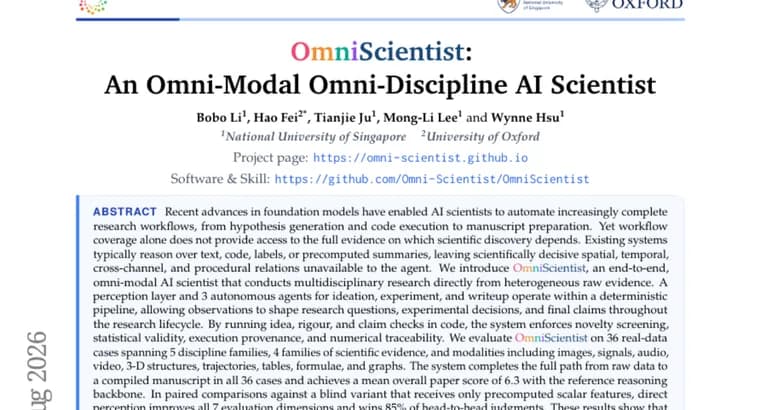
A paper introduces OmniScientist, an end-to-end, omni-modal AI scientist built to conduct multidisciplinary research directly from heterogeneous raw evidence rather than from text, code, labels or precomputed summaries. The authors argue that existing AI-scientist systems, even ones that automate a fairly complete research workflow from hypothesis generation through code execution to manuscript writing, still miss scientifically decisive spatial, temporal, cross-channel and procedural relations because they only reason over already-processed inputs.
OmniScientist's architecture pairs a perception layer with three autonomous agents, one each for ideation, experiment and writeup, running inside a deterministic pipeline. Raw observations are meant to shape the research question, the experimental decisions and the final claims at every stage of that pipeline, not just at the start. The system also runs idea, rigour and claim checks in code, which the authors say enforces novelty screening, statistical validity, execution provenance and numerical traceability.
The evaluation covers 36 real-data cases spanning 5 discipline families and 4 families of scientific evidence, with modalities including images, signals, audio, video, 3-D structures, trajectories, tables, formulae and graphs. OmniScientist completed the full path from raw data to a compiled manuscript in all 36 cases and reached a mean overall paper score of 6.3 using what the paper calls its reference reasoning backbone, a model the text does not name. In paired comparisons against a blind variant of the same system that receives only precomputed scalar features instead of the raw evidence, the direct-perception version improved all 7 evaluation dimensions and won 85% of head-to-head judgments.
The authors conclude that perception spanning the whole research lifecycle, not just workflow automation, is essential for evidence-grounded scientific discovery, and that this is a practical path toward AI scientists capable across many fields.
Key facts
- OmniScientist completed the full path from raw data to a compiled manuscript in all 36 real-data test cases, spanning 5 discipline families.
- Its architecture combines a perception layer with three autonomous agents, for ideation, experiment and writeup, running in a deterministic pipeline.
- The system reached a mean overall paper score of 6.3 with its reference reasoning backbone, a model the paper does not name.
- Against a blind variant that receives only precomputed scalar features, direct perception improved all 7 evaluation dimensions and won 85% of head-to-head judgments.
- The 36 test cases covered 4 families of scientific evidence and modalities including images, signals, audio, video, 3-D structures, trajectories, tables, formulae and graphs.
Why it matters
Prior AI-scientist systems automate the steps of research, hypothesis, code, manuscript, but still reason mainly over text, code, labels or precomputed summaries. The paper's argument is that this leaves out spatial, temporal, cross-channel and procedural relations that can only be read from the raw evidence itself, such as an image, a signal trace or a 3-D structure. OmniScientist's contribution is building perception of that raw evidence into every stage of the research pipeline, from framing the question to writing the final claims, rather than treating perception as a one-off preprocessing step.
Who it affects
The work targets researchers building autonomous or AI-assisted research agents, and by extension scientists in the fields the evaluation covers: 5 discipline families and 4 families of scientific evidence, from images and audio to 3-D structures and graphs. It is a research system rather than a deployed tool for working scientists today.
How to use it
This is a research paper describing a system design and its evaluation, not a product announcement. The source text does not mention a code or data release, so there is nothing here to install or try directly; readers can only evaluate the described architecture and results as reported.
How solid is it
The headline result, completing all 36 real-data cases end to end with a mean paper score of 6.3, comes from a single evaluation set on one reference reasoning backbone that the paper does not identify. The strongest comparison offered is an ablation: a blind variant of the same system that gets only precomputed scalar features instead of raw evidence loses on all 7 evaluation dimensions, and the full system wins 85% of head-to-head judgments against it. That isolates the effect of direct perception convincingly, but it is a comparison against itself, not against other named AI-scientist systems.
Risks and caveats
The abstract names no authors or institutions and gives no publication date, so provenance can't be independently checked from the text alone. The comparison is limited to the system's own blind ablation; no other AI-scientist system is benchmarked against it. The reasoning backbone behind the 6.3 score is not identified, and no code or data release is mentioned, which limits how far the reported numbers can be verified or reproduced by outside readers.