Open Vision Banana adapts Qwen-Image-2.1 into one depth and segmentation model
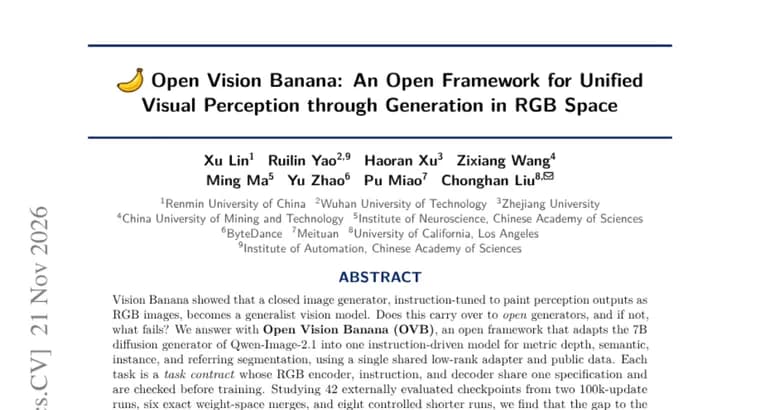
Vision Banana showed that a closed image generator, instruction-tuned to paint perception outputs as RGB images, becomes a generalist vision model. The paper behind Open Vision Banana (OVB) asks whether that carries over to open generators and, if not, what fails.
OVB is an open framework that adapts the 7B diffusion generator of Qwen-Image-2.1 into one instruction-driven model. It handles metric depth, semantic segmentation, instance segmentation and referring segmentation, using a single shared low-rank adapter and public data. Each task is written as a task contract: the RGB encoder, the instruction and the decoder share one specification, and the contract is checked before training starts.
To locate the gap to the closed system, the authors studied 42 externally evaluated checkpoints from two 100k-update runs, six exact weight-space merges and eight controlled shorter runs. They conclude that the gap is specific and measurable.
The first finding is that geometry is learned early while absolute scale is not. Median-aligned NYUv2 delta_1 stays between 0.89 and 0.93 throughout training, while unaligned delta_1 wanders between 0.11 and 0.50. Scale is also not committed by a single sample: a ten-seed ensemble lifts unaligned delta_1 from 0.348 to 0.516 without any retraining.
The second finding is a conflict between tasks. Depth and 2D segmentation compete for the shared adapter, and weight merging moves along this trade-off without escaping it.
The third is about checkpoint selection. Lower validation flow loss comes with lower Cityscapes accuracy, with a Spearman correlation of about -0.9 between loss reduction and mIoU (written as approx -0.9 in the source). So the loss cannot be used to pick checkpoints.
The authors release code, contracts, training data and all evaluation outputs.
Key facts
- OVB adapts the 7B diffusion generator of Qwen-Image-2.1 into one instruction-driven model for metric depth, semantic, instance and referring segmentation, with a single shared low-rank adapter and public data.
- Median-aligned NYUv2 delta_1 stays at 0.89 to 0.93 during training, but unaligned delta_1 wanders between 0.11 and 0.50: geometry is learned early, absolute scale is not.
- A ten-seed ensemble lifts unaligned delta_1 from 0.348 to 0.516 without retraining.
- Depth and 2D segmentation compete for the shared adapter, and weight merging moves along the trade-off without escaping it.
- Lower validation flow loss goes with lower Cityscapes accuracy (Spearman about -0.9 between loss reduction and mIoU), so loss cannot select checkpoints.
Why it matters
Vision Banana showed that a closed image generator, tuned to paint perception outputs as RGB images, can act as a generalist vision model. OVB tests whether the same recipe works with an open generator, and reports where it breaks: absolute depth scale, competition between depth and segmentation, and unreliable validation loss.
Who it affects
The paper concerns anyone trying to repeat the Vision Banana approach with an open generator. It uses the 7B diffusion generator of Qwen-Image-2.1 as the base and covers four tasks: metric depth, semantic, instance and referring segmentation.
How to use it
The authors release code, contracts, training data and all evaluation outputs. The task contract idea is part of the method: the RGB encoder, instruction and decoder for each task share one specification that is checked before training. For practical choices, the paper reports that a ten-seed ensemble raises unaligned delta_1 from 0.348 to 0.516 without retraining, and that validation flow loss should not be used to select checkpoints.
How solid is it
This is a preprint listed on Hugging Face papers, and the account here rests on its abstract. The abstract names no authors or institutions. The evidence base is sizeable on its face: 42 externally evaluated checkpoints from two 100k-update runs, six exact weight-space merges and eight controlled shorter runs. Evaluation outputs are released. No final benchmark scores for OVB versus Vision Banana are given; only the gap is described as specific and measurable.
Risks and caveats
Depth and 2D segmentation compete for the single shared adapter, so gains on one task come at a cost to the other. Absolute scale remains the weak point: unaligned delta_1 ranges from 0.11 to 0.50 during training and reaches 0.516 only with a ten-seed ensemble. The source does not say whether the Spearman correlation is for one run or pooled across runs. No release link, license or model-weights availability is stated; only code, contracts, training data and evaluation outputs are said to be released.