Open Vision Banana releases a fully open recipe for generator-based perception
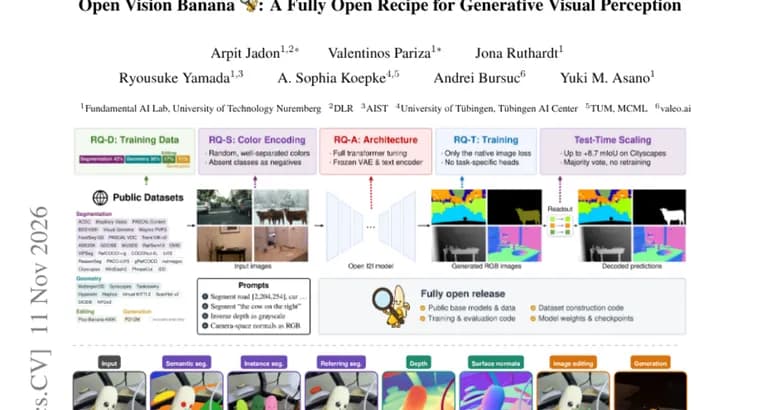
Recent work suggests that pretrained image generators encode real-world understanding beyond image synthesis. One system, Vision Banana, exploits this by framing vision tasks as conditional image editing. The authors of this paper point out that Vision Banana's data, weights, code and implementation details are not public. Their answer is Open Vision Banana (OVB), a fully open and reproducible recipe for converting pretrained generators into unified multi-task perception systems.
The authors' analyses identify the design choices that matter most for generalization: color encoding, prompt design, parameter adaptation and task balancing. These choices interact, so a choice that helps on its own can hurt when combined with others.
OVB starts from open-weight base models with 4B and 9B parameters and uses 2.1M-3.8M training pairs from public datasets. On Cityscapes zero-shot performance it reaches 73.9 mIoU, against 69.9 mIoU for Vision Banana's reported result. The authors also say it rivals state-of-the-art affine-invariant depth estimators. OVB's non-zero-shot variants come within five points of Vision Banana on referring and reasoning segmentation, but remain further behind on instance segmentation. All models largely retain the base model's image-editing abilities.
The paper also introduces legend ensembling, a test-time scaling method for generator-based perception. It segments an image under several class-color legends and fuses the results by majority vote, which corrects unstable color-class bindings. Without any retraining, it improves mIoU by up to 8.7 points on Cityscapes and 15.0 points on COCO-Object.
The authors release the dataset construction and processing pipeline, the training and evaluation code, and the final, intermediate and ablation checkpoints. A project website is at openvisionbanana.github.io.
Key facts
- Open Vision Banana (OVB) is a fully open, reproducible recipe for turning pretrained image generators into unified multi-task perception systems by framing vision tasks as conditional image editing.
- Starting from 4B and 9B parameter open-weight base models and 2.1M-3.8M public training pairs, OVB reports 73.9 mIoU on Cityscapes zero-shot, against 69.9 for Vision Banana's reported result.
- Non-zero-shot variants come within five points of Vision Banana on referring and reasoning segmentation, but remain further behind on instance segmentation.
- Legend ensembling, a test-time method that fuses segmentations under several class-color legends by majority vote, improves mIoU by up to 8.7 points on Cityscapes and 15.0 points on COCO-Object without retraining.
- The authors release the data pipeline, training and evaluation code, and final, intermediate and ablation checkpoints.
Why it matters
The starting premise is that image generators already hold real-world understanding that can be used for perception, and Vision Banana showed one way to tap it by treating vision tasks as conditional image editing. But Vision Banana's data, weights, code and implementation details are not public, so others could not reproduce or study it. OVB offers an open version of the recipe. The paper's analysis of what drives generalization (color encoding, prompt design, parameter adaptation, task balancing) and its warning that these choices interact is useful to anyone building on this approach.
Who it affects
Mainly researchers and engineers working on segmentation, depth estimation and other perception tasks who want to build on generator-based models. Anyone who wanted to reproduce or extend Vision Banana, which has no public data, weights or code, now has an open alternative to start from.
How to use it
The authors release the dataset construction and processing pipeline, the training and evaluation code, and the final, intermediate and ablation checkpoints. The project website is https://openvisionbanana.github.io. Legend ensembling is a test-time method: it needs no retraining, and segments an image under several class-color legends before fusing the results by majority vote. Licence terms of the released code, data and checkpoints are not stated in the source.
How solid is it
This is a preprint abstract with specific benchmark numbers, and the code and checkpoints are said to be released, so the results can in principle be checked. The headline comparison is against Vision Banana's reported Cityscapes zero-shot figure (73.9 vs. 69.9 mIoU), not a head-to-head rerun. The abstract names no authors or institutions.
Risks and caveats
The gains are not uniform. OVB's non-zero-shot variants are within five points of Vision Banana on referring and reasoning segmentation but remain further behind on instance segmentation. The design choices interact, so individually helpful settings can hurt when combined, which makes copying one choice in isolation risky. The base models are not named, only their sizes (4B and 9B parameters). No numeric results are given for depth estimation beyond the claim that OVB rivals state-of-the-art affine-invariant depth estimators. The Cityscapes and COCO-Object gains from legend ensembling are stated as 'up to', not typical figures.
“These choices interact, so individually helpful choices can hurt when combined with others.”
— Open Vision Banana abstract