OpenAI's Navier-Stokes claim splits mathematicians at Heidelberg forum
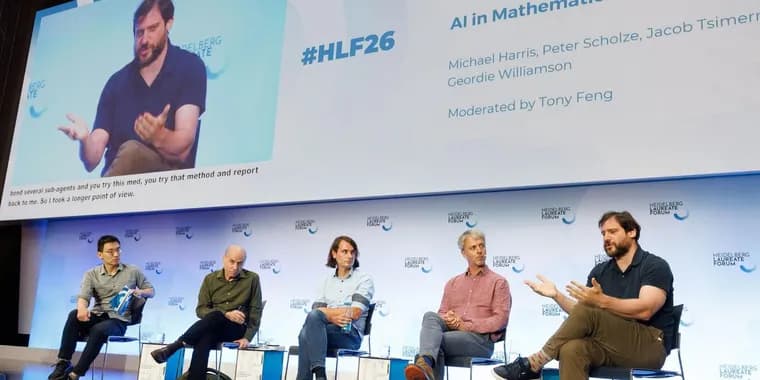
IEEE Spectrum's Benjamin Skuse reports from the annual Heidelberg Laureate Forum in Germany, a week-long gathering of leading and up-and-coming mathematicians and computer scientists that began on 13 September. The author writes that, unlike at past editions, nearly every conversation was about how AI companies such as OpenAI, Anthropic and Google are pushing through mathematics. Maths suits AI as a testing ground because it involves step-by-step logical reasoning and answers that can be checked automatically and objectively.
The article traces the pace of change: AI went from struggling with everyday research-level problems to solving a raft of problems posed by Paul Erdős, then verifying the proof of Fermat's Last Theorem, and most recently OpenAI announcing it had solved the Navier-Stokes existence and smoothness problem. Of the seven Millennium Prize Problems posed by the Clay Mathematics Institute in 2000, only one, the Poincaré conjecture, has been solved by humans so far. OpenAI's claim to have solved a second would, if verified, be a watershed moment for automated reasoning, the article says. Young researcher Ailsa Robertson of the University of Amsterdam put it this way: "AI and LLMs set the math community on fire over summer."
Fields Medalist Jacob Tsimerman of the University of Toronto, speaking at a press conference, acknowledged the achievement: capabilities have risen faster than many people, himself included, expected. He said he does not know the details, but that solving Navier-Stokes "feels pretty definitive."
Rumours now swirl about which Millennium Problem comes next. The Riemann hypothesis is one candidate: in August, Anthropic quietly used an unreleased version of Claude on it, making important progress on a related problem but not on its main mission. OpenAI is reportedly focusing on the Hodge conjecture. Many mathematicians see it as inevitable that at least some of these problems will be solved soon. The author suggests the companies target these problems to verify their systems' capabilities and to show users and investors how powerful the technology is. Fields Medalist Peter Scholze of the University of Bonn, speaking on a panel about AI in mathematical research, was blunter: "They're really just solving these difficult mathematical problems as benchmarks, as some kind of PR stunt."
The same panel included Michael Harris of Columbia University and Geordie Williamson of the University of Sydney, alongside Scholze and Tsimerman. For them, the problems researchers now face stem from tech giants not adhering to the norms and values of the mathematics community, and the Navier-Stokes announcement exemplified that. Williamson said OpenAI "behaved extremely poorly" and that the community should acknowledge it. Harris received what New York University mathematician Tristan Buckmaster, who was making significant progress on Navier-Stokes with Anthropic staffer Levent Alpöge, claimed was correspondence between Harris and OpenAI that appeared coercive, censorious and even threatening. Harris said he trusted Buckmaster's account and did his part in promoting that narrative, and that most media and social media reports are consistent with his takeaway: they depict OpenAI as bullying and disrupting disciplinary norms. OpenAI did not respond to requests for comment before publication.
Williamson also worries about what the summer's progress does to the field. The community wants understanding but measures it against unsolved problems, and he says these two measures are quickly becoming uncorrelated, because AI solutions may give an answer without usually developing understandable or useful new methods. That forces a rethink of how people are assessed, who gets jobs and how people are educated.
The article closes on the pressure on ordinary researchers. Mita Ramabulana of the University of Cape Town said two of the 10 advances in mathematics that OpenAI announced in August overlapped with his own work, which left him disappointed, since anyone might now plug a problem into an LLM and solve it. He worries that unscrupulous researchers use LLMs to scoop others or gain advantage. Robertson, who is studying for a Ph.D. in quantum-safe cryptography, says all her mathematics colleagues now use LLMs intensively, many maxing out Pro subscriptions and some spending thousands of euros on extra tokens, though they are Ph.D. students without that money. Some feel coerced by moves such as OpenAI's July announcement of 100,000 free licenses to its frontier models for academic researchers; others feel they have no choice, because those who work slower than LLMs allow will fall behind peers applying for the same jobs. Partly for this reason, her Ph.D. is now much less mathematics-heavy and focused on the societal implications of moving to a quantum-safe ecosystem, because she does not want a career spent verifying LLM output.
Key facts
- OpenAI announced it solved the Navier-Stokes existence and smoothness problem, one of the seven Millennium Prize Problems; the article says it would be a watershed moment for automated reasoning only if verified.
- Only one Millennium Problem, the Poincaré conjecture, has been solved by humans. Anthropic reportedly tried the Riemann hypothesis in August with an unreleased Claude, and OpenAI is reportedly focusing on the Hodge conjecture.
- Geordie Williamson said OpenAI behaved extremely poorly; Peter Scholze called such problem-solving a likely PR stunt and benchmarking exercise. OpenAI did not respond to requests for comment.
- Tristan Buckmaster claimed Michael Harris received correspondence from OpenAI that appeared coercive and threatening; Harris said he trusted that account.
- Young researchers describe pressure to use LLMs heavily, with some colleagues spending thousands of euros on extra tokens, and worry about careers spent verifying LLM output.
Why it matters
Only one of the seven Millennium Prize Problems, posed by the Clay Mathematics Institute in 2000, has been solved by humans. If OpenAI's Navier-Stokes claim holds up, it would be a second, and the first by an AI system. Tsimerman said it feels pretty definitive. The article also shows a field arguing over more than one result: how companies announce and behave, and whether solving open problems still tracks the understanding mathematicians actually want. Williamson says those two things are quickly becoming uncorrelated.
Who it affects
Working mathematicians, especially early-career ones. Ramabulana saw two of OpenAI's 10 August advances overlap with his own work and worries about being scooped. Robertson says colleagues feel pressure to use LLMs heavily to keep pace in the job market, and she has shifted her Ph.D. toward societal questions. Williamson says hiring, assessment and education all need to be rethought. AI labs, including OpenAI, Anthropic and Google, are the other side of the story, as are the investors and users the article says they want to impress.
How to use it
This is a report on a debate, not a tool, so there is nothing to adopt. What a reader can take from it: the article describes academic researchers being offered 100,000 free licenses to OpenAI's frontier models (announced in July), while Robertson says heavy users are maxing out Pro subscriptions and some spend thousands of euros on additional tokens. Anyone following the Millennium Problems can watch the Riemann hypothesis and the Hodge conjecture, the two named as likely next targets.
How solid is it
The central claim is unverified. The article says OpenAI's Navier-Stokes solution would be a watershed moment only "if verified", and it does not describe the proof or give the date of the announcement. Tsimerman says he does not know the details. The account of OpenAI's conduct rests on Buckmaster's claim about correspondence with Harris, which the article does not reproduce, plus Harris's reading of media reports. OpenAI did not respond to requests for comment. Scholze's PR-stunt remark is his opinion about the companies' motives. The Anthropic Riemann attempt and the OpenAI Hodge focus are reported as rumour or as the author's statement, with no model version or detail given.
Risks and caveats
The piece is a conference report built on panel remarks and interviews, and its tone leans toward the critics. The reported risks are professional rather than technical: young researchers feeling coerced into costly AI use, scooping of their work with LLMs, and a gap between solving problems and building understanding. Williamson notes that AI solutions often give an answer without developing new methodology that is understandable or useful. The article does not give a timescale for further Millennium Problems falling beyond 'soon', and it offers no response from OpenAI.
“What we want as a mathematical community is understanding, but we measure this against unsolved problems, and the problem is that these two measurements are very, very quickly becoming uncorrelated”
— Geordie Williamson, University of Sydney