OpenWAM turns world-action model pretraining into a controlled experiment
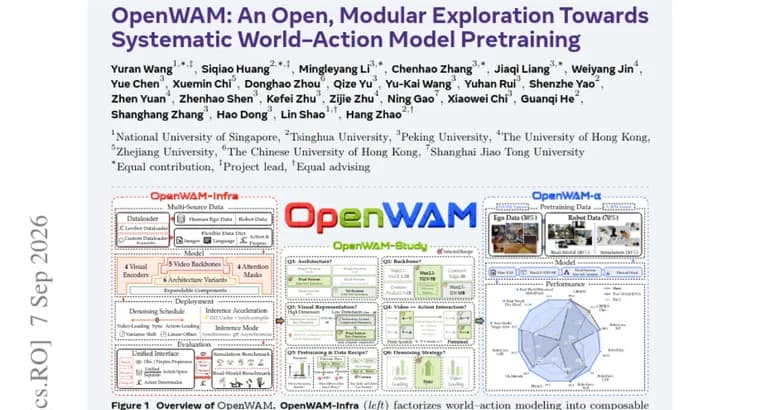
World-Action Models (WAMs) inherit knowledge about the physical world from video-generative models and turn it into control signals for an embodied agent through hands-on experience. The authors argued that existing WAM systems are monolithic: the generative backbone, visual representation, architecture, information flow, inference procedure and training data are all tightly coupled, which obscures which individual design choices actually matter and why.
To address this, the authors introduced OpenWAM, an open research stack that turns WAM pretraining into a controlled experimental program rather than a single fixed design. OpenWAM-Infra factorizes the WAM design space into composable modules with unified training, inference, deployment and evaluation, letting individual components be swapped and compared. Built on this substrate, OpenWAM-Study examined three questions through controlled experiments: what knowledge to inherit from generative pretraining, how world modeling and action learning interact, and how their synergy scales. From these experiments the authors distilled three principles: upstream knowledge transfers best through a sufficiently capable generative backbone paired with a compact, information-rich latent space; world-action synergy requires dedicated action capacity, an explicit information flow from world to action, and synchronized joint denoising; and embodied pretraining mainly improves out-of-domain generalization, with one-stage co-training over egocentric human and robot data integrating world coverage and action grounding.
Applying these principles, the authors built OpenWAM-α, a WAM pretrained on roughly 6,400 hours of egocentric human and robot data. They evaluated it across eight simulation benchmarks and a set of real-robot experiments, together spanning embodiments from single-arm and bimanual manipulation to dexterous hands. The authors reported that OpenWAM-α delivered consistently excellent performance and sustained its top-tier standing when moving from simulation to the physical world; the abstract gives no accuracy or success-rate numbers for these results, describing them only in these qualitative terms, and it does not name the individual benchmarks or the real-robot setup used.
The authors released the full stack, including the infrastructure, the evaluation protocols, the pretrained models and the data recipes, to support future research into world-action model pretraining. The abstract does not name the authors or their institution, gives no release date or timeline, and does not identify any specific prior system by name despite describing existing WAM systems as monolithic.
Key facts
- OpenWAM is an open, modular research stack that turns world-action model (WAM) pretraining into a controlled experimental program, addressing what the authors called the monolithic design of existing WAM systems, where the backbone, architecture, information flow and training data are tightly coupled.
- OpenWAM-Infra factorizes the WAM design space into composable modules with unified training, inference, deployment and evaluation; on that base, OpenWAM-Study ran controlled experiments on three questions and distilled three design principles.
- Applying those principles, the authors built OpenWAM-α, a WAM pretrained on roughly 6,400 hours of egocentric human and robot data.
- OpenWAM-α was evaluated across eight simulation benchmarks and real-robot experiments spanning single-arm and bimanual manipulation to dexterous hands, with the authors reporting consistently top-tier performance from simulation to the physical world.
- The authors released the full stack, infrastructure, evaluation protocols, pretrained models and data recipes, to support future research; the abstract names no authors, institution, release date or specific benchmarks.
Why it matters
World-Action Models promise to turn the broad knowledge inside video-generative models into concrete control signals for embodied agents, but each WAM project has typically built that pipeline as a single tightly coupled system, so it has been unclear which specific design choices (the backbone, the latent space, how action information flows, the training data mix) were actually doing the work. OpenWAM reframed WAM pretraining as a controlled experimental program: a shared, modular infrastructure (OpenWAM-Infra) let the authors swap one design axis at a time and measure the effect, and the resulting study distilled that into three explicit design principles rather than folklore passed between papers. That is useful well beyond this one paper. It gives the field a validated set of design choices to start from instead of every group re-deriving them by trial and error.
Who it affects
The direct audience is researchers building embodied AI and robot-learning systems, especially anyone working on world models, video-generative pretraining, or action pretraining for robots. Teams that want a ready pretrained backbone rather than a full research platform can use OpenWAM-α directly: it was evaluated across embodiments from single-arm and bimanual manipulation to dexterous hands, so it is meant to generalize across different robot forms rather than one specific setup.
How to use it
The authors said they released the full stack, including the infrastructure (OpenWAM-Infra), the evaluation protocols used in OpenWAM-Study, the pretrained models (including OpenWAM-α) and the data recipes behind the roughly 6,400 hours of training data, for other researchers to build on. The abstract gives no release date or timeline for that release.
How solid is it
The three design principles came out of OpenWAM-Study's controlled experiments on a shared, modular infrastructure, which is stronger evidence than results from a single end-to-end system, since individual design axes could be isolated and compared directly. OpenWAM-α itself was checked across eight simulation benchmarks and real-robot experiments spanning several embodiments, a reasonably broad test bed. That said, the abstract reports the results only qualitatively, as 'consistently excellent performance' and a 'top-tier standing' sustained from simulation to the physical world, without accuracy, success-rate or other quantitative figures, and without naming the specific benchmarks or the real-robot setup used. That makes the size of the claimed advantage impossible to check from the abstract alone.
Risks and caveats
The abstract does not name any specific prior or existing WAM system, even though it describes existing systems as monolithic. That means the comparison cannot be checked against a concrete baseline. It also does not name the authors or their institution, which limits any independent check of who did the work. Performance is reported only in qualitative terms, so readers should treat 'consistently excellent' and 'top-tier' as the authors' own characterization of the results rather than as independently verifiable numbers until fuller results are available.