β-OPSD reframes self-distillation as a tunable policy-optimization family
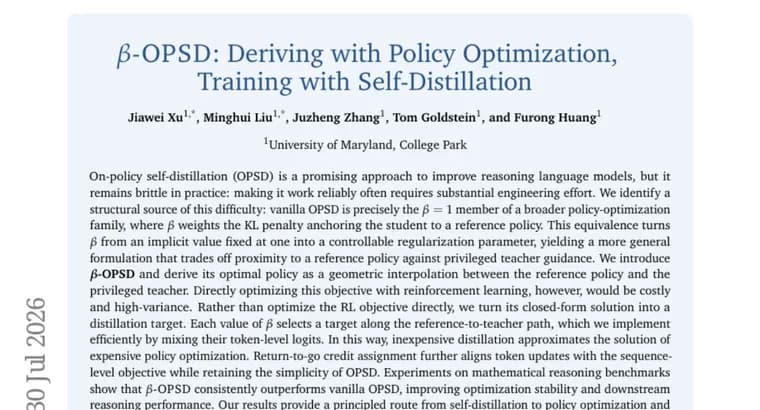
On-policy self-distillation (OPSD) has become a promising way to improve reasoning language models, but the authors say it remains brittle in practice: getting it to work reliably often takes substantial engineering effort. Their paper traces this brittleness to a structural cause: vanilla OPSD is just the case where a parameter called beta is fixed at 1, inside a wider family of policy-optimization methods where beta weights the KL penalty that anchors the student model to a reference policy. Once beta is unlocked as a controllable regularization parameter rather than an implicit constant, it becomes a knob that trades off staying close to the reference policy against following privileged guidance from a teacher model. The authors call this generalized method beta-OPSD (written β-OPSD) and derive its optimal policy as a geometric interpolation between the reference policy and the teacher. Directly optimizing that objective with reinforcement learning would be costly and high-variance, so instead of running RL, the authors turn the closed-form solution into a distillation target: each value of beta picks a target along the path from reference to teacher, implemented efficiently by mixing the two models' token-level logits. This lets inexpensive distillation approximate what expensive policy optimization would otherwise compute. The method also adds return-to-go credit assignment, which aligns token-level updates with the sequence-level training objective while keeping the simplicity of OPSD. On mathematical reasoning benchmarks, the authors report that beta-OPSD consistently outperforms vanilla OPSD, improving both optimization stability and downstream reasoning performance. The paper does not name the specific benchmarks or models used, does not report the size of the improvement in numbers, and does not name author affiliations.
Key facts
- Vanilla on-policy self-distillation (OPSD) is shown to be the beta=1 special case of a broader family of policy-optimization methods, where beta weights the KL penalty tying the student to a reference policy.
- The generalized method, beta-OPSD, derives an optimal policy as a geometric interpolation between the reference policy and a privileged teacher, controlled by beta.
- Instead of optimizing that objective directly with reinforcement learning, which the authors say would be costly and high-variance, they convert its closed-form solution into a distillation target implemented by mixing token-level logits.
- A return-to-go credit assignment mechanism aligns token-level updates with the sequence-level training objective while keeping OPSD's simplicity.
- On mathematical reasoning benchmarks, beta-OPSD consistently outperforms vanilla OPSD on both optimization stability and downstream reasoning performance, though no specific benchmark names or numeric results are given.
Why it matters
On-policy self-distillation is one of the more promising cheap ways to train reasoning language models, since it avoids the cost and variance of full reinforcement learning. But practitioners have found it brittle: getting stable results often takes heavy engineering. This paper's contribution is diagnostic as much as practical: it shows that the standard version of OPSD was silently sitting at one fixed point (beta=1) of a larger family of methods, and that exposing beta as a tunable parameter gives a principled way to trade reference-policy proximity against teacher guidance, which the authors report improves stability.
Who it affects
The work is aimed at researchers and engineers building reasoning language models with distillation-based training pipelines, particularly teams currently relying on on-policy self-distillation and running into instability. It is a training-method paper, not a released model or product, so it does not directly affect end users of AI tools.
How to use it
The paper describes a method rather than a released tool, model or service: beta-OPSD is implemented by mixing the token-level logits of a reference policy and a teacher policy according to the beta parameter, plus a return-to-go credit assignment step, layered on top of an existing OPSD-style training setup. No code release, licensing terms, or pricing are mentioned in the source.
How solid is it
The core claim, that beta-OPSD consistently outperforms vanilla OPSD, rests on the authors' own experiments on mathematical reasoning benchmarks. The source text does not name which benchmarks or models were used, nor does it give numeric results, so the size of the improvement cannot be independently assessed from what is available here. The theoretical derivation, that vanilla OPSD is the beta=1 case of a broader family with a closed-form optimal policy, is presented as a formal result rather than an empirical one.
Risks and caveats
The source provides no benchmark names, datasets, model sizes, quantitative results, author affiliations, or details of how the token-level logit mixing is implemented in practice beyond the general description; it also gives no information on compute cost or training duration for the reported experiments. All performance claims come from the authors' own paper, with no independent replication described.