Optical computing startups Lumai and Neurophos target AI inference power
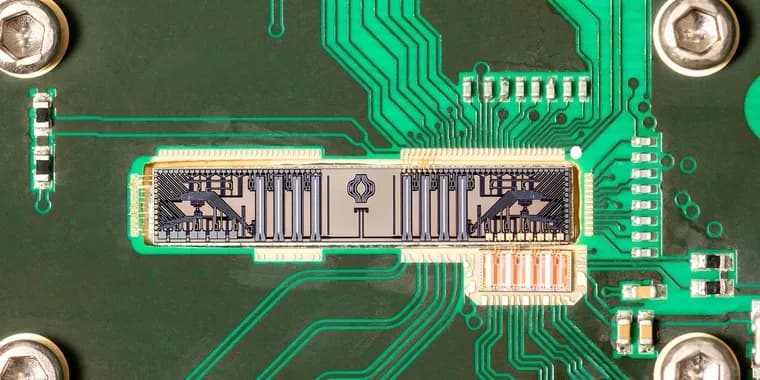
IEEE Spectrum reports that computing with light, an idea more than 70 years old and long confined mostly to research, has become a fast-growing industry. The article says the market valuation of optical-computing companies now totals US $2.22 billion, up from $0.4 billion in 2022, and that one projection suggests exponential growth in the coming years. The driver is AI, and inference in particular: answering user queries has pushed the construction of huge, power-hungry data centers, and relatively energy-efficient optical systems are seen as a potential way forward. Peter McMahon, associate professor of applied and engineering physics at Cornell University, who has researched optical computing for over a decade, says most of the interest in photonics comes from the fact that AI inference has become limited by power, "in a rather striking manner." Startups are appearing in the United States, China, Germany and Israel. Competing with GPU makers such as Nvidia is ambitious, the article says, but the investment has also spurred complementary work: alternative AI algorithms, scientific computing and in-network computing. Optalysys, based in England, is inserting optical elements into the networking path, where data centers already use light.
The technical case rests on one operation, matrix-vector multiplication, done countless times a second in inference. In 1978 the pioneer Joseph W. Goodman and coworkers proposed doing it with light. A row of N light-emitting diodes encodes a vector as brightness; a cylindrical lens copies it N times; the light passes through an N by N attenuator whose pixels encode the matrix, which performs the multiplication; a second, perpendicular lens sums each row; and detectors read the result. In electronics, an N by N matrix times a length-N vector takes N squared multiplications, each costing energy, so energy scales as N squared. In optics the multiplication step is passive as long as the matrix stays the same, and the only costs are encoding the vector and reading the answer, so energy scales as N.
Optical components have improved a lot since 1978. In 2022 a Cornell team led by McMahon demonstrated an optical neural network that used less than one photon of energy, about 2.5 x 10^-19 joules, per multiplication. A standard computer can spend between 10^-14 and 10^-12 joules on one multiply, which hints at a possible 100,000-fold energy cut. McMahon warns against that extrapolation. First, the cost of encoding data into optics was left out. Scaling is not the whole story, because the coefficients matter too: if an electronic multiplication costs 1 picojoule and encoding one vector element in optics costs 1,000 picojoules, electronics still wins for vectors shorter than 1,000 elements. McMahon says this example is not far from reality, and that the "very rough answer" for how big a system must be before optics wins is somewhere between N equals 1,000 and N equals 10,000. Second, Amdahl's law applies: if a technique accelerates 90 percent of the code but not the other 10 percent, the maximum speedup is 10x. Inference aims to save energy rather than time, but the point still holds, since matrix multiplication is only part of the workload and nonlinear operations must also be performed. Taking all this into account, optical-computing companies are aiming for a 10- to 80-fold energy-efficiency improvement over today's GPUs. The open question is whether they can deliver at scale before traditional electronics catches up.
Lumai, based in Oxford, England, took perhaps the most direct inspiration from Goodman. Head of product Phillip Burr says a free-space approach, with light travelling through air rather than on-chip waveguides, is what will let the company beat GPUs. Instead of a fixed attenuator, Lumai uses a programmable spatial light modulator, a pixelated membrane akin to a liquid-crystal display that can modulate both intensity and phase. A vector is encoded into light, copied N times by a lens, passed through the modulator, collected by another lens and converted back to digital electronics, which handle the nonlinear functions. Burr says a full vector-matrix multiply completes in a single optical cycle. Lumai and others focus on the compute-intensive prefill phase of inference (processing the input query), not decode (generating output token by token), which is limited more by memory reads. Lumai says its Iris Nova optical server, available for evaluation since April 2026, is a proof of concept, and that its next-generation Iris Aura server will do prefill with roughly one-tenth of the energy a GPU would use.
Neurophos, based in Austin, Texas, puts a different spin on the Goodman design by using metamaterials, structures that manipulate light at sub-wavelength scales. Its structures are bigger than a wavelength but only several micrometers per side. CEO Patrick Bowen says the optical transistor equivalent from standard silicon photonics is about 2 millimeters long, so too few fit on a chip to compete on compute density with TSMC's best. Neurophos built metamaterial modulators that program the phase and intensity of light at micrometer scale, giving an array of 1,000 by 1,000 modulators on a square chip with 5-mm sides. Bowen says they switch over 10,000 times as fast as a standard liquid-crystal spatial light modulator. He says the company targets 50 times the speed and 35 times the energy efficiency of Nvidia's Blackwell B200, with a road map to 250 times the speed and roughly 90 times the efficiency in later generations. The approach is CMOS-compatible, Bowen says, which should allow manufacturing on existing high-volume lines. Neurophos is choosing a site for a production facility ahead of rack deliveries to customers in 2028.
Both Lumai and Neurophos are betting they can reach market before conventional CMOS closes the energy gap. Burr says silicon will keep improving, but digital efficiency gains now come slowly and at rising cost, while optics offers a different scaling relationship in which efficiency improves as matrices grow. Logan Wright, assistant professor of applied physics at Yale University and a former postdoc in McMahon's lab, says it would be good for the technology if many companies made a good run at it, and that what gets developed could enable photonic systems that do special things beyond the AI wave.
Key facts
- Market valuation of optical-computing companies totals US $2.22 billion, up from $0.4 billion in 2022, per the article.
- A 2022 Cornell experiment led by Peter McMahon used about 2.5 x 10^-19 joules per multiplication, hinting at a 100,000-fold saving, but McMahon says the figure leaves out data-encoding costs and optics likely wins only for vectors of roughly 1,000 to 10,000 elements.
- Companies are aiming for a 10- to 80-fold energy-efficiency gain over today's GPUs; Lumai says its next-generation Iris Aura server will use roughly one-tenth of a GPU's energy for prefill.
- Neurophos CEO Patrick Bowen targets 50 times the speed and 35 times the energy efficiency of Nvidia's Blackwell B200, with rack deliveries planned for 2028.
- Amdahl's law limits the gain: matrix multiplication is only part of inference, and nonlinear operations still run in electronics.
Why it matters
The article frames AI inference as the bulk of AI energy use and says it has become limited by power, which is what is pulling a decades-old idea into industry. If optics can do the same matrix math as GPUs at much lower power, it would address a main cost behind the build-out of large data centers. The article also notes that the investment is feeding side benefits: alternative AI algorithms, scientific computing and in-network computing.
Who it affects
Chipmakers such as Nvidia are the incumbents the startups measure themselves against. Data center operators facing power limits are the potential customers, with Neurophos planning rack deliveries in 2028 and Lumai offering its Iris Nova server for evaluation. Startups in the United States, China, Germany and Israel are entering the field, and researchers such as Yale's Logan Wright expect the technology to enable photonic systems beyond AI.
How to use it
Nothing here is a product a team can deploy today. Lumai's Iris Nova optical server was made available for evaluation in April 2026 and is described by the company as a proof of concept. Neurophos plans rack deliveries to customers in 2028. For readers tracking the field, the useful test from McMahon is system size: optics is expected to start winning somewhere between vector lengths of 1,000 and 10,000, and the energy cost of encoding data into light must be counted.
How solid is it
The physics and the scaling argument are explained in detail and the Cornell result is a 2022 experiment. The company figures are another matter: no independent benchmark or measured result for Lumai or Neurophos hardware is given, and the efficiency numbers are company targets or claims, such as Bowen's 50 times speed and 35 times efficiency versus the Blackwell B200 and Lumai's one-tenth energy claim for prefill. The source does not say which sources underlie the market valuation figure or the exponential growth projection.
Risks and caveats
McMahon cautions that the 100,000-fold figure leaves out the cost of encoding data into optics and that coefficients matter as much as scaling. Amdahl's law caps the gain because nonlinear operations cannot be done optically in the designs described, and the fraction of inference that optics can handle is below 100 percent. The central open question, in the article's words, is whether optical companies can deliver at scale before traditional electronics catches up to those gains. No timescale is given for when optics might overtake GPUs in production use.
“Most of the interest in [photonics] is driven by the fact that AI inference has literally become limited by power, and in a rather striking manner”
— Peter McMahon, associate professor of applied and engineering physics at Cornell University