PaperCritic trains an AI reviewer with RL to judge paper soundness
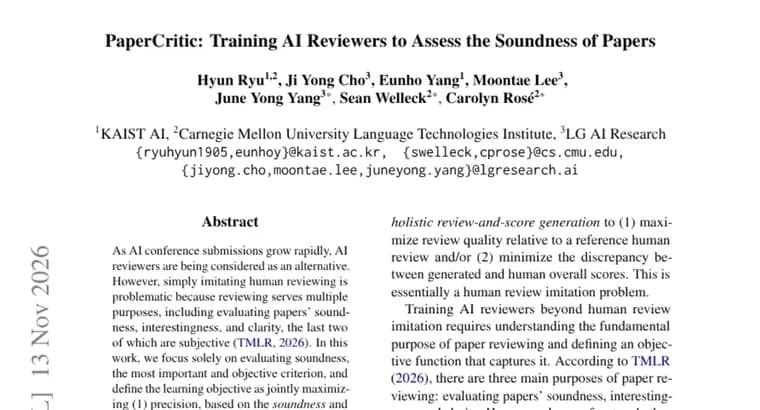
As AI conference submissions grow rapidly, AI reviewers are being considered as an alternative to human reviewing. The authors of this paper argue that simply imitating human reviewing is problematic, because reviewing serves several purposes: evaluating a paper's soundness, interestingness and clarity. The last two are subjective.
So the work focuses solely on soundness, which the authors call the most important and objective criterion. They define the learning objective as jointly maximizing two things: precision, based on the soundness and substantiveness of review points, and recall, meaning the coverage of high-quality reference review points.
Under this formulation the authors build a quality-labeled dataset of review points called PaperSound-23K. It uses 1K ICLR submissions and 23K review points, both human-written and LLM-generated. They then train an AI reviewer model, PaperCritic, through reinforcement learning, with the F1 score of precision and recall as the reward.
The authors report that PaperCritic outperforms frontier models and models trained with other AI reviewer training methods on an in-domain test set. They also call it surprising that learning to review ICLR submissions transfers to reviewing Nature-family papers, and even to out-of-domain reviewing tasks such as code review, legal contract review and feedback on story writing.
Key facts
- PaperCritic is an AI reviewer model trained with reinforcement learning, using the F1 score of precision and recall as the reward.
- It evaluates only soundness, which the authors call the most important and objective criterion, and leaves out the subjective axes of interestingness and clarity.
- The new PaperSound-23K dataset is built from 1K ICLR submissions and 23K human-written and LLM-generated review points, labeled for quality.
- On an in-domain test set, the authors report that PaperCritic outperforms frontier models and models trained with other AI reviewer methods.
- The authors say training on ICLR reviewing also transfers to Nature-family papers and to code review, legal contract review and story-writing feedback.
Why it matters
Conference submissions are growing quickly, and AI reviewers are being considered as an alternative to human reviewing. This work takes a narrower route than imitating human reviewers: it targets only soundness and rewards both precision (sound, substantive points) and recall (coverage of high-quality reference points). The reported transfer beyond ICLR, to Nature-family papers and to code, legal and story feedback, is the part the authors themselves call surprising.
Who it affects
The framing points mainly at conference organizers and reviewers facing rising submission counts, and at researchers building AI reviewing systems. The reported out-of-domain results also touch people who review code, legal contracts or creative writing.
How to use it
The source does not say whether the model or the dataset is released, so there is nothing concrete to download or run from this listing. Anyone building a reviewer could borrow the design idea: score review points for soundness and substantiveness, and reward the F1 of precision and recall.
How solid is it
This is a paper abstract as listed on Hugging Face Papers, so the claims are the authors' own, from their experiments. No numeric results are reported there: no F1, precision or recall figures and no margins over baselines. The frontier models and rival training methods are not named. The Nature-family and out-of-domain results come without figures, and it is not stated whether PaperCritic beats baselines there.
Risks and caveats
The work deliberately drops interestingness and clarity, so it does not cover the full job of a human reviewer. The headline win is on an in-domain test set. The source does not say how review points were quality-labeled or who did the labeling, and the size of the model and its base model are not stated. The transfer claims are reported without figures.