OraRL trains video AI faster and beats GPT-5 on spatial reasoning
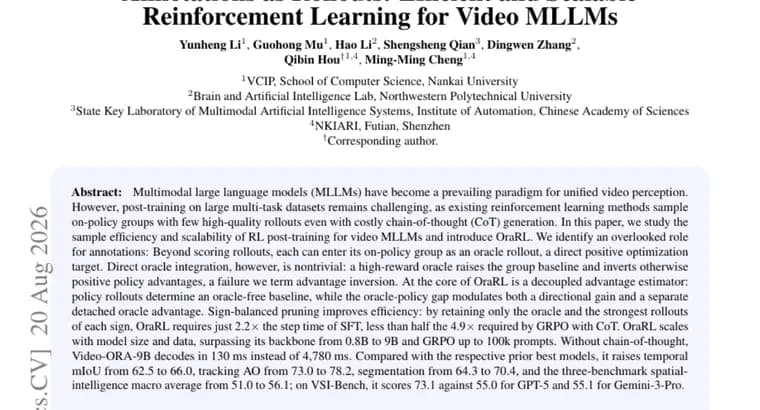
A paper posted to Hugging Face's papers feed studies why reinforcement-learning post-training for video multimodal large language models (MLLMs) stays sample-inefficient: existing RL methods sample on-policy groups that contain few high-quality rollouts, even when the model generates costly chain-of-thought (CoT) reasoning to get there. The authors introduce OraRL to fix this.
OraRL's core idea is to give annotations a second job. Normally an annotation only scores a rollout after the fact. OraRL also feeds each annotation into the on-policy group as an oracle rollout, a rollout the policy can be optimized toward directly. Doing this naively breaks the training signal, a failure the authors call advantage inversion: a high-reward oracle rollout raises the whole group's reward baseline, which flips otherwise-positive policy advantages negative. OraRL's fix is a decoupled advantage estimator: the ordinary policy rollouts alone set an oracle-free baseline, while the gap between the oracle and the policy separately drives both a directional gain and a detached oracle advantage, so the oracle no longer distorts the baseline the other rollouts are judged against.
On top of this, sign-balanced pruning keeps only the oracle rollout and the strongest rollouts of each sign (positive and negative) per group, dropping the rest. The authors report this makes OraRL cost just 2.2 times the per-step time of plain supervised fine-tuning (SFT), versus 4.9 times for GRPO run with chain-of-thought, so OraRL trains at under half the relative step cost of that CoT-based baseline.
The method is shown to scale: OraRL surpasses its own backbone model across sizes from 0.8B to 9B parameters, and it keeps beating GRPO as the prompt set grows to 100,000 prompts. The resulting 9B model, Video-ORA-9B, also runs faster at inference because it does not need chain-of-thought: it decodes in 130 milliseconds, versus 4,780 milliseconds for a chain-of-thought-based approach.
On benchmark scores, Video-ORA-9B raises temporal mIoU from a prior best of 62.5 to 66.0, tracking AO from 73.0 to 78.2, and segmentation from 64.3 to 70.4, and it lifts a three-benchmark spatial-intelligence macro average from 51.0 to 56.1. On VSI-Bench specifically, it scores 73.1, ahead of GPT-5 at 55.0 and Gemini-3-Pro at 55.1.
Key facts
- OraRL feeds annotations into the on-policy rollout group as an oracle rollout, a direct optimization target, rather than only using them to score rollouts.
- A decoupled advantage estimator fixes advantage inversion, the failure where a high-reward oracle rollout raises the group baseline and flips otherwise-positive advantages negative.
- Sign-balanced pruning keeps step cost to 2.2x that of plain SFT, versus 4.9x for GRPO run with chain-of-thought.
- OraRL scales across backbone sizes from 0.8B to 9B parameters and beats GRPO up to 100k prompts; the resulting Video-ORA-9B decodes in 130ms without chain-of-thought, versus 4,780ms with it.
- Video-ORA-9B scores 73.1 on VSI-Bench, ahead of GPT-5 (55.0) and Gemini-3-Pro (55.1), and raises temporal mIoU from 62.5 to 66.0, tracking AO from 73.0 to 78.2, and segmentation from 64.3 to 70.4.
Why it matters
RL post-training for video MLLMs has been bottlenecked by sample efficiency: on-policy sampling tends to produce few high-quality rollouts per group, even when the model is made to generate expensive chain-of-thought reasoning to improve them. OraRL's contribution is to stop treating annotations as pure judges and start using them as training targets in their own right, while solving the advantage inversion problem that naive versions of this idea run into.
Who it affects
The method targets teams training or post-training video MLLMs for tasks such as temporal localization, object tracking, video segmentation, and spatial reasoning, plus researchers working on RL sample efficiency more broadly. It is a training method described in a paper, not a shipped product.
How to use it
No pricing, license, or release details for code or weights are given in the text. What is specified is scale: the method is demonstrated on backbones from 0.8B to 9B parameters and on datasets up to 100k prompts. A practical payoff for anyone deploying the resulting model is inference speed: because Video-ORA-9B skips chain-of-thought at decode time, it responds in 130ms instead of the 4,780ms a chain-of-thought-based approach needs.
How solid is it
The paper backs its claims with head-to-head numbers against a stated prior best model on several benchmarks (temporal mIoU, tracking AO, segmentation, a spatial-intelligence macro average) and against GRPO with chain-of-thought on training cost, plus a direct VSI-Bench comparison against GPT-5 and Gemini-3-Pro. The text does not name the authors, their institutions, or a publication date, and does not spell out what the benchmark abbreviations stand for.
Risks and caveats
As a single paper's self-reported results, the figures have not been independently replicated in what is available here. The text gives no information on the size or source of the annotation data used to build oracle rollouts, no comparison to human performance, and no cost or hardware figures beyond the relative step-time multiples (2.2x and 4.9x), so the absolute compute cost and real-world data requirements remain unclear.
“A high-reward oracle raises the group baseline and inverts otherwise positive policy advantages, a failure we term advantage inversion.”
— OraRL paper