PANINI-DR deep-research harness scores 73.3% on BrowseComp-Plus
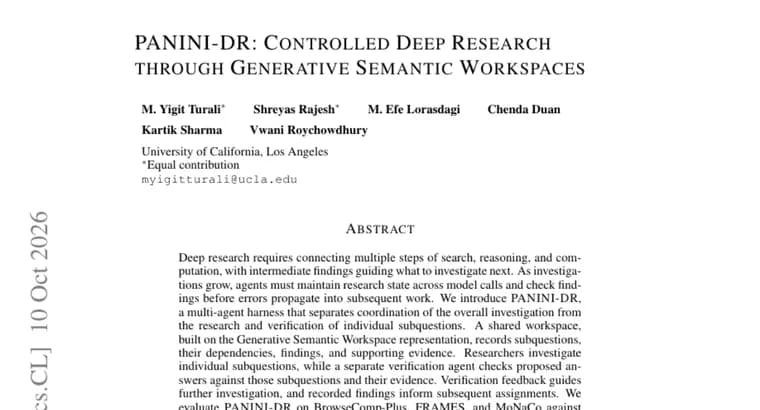
PANINI-DR is a multi-agent harness for deep research, described in a new preprint. The starting point is a familiar problem: deep research chains many steps of search, reasoning and computation, intermediate findings decide what to investigate next, and as an investigation grows the agents must keep research state across model calls and check findings before errors propagate into later work.
The design separates two jobs. One part coordinates the overall investigation. Another handles the research and verification of individual subquestions. A shared workspace, built on the Generative Semantic Workspace representation, records the subquestions, their dependencies, findings and supporting evidence. Researchers investigate individual subquestions, while a separate verification agent checks proposed answers against those subquestions and their evidence. Verification feedback guides further investigation, and recorded findings inform subsequent assignments.
The authors evaluate PANINI-DR on three benchmarks, BrowseComp-Plus, FRAMES and MoNaCo, against seven state-of-the-art deep-research harnesses. All of them use a shared language-model backbone and frozen corpora. PANINI-DR achieves the strongest average performance across the three benchmarks. On BrowseComp-Plus it reaches 73.3% accuracy, outperforming the next-best harness by 16.0 points. Its advantage is strongest on hard questions, where it answers nearly twice as many as the next-best harness.
Ablations show that structured planning and persistent state improve performance, as does checking each finding against its cited evidence before it is reused.
Because a model can answer correctly from memory alone, the authors also analyse the evidence each harness retains. PANINI-DR achieves the highest answer recoverability from saved evidence on all three benchmarks, and complementary claim-support audits show stronger evidence-backed answers. Accounting for this evidence changes how the harnesses compare and further strengthens PANINI-DR's advantage.
Key facts
- PANINI-DR separates coordination of the whole investigation from research and verification of individual subquestions.
- A shared workspace built on the Generative Semantic Workspace representation records subquestions, dependencies, findings and supporting evidence.
- On BrowseComp-Plus it reaches 73.3% accuracy, 16.0 points above the next-best harness.
- It was compared with seven state-of-the-art harnesses on BrowseComp-Plus, FRAMES and MoNaCo, all on a shared language-model backbone and frozen corpora.
- On hard questions it answers nearly twice as many as the next-best harness, and it has the highest answer recoverability from saved evidence on all three benchmarks.
Why it matters
Long deep-research runs tend to lose state and let early mistakes carry into later steps. PANINI-DR targets exactly that by keeping a persistent, structured record of subquestions, dependencies and evidence, and by putting a separate verification agent between a proposed answer and its reuse. The reported gains are largest on hard questions, which is where long investigations are most likely to go wrong.
Who it affects
Teams building or evaluating deep-research agents are the direct audience, particularly anyone comparing harnesses on BrowseComp-Plus, FRAMES or MoNaCo. The evidence-retention analysis is also relevant to anyone who needs answers that can be traced back to saved sources rather than to model memory.
How to use it
The abstract does not describe a release, so there is nothing to install from it. The practical takeaways are the design ideas: keep the planner apart from the researchers, store findings together with their evidence and dependencies in a shared workspace, and check each finding against its cited evidence before it is reused.
How solid is it
The comparison is controlled in a useful way: seven harnesses, one shared language-model backbone, frozen corpora. Ablations point to structured planning, persistent state and evidence checking as contributors. The evidence analysis also guards against answers that come from memory alone. Caveats: these are the authors' own reported results from a preprint, and the abstract does not name the backbone or the seven harnesses. It gives no accuracy figures for FRAMES or MoNaCo, or for the next-best harness on BrowseComp-Plus beyond the 16.0-point margin.
Risks and caveats
The abstract names no authors or institutions, and gives no absolute count or share of hard questions answered. No code, licence, cost or latency figures are mentioned, so the overhead of running a verification agent and a shared workspace is unknown. Without the backbone and the compared harnesses named, the size of the gain is hard to put in context.