Paper: uncertainty-guided contraction cuts reasoning SFT budget to as little as 0.22%
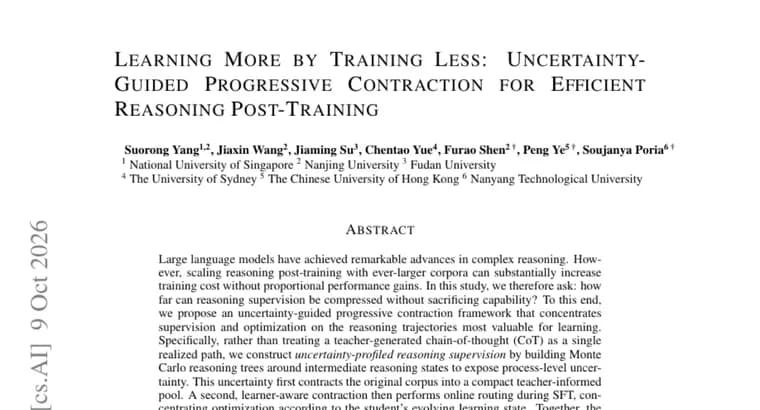
The paper starts from a cost problem. Large language models have advanced in complex reasoning, but scaling reasoning post-training with ever-larger corpora can substantially increase training cost without proportional performance gains. The authors ask how far reasoning supervision can be compressed without sacrificing capability.
Their answer is an uncertainty-guided progressive contraction framework, which concentrates supervision and optimization on the reasoning trajectories most valuable for learning. Instead of treating a teacher-generated chain-of-thought (CoT) as a single realized path, they build Monte Carlo reasoning trees around intermediate reasoning states. That exposes process-level uncertainty and yields what they call uncertainty-profiled reasoning supervision.
The method then works in two stages. First, this uncertainty contracts the original corpus into a compact teacher-informed pool. Second, a learner-aware contraction performs online routing during supervised fine-tuning (SFT), concentrating optimization according to the student's evolving learning state. Together the two stages progressively contract both supervision and optimization, which the authors say substantially reduces the student training budget.
The headline result is stated as follows: experiments across diverse reasoning benchmarks and LLM families show the method uses as little as 0.22% of the optimization budget of full-data SFT, over 450x less training exposure, while maintaining or improving reasoning performance. The authors also say the framework generalizes well across heterogeneous student families, black-box teachers, and weak-to-strong transfer. From this they conclude it is not only a way to accelerate training but can also enhance reasoning capability.
Key facts
- The framework contracts a teacher-generated CoT corpus in two stages: an uncertainty-based contraction into a compact pool, then learner-aware online routing during SFT.
- Uncertainty comes from Monte Carlo reasoning trees built around intermediate reasoning states, rather than from a single teacher CoT path.
- The authors report using as little as 0.22% of the optimization budget of full-data SFT, over 450x less training exposure, while maintaining or improving reasoning performance.
- They say the approach generalizes across heterogeneous student families, black-box teachers, and weak-to-strong transfer.
- The authors present it as more than a speed-up: they say it can also enhance reasoning capability.
Why it matters
Reasoning post-training is getting more expensive as corpora grow, and the authors argue the returns do not keep pace with the cost. A method that picks out the most valuable reasoning trajectories, and then routes optimization toward what the student still needs, targets that cost directly. If the reported figures of as little as 0.22% of the full-data SFT optimization budget, and over 450x less training exposure, hold up more broadly, the same reasoning gains would need a small fraction of the training effort.
Who it affects
The work is aimed at people who fine-tune student models on teacher-generated chain-of-thought data and want to cut the training budget. The authors say it generalizes across heterogeneous student families, black-box teachers (where only the teacher's outputs are available) and weak-to-strong transfer, which widens the set of setups it could apply to.
How to use it
The recipe, as described, has two steps. First, build Monte Carlo reasoning trees around intermediate reasoning states of teacher CoTs to profile uncertainty, and use that uncertainty to contract the corpus into a compact teacher-informed pool. Second, during SFT, route training online according to the student's evolving learning state so optimization concentrates where it is most useful. No code release, dataset release or publication venue is mentioned in the source.
How solid is it
The evidence is the authors' own report of experiments across diverse reasoning benchmarks and LLM families. The 0.22% figure is the best case ('as little as'), not a typical or average figure across all settings, and it refers to the optimization budget, not to the dataset being reduced to 0.22%. The claim about performance is limited to 'maintaining or improving'. No specific benchmarks, model names or model sizes are given, and no absolute accuracy figures or per-benchmark gains are given, so the size of any improvement cannot be judged from the abstract.
Risks and caveats
The claims are the authors' and have not been independently checked here. Without named benchmarks, models or absolute scores, it is hard to tell how large the gains are or how well the results transfer to other settings. No wall-clock time, GPU hours or dollar cost is stated, so the practical savings are not quantified beyond the budget and exposure ratios. The step from 'generalizes well' to 'can also enhance reasoning capability' is the authors' interpretation.
“how far can reasoning supervision be compressed without sacrificing capability?”
— Paper abstract