Paper finds a tiny 856K-parameter unmasking policy speeds up LLaDA-8B-Instruct
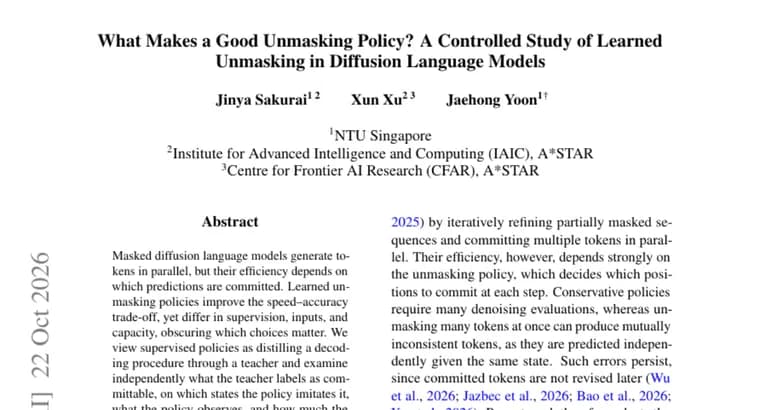
Masked diffusion language models generate tokens in parallel, but how efficient they are depends on which predictions get committed at each step. Learned unmasking policies, small models that decide what to commit, improve the trade-off between speed and accuracy. The problem, the paper says, is that existing policies differ at once in supervision, inputs and capacity, so it is unclear which choices actually matter.
The authors treat a supervised policy as distilling a decoding procedure through a teacher. They then examine four things independently: what the teacher labels as committable, on which states the policy imitates the teacher, what the policy observes, and how much the number of function evaluations (NFE) must fall to offset the policy's own overhead.
Three findings come out of this. First, labeling predictions that match the final output as committable is overly permissive at low NFE. Second, hidden states are weak as the only policy input, but they can complement confidence. Third, about a 10% NFE reduction suffices to offset policy overhead for policies up to 7.5M parameters across the tested settings.
Based on this, the authors train a policy on trajectory-contraction targets, which accept only commitments that stay on a reference trajectory. The policy takes confidence and hidden states as inputs. On LLaDA-8B-Instruct, the resulting 856K-parameter policy achieves the best accuracy-NFE frontier and the highest throughput on GSM8K. It is competitive at moderate targets on MATH-500 and HumanEval, and it largely transfers to Dream-7B-Instruct.
Key facts
- The study separates four design choices of learned unmasking policies: teacher labels, training states, policy inputs and overhead.
- Labeling predictions that match the final output as committable is overly permissive at low NFE.
- Hidden states are weak alone as a policy input but can complement confidence.
- About a 10% NFE reduction suffices to offset policy overhead for policies up to 7.5M parameters across tested settings.
- The final 856K-parameter policy, trained on trajectory-contraction targets, gets the best accuracy-NFE frontier and highest throughput on GSM8K with LLaDA-8B-Instruct, and largely transfers to Dream-7B-Instruct.
Why it matters
Masked diffusion language models decode in parallel, so the choice of which tokens to commit at each step drives their speed. Earlier learned policies improved the speed-accuracy trade-off but varied in several ways at once. This paper tries to say which choices matter by changing them one at a time, and uses the answers to build a policy with under a million parameters.
Who it affects
Researchers and engineers working on diffusion language model decoding and inference speed, particularly anyone using LLaDA-8B-Instruct or Dream-7B-Instruct, the two models the policy is tested on.
How to use it
The findings read as design guidance for a learned unmasking policy: use trajectory-contraction targets rather than labels based on matching the final output, feed the policy both confidence and hidden states, and expect that a roughly 10% NFE reduction covers the overhead of policies up to 7.5M parameters. The source mentions no code or weights release.
How solid is it
This is a preprint summary, and the account here rests on the abstract alone. The claims are the authors' own. The abstract gives no numeric accuracy, throughput or NFE values and does not say which baselines the policy is compared against. The result is described as best on GSM8K, only competitive at moderate targets on MATH-500 and HumanEval, and as transferring "largely" to Dream-7B-Instruct.
Risks and caveats
The strongest claim is limited to GSM8K on LLaDA-8B-Instruct. On MATH-500 and HumanEval the policy is not stated to be best. The 10% NFE figure holds across the tested settings and for policies up to 7.5M parameters, so it should not be assumed beyond that range. Transfer to Dream-7B-Instruct is not quantified.