Paper finds prediction error in video world models is an unreliable physical surprise signal
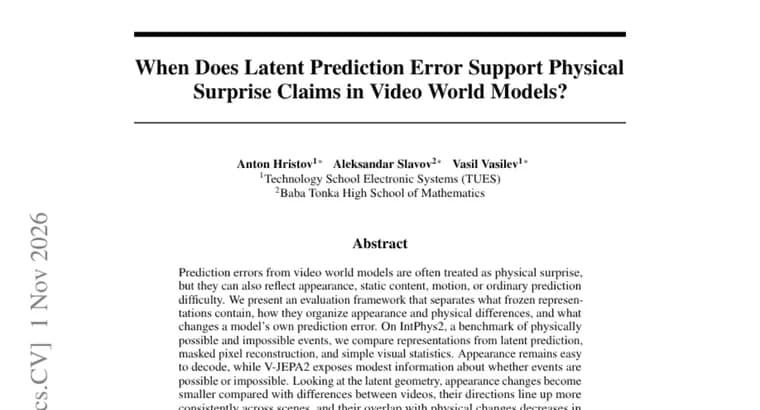
Video world models are often judged by how badly they predict what comes next, and a high prediction error is commonly read as the model being surprised by something physically impossible. A paper listed on Hugging Face questions that reading. Its starting point is that prediction error can also reflect appearance, static content, motion, or ordinary prediction difficulty, so it may not say anything about physics.
The authors present an evaluation framework that separates three questions: what frozen representations contain, how they organize appearance differences and physical differences, and what actually changes a model's own prediction error.
The first test uses IntPhys2, a benchmark of physically possible and impossible events. The paper compares representations from latent prediction, masked pixel reconstruction, and simple visual statistics. Appearance stays easy to decode from them. V-JEPA2, the latent-prediction model named in the abstract, exposes only modest information about whether an event is possible or impossible.
The second test looks at latent geometry. In deeper layers, appearance changes become smaller compared with differences between videos, their directions line up more consistently across scenes, and their overlap with physical changes decreases.
The third test looks at what moves prediction error. Across action-conditioned models, incorrect actions do raise the error, but appearance changes also produce substantial responses. On Physion++ video clips, repeating a single frame can produce higher error than the original clip, while changing color throughout the clip can lower it. Using Kubric, a simulation and rendering framework, the authors find that impossible events can produce lower error than possible events. A fixed error threshold also incorrectly flags many possible events as impossible.
The conclusion: a model can represent physical information and respond to incorrect actions without its native prediction error reliably measuring physical surprise.
Key facts
- Prediction error from video world models is often treated as physical surprise, but it can also reflect appearance, static content, motion, or ordinary prediction difficulty.
- On IntPhys2, appearance remains easy to decode from the compared representations, while V-JEPA2 exposes only modest information about whether events are possible or impossible.
- On Physion++ clips, repeating a single frame can raise error above the original clip, and changing color throughout the clip can lower it.
- Using Kubric, impossible events can produce lower error than possible events, and a fixed error threshold flags many possible events as impossible.
- The authors conclude that a model can encode physical information and react to incorrect actions without its native prediction error reliably measuring physical surprise.
Why it matters
Using a world model's own prediction error as a physics-violation detector is an intuitive shortcut: if the model is surprised, something impossible happened. This paper tests that shortcut and finds it shaky. Error can rise or fall for reasons unrelated to physics, such as a color change or a repeated frame, and in the Kubric tests impossible events sometimes scored lower error than possible ones. Claims that a model understands physics because its error spikes on impossible events need more support than that spike alone.
Who it affects
Researchers who build or evaluate video world models, especially latent-prediction models such as V-JEPA2, and anyone who reads results on physical-plausibility benchmarks like IntPhys2 and Physion++. It also touches work that uses prediction error as a signal, including action-conditioned models, where the paper finds appearance changes trigger substantial responses alongside incorrect actions.
How to use it
The framework itself is a practical checklist: ask separately what the frozen representations contain, how they arrange appearance and physical differences, and what changes the model's own prediction error. The control manipulations described in the abstract, such as repeating a single frame or changing color across a clip, show the kind of check that can expose a surprise metric responding to the wrong thing. The abstract does not describe a released tool or a replacement metric.
How solid is it
The material is a short abstract, so the findings are stated qualitatively: the abstract uses words like "modest" and "many" rather than figures. It gives no accuracy numbers, error values or thresholds, and no counts of videos or events. The tests span three benchmarks or frameworks (IntPhys2, Physion++, Kubric) and several representation types, which supports the breadth of the claim. Beyond V-JEPA2, the abstract does not name which models were tested, nor which action-conditioned models.
Risks and caveats
The result is about native prediction error as a measure of physical surprise. It does not say that the models lack physical knowledge; the authors note a model can represent physical information. It also makes no ranking among latent prediction, masked pixel reconstruction and simple visual statistics. The claim is hedged with "can" and "often": error sometimes misleads, not always. Without the full paper's figures and setup, how large the effects are cannot be judged from the abstract alone.
“A model can therefore represent physical information and respond to incorrect actions without its native prediction error reliably measuring physical surprise.”
— Paper abstract, Hugging Face Papers