Paper: LLMs are General Asynchronous Agents, shown with Qwen 3.x
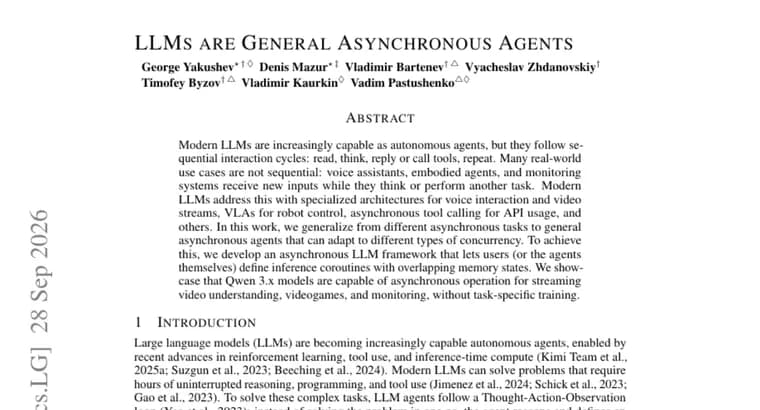
The paper "LLMs are General Asynchronous Agents" starts from a limit in how modern LLM agents work. Even as they get better at acting autonomously, they follow a sequential cycle: read, think, reply or call tools, then repeat.
The authors point out that many real-world uses do not fit that cycle. Voice assistants, embodied agents and monitoring systems receive new inputs while they are still thinking or carrying out another task.
Today these cases are handled with specialized solutions, according to the authors: dedicated architectures for voice interaction and video streams, vision-language-action models (VLAs) for robot control, and asynchronous tool calling for API usage, among others. Each one targets a single kind of asynchrony.
The paper tries to generalize from these separate asynchronous tasks to general asynchronous agents that can adapt to different types of concurrency. To get there, the authors develop an asynchronous LLM framework. It lets users, or the agents themselves, define inference coroutines with overlapping memory states.
As a demonstration, the authors showcase that Qwen 3.x models are capable of asynchronous operation for streaming video understanding, videogames and monitoring, without task-specific training. The text available here is the abstract; it gives no quantitative results, benchmarks, latencies or accuracy figures.
Key facts
- Modern LLM agents follow a sequential cycle of read, think, reply or call tools, repeat, which the authors say does not fit voice assistants, embodied agents or monitoring systems.
- Existing answers are specialized: architectures for voice and video streams, VLAs for robot control, and asynchronous tool calling for API usage.
- The authors propose an asynchronous LLM framework in which users (or the agents themselves) define inference coroutines with overlapping memory states.
- They report that Qwen 3.x models can operate asynchronously on streaming video understanding, videogames and monitoring without task-specific training.
- No quantitative results, benchmarks, latencies or accuracy figures are given.
Why it matters
Most LLM agents today wait for an input, think, answer and start over. Real deployments such as voice assistants, robots and monitors keep receiving input while the model is busy. The paper's pitch is one general mechanism for that, in place of a separate specialized system for each case (voice and video architectures, VLAs for robots, asynchronous tool calling for APIs).
Who it affects
Developers building agents that must react to live input: voice assistants, embodied agents, monitoring systems, streaming video understanding and game-playing agents. Teams that now maintain different asynchronous stacks for different products are the natural audience for a unified framework.
How to use it
The authors describe a framework in which users, or the agents themselves, define inference coroutines with overlapping memory states. They show that Qwen 3.x models can be run this way without task-specific training. No code or model release is mentioned, so there is no concrete entry point to point to yet.
How solid is it
The evidence here is an abstract. The authors showcase Qwen 3.x models working asynchronously on streaming video understanding, videogames and monitoring. No quantitative results, benchmarks, latencies or accuracy figures are given, and no comparison against the specialized asynchronous systems is reported. Which Qwen 3.x sizes or versions were tested is not stated.
Risks and caveats
Without numbers, the claim that these models are "capable of asynchronous operation" cannot be judged for quality or reliability. It is also unclear how the general approach compares with purpose-built voice, VLA or async tool-calling systems. The abstract names no authors or institutions, and mentions no code or model release, so independent checking depends on the full paper.