Paper ties diffusion transformer speedups to AdaLN-Zero residual gates
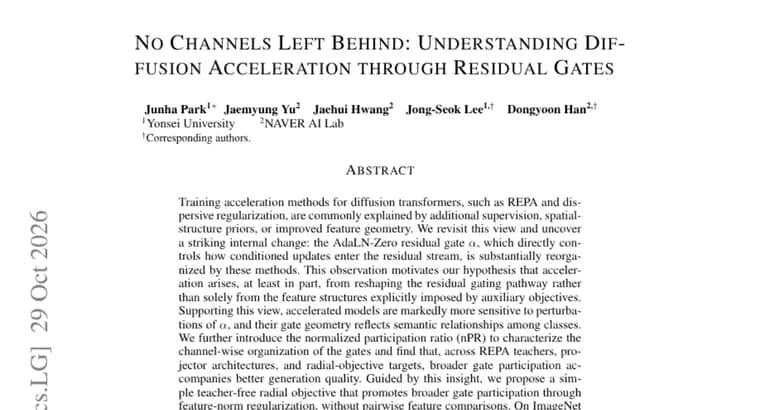
Methods that speed up the training of diffusion transformers, such as REPA and dispersive regularization, are usually explained by extra supervision, spatial-structure priors or better feature geometry. This paper revisits that view and reports what the authors call a striking internal change: the AdaLN-Zero residual gate α, which directly controls how conditioned updates enter the residual stream, is substantially reorganized by these methods.
That observation leads to a hypothesis. The authors propose that acceleration comes, at least in part, from reshaping the residual gating pathway, and not solely from the feature structures that the auxiliary objectives explicitly impose.
Two findings are offered in support. Accelerated models are markedly more sensitive to perturbations of α, and their gate geometry reflects semantic relationships among classes.
The authors also introduce the normalized participation ratio (nPR), a measure of how the gates are organized channel by channel. Across REPA teachers, projector architectures and radial-objective targets, they find that broader gate participation accompanies better generation quality.
Guided by this, they propose a simple teacher-free radial objective. It promotes broader gate participation through feature-norm regularization and uses no pairwise feature comparisons. On ImageNet 256x256 with SiT-B/2, the method improves FID over dispersive loss while also increasing mean gate participation over timesteps and classes. The authors say this further supports a link between gate organization and training acceleration.
Their conclusion is that residual-gate reorganization is a measurable axis of diffusion training acceleration, and that it points to a simple direction for further acceleration.
Key facts
- The paper says acceleration methods for diffusion transformers, including REPA and dispersive regularization, substantially reorganize the AdaLN-Zero residual gate α.
- The authors hypothesize that acceleration arises at least in part from reshaping the residual gating pathway, not only from the features the auxiliary objectives impose.
- They introduce the normalized participation ratio (nPR) and report that broader gate participation accompanies better generation quality across REPA teachers, projector architectures and radial-objective targets.
- Their proposed teacher-free radial objective uses feature-norm regularization with no pairwise feature comparisons.
- On ImageNet 256x256 with SiT-B/2, the method improves FID over dispersive loss while raising mean gate participation over timesteps and classes.
Why it matters
Acceleration methods such as REPA and dispersive regularization are commonly explained by added supervision, spatial-structure priors or improved feature geometry. This paper offers a different angle: that much of the effect may come from how the AdaLN-Zero gate α, which controls how conditioned updates enter the residual stream, gets reorganized. If that holds, residual-gate organization becomes a measurable axis for studying and tuning diffusion training speed, which the authors say suggests a simple direction for further acceleration.
Who it affects
Mainly researchers working on diffusion transformers and on training-acceleration techniques such as REPA and dispersive regularization. The experiment uses SiT-B/2 on ImageNet, so the work speaks most directly to people studying class-conditional image generation of that kind.
How to use it
The paper offers two practical ideas. First, nPR can serve as a diagnostic of how broadly the gate channels participate. Second, the teacher-free radial objective is a feature-norm regularizer that needs no external teacher and no pairwise feature comparisons, so it could be tried as an alternative to dispersive loss. The source does not give a definition or formula for nPR.
How solid is it
This is a paper abstract, and the claims are the authors' own. The evidence described is correlational: broader gate participation accompanies better generation quality. The authors frame gate reorganization as a hypothesis (acceleration arises "at least in part" from it), and the abstract does not state that it causes acceleration. No FID values, baseline numbers or size of the improvement are given. No training speedup factor or compute figure is given. No results are reported beyond ImageNet 256x256 with SiT-B/2.
Risks and caveats
The headline result, an FID improvement over dispersive loss, comes with no stated magnitude, so its practical weight is unknown. Evidence is limited to one model and dataset setting, SiT-B/2 on ImageNet 256x256, and the link between gate organization and acceleration rests on correlation and sensitivity tests rather than a demonstrated cause. No code release or checkpoints are mentioned.
“broader gate participation accompanies better generation quality”
— From the paper's abstract, Hugging Face Papers