PhysLDM uses latent diffusion to simulate deformable 3D bodies in one shot
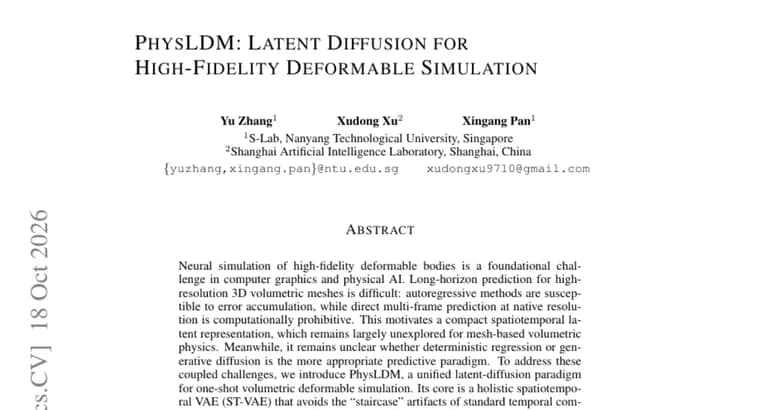
PhysLDM is a preprint on neural simulation of deformable bodies, a problem the authors call foundational in computer graphics and physical AI. The difficulty they start from is long-horizon prediction on high-resolution 3D volumetric meshes. Autoregressive methods are prone to error accumulation, while predicting many frames directly at native resolution is computationally prohibitive. That points to a compact spatiotemporal latent representation, which the authors say is largely unexplored for mesh-based volumetric physics. A second open question is whether deterministic regression or generative diffusion is the better predictive paradigm.
The authors answer both with PhysLDM, which they describe as a unified latent-diffusion paradigm for one-shot deformable simulation. Its core is a holistic spatiotemporal VAE. They say it avoids the "staircase" artifacts of standard temporal compression such as video VAEs. They report a reconstruction precision of about 2.48 mm on meter-scale scenes at up to 78x token compression.
With that latent space in place, the authors compare regression and diffusion systematically. Their stated finding is that complex deformable dynamics are often chaotic. In that regime deterministic regression tends to produce non-physical averages, whereas diffusion better models the distribution of outcomes. So they use a latent diffusion model that learns from chaotic data and generates physically plausible trajectories.
Trained purely kinematically on an Objaverse-scale dataset, a single PhysLDM generalizes zero-shot to unseen out-of-distribution datasets. The authors add that the model is differentiable, which they say enables efficient solution of inverse problems and higher-order design optimization. To their knowledge, PhysLDM is the first high-fidelity spatiotemporal autoencoder and latent-diffusion paradigm for volumetric deformable dynamics. They present it as a scalable and robust approach to neural simulation. A project page accompanies the paper.
Key facts
- PhysLDM is a latent-diffusion approach to one-shot simulation of deformable bodies on 3D volumetric meshes, built on a spatiotemporal VAE.
- The VAE reaches about 2.48 mm reconstruction precision on meter-scale scenes with up to 78x token compression, and the authors say it avoids the "staircase" artifacts of video VAEs.
- The authors report that for chaotic deformable dynamics, regression tends to produce non-physical averages while diffusion better models the distribution.
- Trained purely kinematically on an Objaverse-scale dataset, a single model generalizes zero-shot to unseen out-of-distribution datasets.
- The authors say the model's differentiability enables inverse problems and higher-order design optimization.
Why it matters
Simulating deformable bodies over long horizons on detailed 3D meshes is expensive and error-prone: autoregressive rollouts accumulate error, and predicting many frames at full resolution costs too much. PhysLDM tackles this by compressing space and time into a compact latent and predicting there. The authors also take a position on a live question, regression versus diffusion, arguing diffusion fits chaotic dynamics better. They claim it is the first high-fidelity spatiotemporal autoencoder and latent-diffusion approach for volumetric deformable dynamics.
Who it affects
The work is aimed at researchers in computer graphics and physical AI who build neural simulators for deformable objects. The differentiability claim, which the authors tie to inverse problems and design optimization, points to people who need to fit or optimize simulated behavior rather than only run it forward.
How to use it
The paper has a project page at https://yucrazing.github.io/physldm/. Practitioners can read the reported recipe: train a spatiotemporal VAE on mesh dynamics, then train a latent diffusion model on that latent space instead of a deterministic regressor. The source mentions only the project page, so there is nothing to install or run from what is described here.
How solid is it
This is a preprint listed on Hugging Face Papers, and the claims are the authors' own. The headline numbers, about 2.48 mm reconstruction precision and up to 78x token compression, describe the VAE's reconstruction, not simulation prediction error. The 78x figure is an upper bound. The abstract gives no benchmark scores, baselines or error figures for the regression-versus-diffusion comparison, so the central finding is stated but not quantified there. The first-of-its-kind claim is made "to our knowledge".
Risks and caveats
The abstract does not give inference speed, hardware, model size or training cost, so practical cost is unclear. The source mentions no real-world or physical-experiment validation. The insight that diffusion beats regression is framed for the chaotic regime, which the authors say is common, not universal. Zero-shot generalization is claimed from a kinematic training set at Objaverse scale, and no further dataset details are given. No code or model release is mentioned; only a project page is linked.