PhysVista benchmark tests whether VLMs understand physics through a perception-reasoning-assessment loop
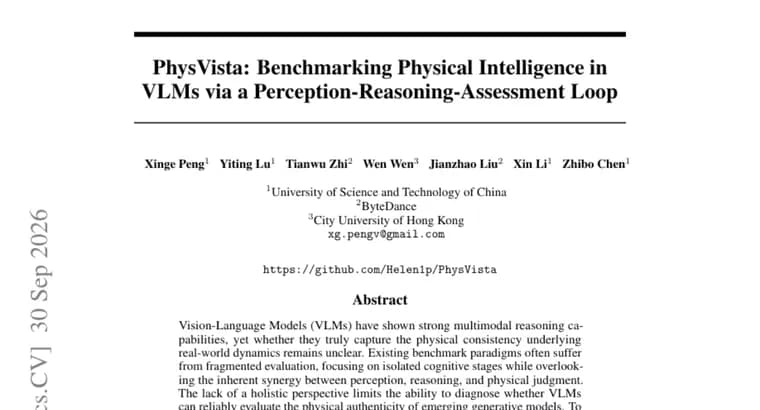
A new paper introduces PhysVista, a benchmark for measuring physical intelligence in vision-language models (VLMs). The authors start from a gap: VLMs have shown strong multimodal reasoning, but whether they truly capture the physical consistency underlying real-world dynamics remains unclear.
They argue that existing benchmarks often suffer from fragmented evaluation. These tests focus on isolated cognitive stages and overlook the synergy between perception, reasoning and physical judgment. That lack of a holistic view, the authors say, limits the ability to diagnose whether VLMs can reliably evaluate the physical authenticity of emerging generative models.
PhysVista is built around a closed cognitive loop inspired by the human seeing-reasoning-assessment process. It restores that loop by jointly evaluating three things: physical state perception, physical dynamics reasoning, and physical plausibility assessment. It also distinguishes event-level reasoning from scale-level reasoning, which allows a finer-grained analysis of physical understanding.
The benchmark uses both real-world and AI-generated videos. That lets it evaluate models across diverse domains and in emerging generative scenarios, where the question is whether a model can tell physically plausible footage from implausible footage.
The authors ran extensive experiments across a diverse set of VLMs. They report substantial limitations in physical reasoning and plausibility assessment, which they read as a persistent gap between visual recognition and genuine physical understanding. They say the results point toward more principled designs for physically grounded multimodal intelligence.
Key facts
- PhysVista is a benchmark that evaluates physical intelligence in VLMs through a closed loop inspired by the human seeing-reasoning-assessment process.
- It jointly tests three skills: physical state perception, physical dynamics reasoning, and physical plausibility assessment.
- It separates event-level reasoning from scale-level reasoning for finer-grained analysis.
- It combines real-world and AI-generated videos, so it also probes how VLMs judge emerging generative content.
- Experiments across a diverse set of VLMs show substantial limitations in physical reasoning and plausibility assessment.
Why it matters
VLMs look strong on multimodal reasoning, but it is unclear whether they grasp the physical consistency of real-world dynamics. The authors say existing benchmarks test isolated stages and miss how perception, reasoning and physical judgment work together. PhysVista tries to test them as one loop. Its inclusion of AI-generated videos also targets a practical question: whether VLMs can reliably judge the physical authenticity of output from generative models.
Who it affects
Researchers building and evaluating VLMs are the direct audience, since the benchmark is meant to diagnose where physical understanding breaks down. The authors also point to those working on physically grounded multimodal intelligence, and to anyone relying on VLMs to evaluate the physical authenticity of generated video.
How to use it
The source text describes the benchmark's design: three jointly evaluated abilities, a split between event-level and scale-level reasoning, and a mix of real and AI-generated videos. No release date, code or dataset link is stated in the source text, so there is nothing here to run yet.
How solid is it
This is a paper abstract, and the findings are the authors' own claims. They report experiments across a diverse set of VLMs and substantial limitations in physical reasoning and plausibility assessment. No VLMs are named, and no scores, accuracies or rankings are given. No benchmark size (number of videos, questions or categories) is given either.
Risks and caveats
Without numerical results, the size of the reported gap cannot be judged from the abstract. It does not say which models performed best or worst, or whether open or proprietary models were tested. It does not say how plausibility of AI-generated videos was labelled or which generative models produced the videos. The conclusion that recognition and physical understanding diverge is the authors' reading of their experiments.
“highlighting a persistent gap between visual recognition and genuine physical understanding”
— PhysVista paper abstract