PixVid lifts Wan2.1-14B video diffusion into pixel space
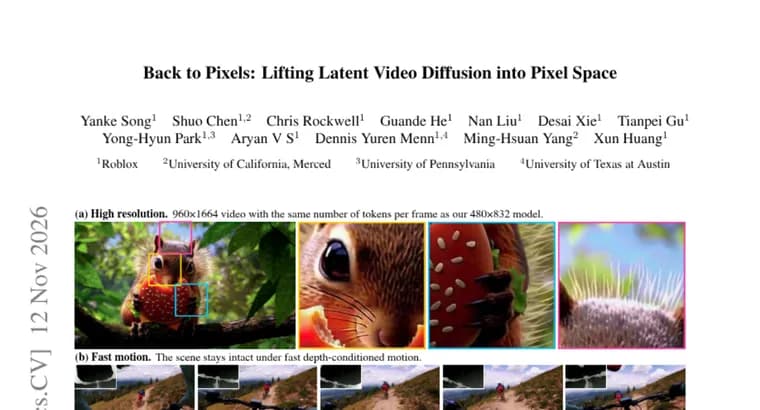
A new paper presents PixVid, a method for moving a pretrained latent video diffusion model into pixel space. The authors start from how frontier video generators work today: they operate in a VAE latent space that compresses video in both space and time. That compression made training tractable, the authors say, but it now limits high-resolution, controllable and interactive generation.
They name three specific problems. Doubling the resolution quadruples the token count. Conditions apply to groups of frames rather than to individual frames. And each response has to wait for the rest of its multi-frame block.
PixVid's fix is to keep the diffusion transformer and replace the VAE decoder with a convolutional head that renders the transformer's outputs into pixels. The result generates every frame directly in pixel space. The authors report one training finding: predicting clean video rather than velocity, together with a larger noise shift, is key to quality.
PixVid is finetuned from Wan2.1-14B. The authors say it is competitive with the latent baseline within about 1.3M training clips. Because it works framewise in pixels, they report three benefits: it generates at twice the resolution with the same per-frame token count, it keeps depth-conditioned video editing aligned under fast motion, and it responds to each action at the next frame. A project page is linked at https://chenshuo20.github.io/PixVid/.
Key facts
- PixVid keeps the diffusion transformer of a pretrained latent video model and replaces the VAE decoder with a convolutional head that renders outputs into pixels.
- It is finetuned from Wan2.1-14B and is reported as competitive with the latent baseline within about 1.3M training clips.
- Working framewise in pixels, it generates at 2x higher resolution with the same per-frame token count.
- The authors find that predicting clean video rather than velocity, plus a larger noise shift, is key to quality.
- It is reported to keep depth-conditioned video editing aligned under fast motion and to respond to each action at the next frame.
Why it matters
Most frontier video generators compress video into a VAE latent space across both space and time. The authors argue this helped make training tractable but now holds back high-resolution, controllable and interactive generation. In their account, doubling resolution quadruples the token count, conditions attach to groups of frames, and every response waits for the rest of a multi-frame block. PixVid is an attempt to remove that bottleneck without training a video model from scratch: it reuses a pretrained latent model and changes only how outputs are rendered.
Who it affects
Researchers and engineers building video generation systems are the direct audience, especially those working on higher resolution, depth-conditioned video editing, or interactive generation where a model reacts to actions frame by frame. Teams that already use Wan2.1-14B as a base are the most obvious readers, since PixVid is finetuned from it.
How to use it
The source describes a method, not a product, and gives no price or licence. The authors point to a project page at https://chenshuo20.github.io/PixVid/. The source does not say whether code, weights or a demo are released, beyond naming that project page. The recipe described is to keep the diffusion transformer, swap the VAE decoder for a convolutional head, finetune from Wan2.1-14B, and predict clean video rather than velocity with a larger noise shift.
How solid is it
This is a preprint abstract, and every claim is the authors' own. The headline result is that PixVid is competitive with the latent baseline within about 1.3M training clips. No benchmark names, scores or metrics are given for that claim. The same is true of the editing and interactivity claims, which are stated without numbers. The only quantified benefit is generating at 2x higher resolution with the same per-frame token count.
Risks and caveats
The abstract says "competitive", not better, so PixVid is not claimed to beat the latent baseline. The source gives no inference speed, compute cost or training cost. The absolute resolution values are not given, only the 2x factor. The source does not say the 1.3M clips are the entire training set size of the baseline; it only says PixVid is competitive within about 1.3M training clips. No authors or institutions are named in the source text, and no submission or publication date is given.
“PixVid keeps the diffusion transformer and replaces the VAE decoder with a convolutional head that renders its outputs into pixels.”
— PixVid paper abstract