PoS framework keeps explicit belief states for long-horizon LLM agents
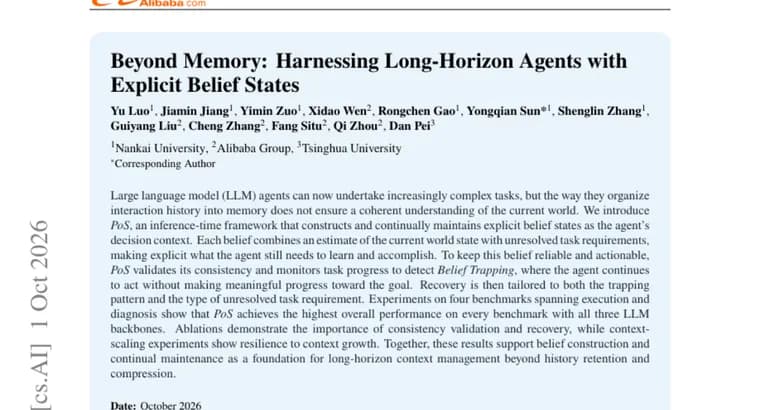
A paper titled "Beyond Memory: Harnessing Long-Horizon Agents with Explicit Belief States" starts from a problem with today's LLM agents. They can now take on increasingly complex tasks, but the way they organize interaction history into memory does not ensure a coherent understanding of the current world.
The authors' answer is PoS, an inference-time framework that constructs and continually maintains explicit belief states as the agent's decision context. Each belief combines an estimate of the current world state with the task requirements that are still unresolved. That makes explicit what the agent still needs to learn and accomplish, instead of leaving it buried in a growing transcript.
To keep the belief reliable and actionable, PoS does two further things. It validates the belief's consistency, and it monitors task progress to detect what the authors call Belief Trapping: the agent continues to act without making meaningful progress toward the goal. When a trap is detected, recovery is tailored to both the trapping pattern and the type of unresolved task requirement.
On results, the authors report experiments on four benchmarks spanning execution and diagnosis. PoS achieves the highest overall performance on every benchmark with all three LLM backbones. Ablations demonstrate the importance of consistency validation and recovery, and context-scaling experiments show resilience to context growth. The authors conclude that the results support belief construction and continual maintenance as a foundation for long-horizon context management beyond history retention and compression.
Key facts
- PoS is an inference-time framework that builds and continually maintains explicit belief states as an LLM agent's decision context.
- Each belief combines an estimate of the current world state with unresolved task requirements.
- PoS validates the belief's consistency and watches for Belief Trapping, where the agent keeps acting without meaningful progress; recovery is tailored to the trapping pattern and the type of unresolved requirement.
- The authors report the highest overall performance on every one of four benchmarks (spanning execution and diagnosis) with all three LLM backbones tested.
- Ablations point to consistency validation and recovery as important, and context-scaling experiments show resilience to context growth.
Why it matters
Long-running agents accumulate interaction history, and the usual fixes are to retain it or compress it. The authors argue that how current agents organize that history into memory does not ensure a coherent understanding of the current world. PoS takes a different route: instead of managing the transcript, it maintains an explicit belief about the world state and about what remains unresolved. The authors present this as a foundation for long-horizon context management beyond history retention and compression.
Who it affects
The work is aimed at people building or studying LLM agents that run on long-horizon tasks, where the agent must keep acting over many steps and keep track of what it has learned and what is still open. The evaluation spans execution and diagnosis benchmarks, so those task types are the ones the reported results speak to.
How to use it
PoS is described as an inference-time framework, so it concerns how an agent's decision context is built while it runs. The idea an agent builder can take from the abstract is to keep a belief that pairs a world-state estimate with the task requirements still unresolved, check that belief for consistency, monitor progress for Belief Trapping, and choose recovery according to the trapping pattern and the kind of unresolved requirement. No code release, dataset or availability is mentioned.
How solid is it
The claims are the authors' own, drawn from the paper's abstract. They report the highest overall performance on every benchmark with all three LLM backbones, and ablations that show consistency validation and recovery matter. The abstract names no benchmarks, does not name the three LLM backbones, and gives no numeric scores, margins of improvement or baselines, so the size of the gains cannot be judged from it.
Risks and caveats
No numeric scores or baselines are reported, and the size of the context-scaling range is not given. No compute, latency or cost overhead of maintaining belief states is stated, and no limitations are mentioned. Results such as "highest overall performance" should be read as the authors' summary until the detailed numbers can be checked.
“the way they organize interaction history into memory does not ensure a coherent understanding of the current world”
— Abstract of the PoS paper, on current LLM agents