Prime Agent harness lifts ARC-AGI-3 score from 30% to 95.5%
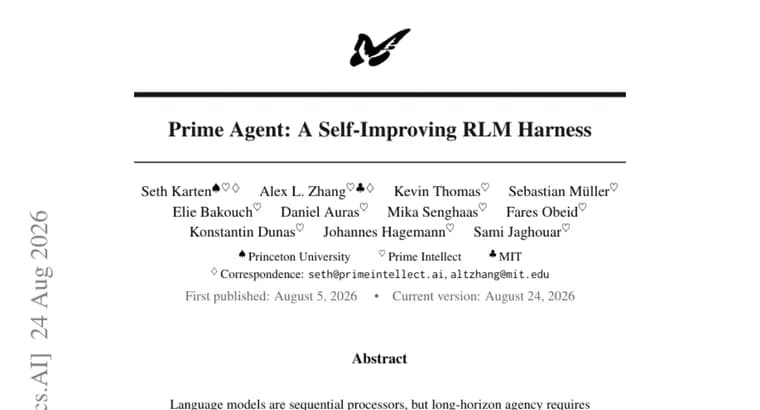
Prime Agent is a newly released open-source harness built for long-horizon evaluation and coding-agent workflows. At its core sits a persistent IPython REPL that follows the Recursive Language Model (RLM) abstraction, letting the agent process context and spend test-time compute programmatically rather than through a single fixed prompt. A companion component called the Continual Harness preserves histories, memories, skills, prompts and subagent specifications across trajectories, so an agent working on a long task does not lose its state between steps. Recursive subagents can coordinate directly with one another through agent-to-agent communication, and a separate interface called the Agents View lets a human operator inspect and manage these daemon-backed sessions while they run.
The harness standardizes execution, recovery, verification and resource accounting, leaving the actual problem-solving strategy to the model itself. The researchers describe this as a low-friction, expressive membrane meant to stop harness failures, such as a broken tool call or a lost session, from being mistaken for a failure of the underlying model, pushing benchmark measurements closer to a model's true maximal capability.
On ARC-AGI-3, a benchmark for long-horizon reasoning, Prime Agent raises the RHAE Best@1 score from a baseline of 30% to 95.5%. Across separate tests in long-context coding, GPU-kernel generation, emulator construction and autonomous nanoGPT speedruns, the harness matches or exceeds the results produced by native and other popular agent harnesses, though the specific harnesses used for comparison are not named in the released abstract.
In the strategy game Factorio, the researchers report that giving the agent room to refine its plans allows continuous progression through the game's technology tree, and that assigning dedicated subagents to specific jobs enables parallelized work. The project's code has been published on GitHub under PrimeIntellect-ai/prime-agent.
Key facts
- Prime Agent raises the ARC-AGI-3 RHAE Best@1 score from a 30% baseline to 95.5%.
- The harness runs on a persistent IPython REPL following the Recursive Language Model abstraction, letting an agent process context and spend test-time compute programmatically.
- A Continual Harness component preserves histories, memories, skills, prompts and subagent specifications across long trajectories.
- It matches or exceeds native and other popular harnesses on long-context coding, GPU-kernel generation, emulator construction and autonomous nanoGPT speedruns.
- In Factorio, refinement lets the agent progress continuously through the tech tree and dedicated subagents parallelize work; the code is published on GitHub.
Why it matters
Long-horizon agent benchmarks are often bottlenecked by the harness wrapped around a model, not the model itself: lost context, broken recovery, or a session that cannot resume a task all masquerade as a capability gap. Prime Agent's design goal is to strip that noise out by standardizing execution, recovery, verification and resource accounting so that what gets measured is closer to the model's actual ceiling. The jump on ARC-AGI-3, from a 30% baseline to 95.5%, is the harness's own evidence for that claim: most of that gain is attributed to removing harness-level failure rather than to a different underlying model.
Who it affects
Researchers building or evaluating long-horizon coding and reasoning agents, teams designing agent benchmarks, and developers building autonomous coding workflows that need an agent to keep state, memory and subagent coordination across many steps rather than a single prompt-response turn.
How to use it
Prime Agent is released as open-source code on GitHub at PrimeIntellect-ai/prime-agent. The abstract does not state a license, pricing or hosting requirement, so anyone wanting to run it needs to check the repository directly for setup details.
How solid is it
The results come from the project's own abstract on Hugging Face Papers, a self-reported benchmark rather than an independent evaluation. The abstract names the four other benchmark categories, long-context coding, GPU-kernel generation, emulator construction and autonomous nanoGPT speedruns, where Prime Agent matches or exceeds other harnesses, but it does not name which native or popular harnesses were used for that comparison, nor does it give figures for the compute, cost or time the evaluations took.
Risks and caveats
The abstract does not identify the authors, their institution or affiliation, which limits independent verification of the claims. The comparison harnesses on the four secondary benchmarks are unnamed, so the size of the reported advantage cannot be checked against a specific baseline. ARC-AGI-3 RHAE Best@1 is one benchmark among several, and a large jump on it does not by itself establish that the harness generalizes to other long-horizon tasks.
“This low-friction, expressive membrane prevents harness failures from becoming model failures and pushes measurement toward the model's true maximal underlying capability.”
— Prime Agent paper abstract