Prime Medicine treats first patient in prime-editing trial for Wilson's disease
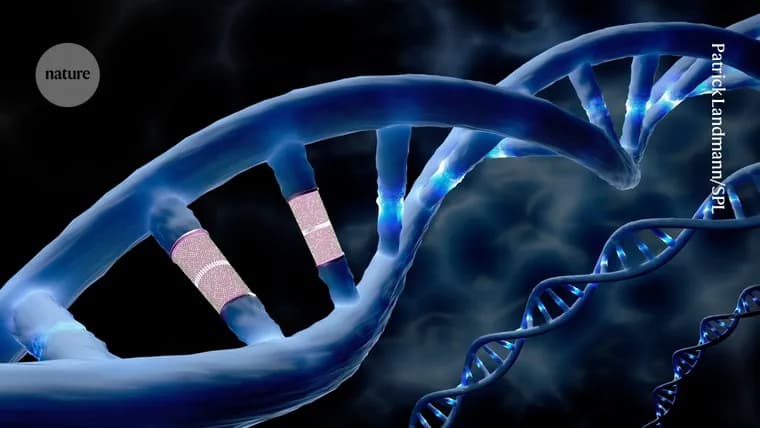
Prime Medicine, a biotechnology company in Cambridge, Massachusetts, announced that it had treated the first person in its clinical trial of prime editing earlier this month. Nature describes the treatment as the first known instance of DNA being edited directly in a person's body. The company expects to announce the first results from the study next year.
Prime editing is a gene-editing technique that, in Nature's words, can alter DNA with more precision than standard CRISPR-Cas9 methods. It is a more complex and versatile system that can insert, delete and rewrite segments of DNA. In this trial it is aimed at Wilson's disease: the therapy rewrites DNA in liver cells to erase a mutation that prevents them from eliminating excess copper.
Wilson's disease is caused by mutations in a gene called ATP7B, which encodes a protein that transports excess copper out of the liver. Left untreated, the resulting copper build-up can cause liver and nerve damage, as well as neurological disorders. Today's treatment is a complicated regimen of copper-clearing molecules and other medicines. Rhonda Rowland, president of the Wilson Disease Association in Atlanta, Georgia, says people with the condition are eager for a one-and-done treatment. Gene editing could, in theory, provide a lasting solution by correcting the faulty ATP7B gene. "I never dreamed that in my lifetime I would see this applied to my rare disease," she says. "It's going to be a really exciting year."
Why prime editing and not another tool? Base editing, which can rewrite individual DNA letters, cannot make the particular corrections needed to fix the most common ATP7B mutations. That left prime editing. In a separate clinical trial, Prime Medicine used the technique to treat two people with a rare immune disorder, but there it rewrote DNA in each participant's blood stem cells outside the body and then injected them back in.
The Wilson's trial differs because the editing happens in vivo, inside the body. Prime Medicine joins a host of companies trying to engineer cells directly in the body, rather than the standard method of extracting a person's cells, editing their DNA in a laboratory and reinjecting them. Nature says in vivo editing is appealing because manufacturing and administering the treatment might be much cheaper and faster than making a bespoke therapy for each person from their own cells. But in vivo approaches have their own challenges, says Krishanu Saha, a biomedical engineer at the University of Wisconsin-Madison: "It depends on what types of risks you're willing to accept."
The regulatory picture is thin so far. The US Food and Drug Administration has approved only one gene-editing therapy, Casgevy, which treats two inherited blood disorders and relies on CRISPR-Cas9, often used to disable genes rather than rewrite their sequences. No gene-editing therapy has been approved for use in vivo. The FDA is expected to issue a decision early next year on an in vivo CRISPR-Cas9 therapy for hereditary angioedema, a condition that causes severe swelling.
Key facts
- Prime Medicine, a Cambridge, Massachusetts biotech, announced it treated the first person in its prime-editing trial for Wilson's disease earlier this month; first results are expected next year.
- Nature calls it the first known instance of DNA edited directly in a person's body, here in liver cells to erase a mutation that stops them from clearing excess copper.
- Prime editing was chosen because base editing cannot make the corrections needed for the most common ATP7B mutations.
- Prime Medicine's other trial treated two people with a rare immune disorder, with blood stem cells edited outside the body and injected back.
- No gene-editing therapy is approved for in vivo use; the FDA is expected to decide early next year on an in vivo CRISPR-Cas9 therapy for hereditary angioedema.
Why it matters
Nature describes this as the first known instance of DNA edited directly in a person's body with prime editing, a technique it says alters DNA with more precision than standard CRISPR-Cas9 methods. It moves prime editing from cells edited in a lab, as in Prime Medicine's two-person immune disorder trial, to editing inside the patient. In vivo editing is appealing because making and giving the treatment might be much cheaper and faster than a bespoke therapy built from each person's own cells. So far, no gene-editing therapy has been approved for in vivo use.
Who it affects
Most directly, people with Wilson's disease, a condition in which mutations in the ATP7B gene let copper build up and can damage the liver and nerves. They currently manage it with a complicated regimen of copper-clearing molecules and other medicines, and Rhonda Rowland of the Wilson Disease Association says they are eager for a one-and-done treatment. It also matters to the other companies working on in vivo editing, which Prime Medicine has now joined.
How to use it
This is not something patients or developers can use yet. It is an early clinical trial, and the first results are expected next year. The source does not give the name of the trial, the number of planned participants, the dose or the delivery method. Nothing here is an approved treatment.
How solid is it
The core fact comes from Prime Medicine's own announcement, reported by Nature, and the milestone is described as the first known instance rather than a confirmed record. The source does not say anything about the patient's condition after treatment, or about safety or outcome. The therapy's name is not given either. The original article is partly paywalled, so the retelling covers only the text that was available.
Risks and caveats
There are no results yet, so efficacy and safety are unknown. Krishanu Saha, a biomedical engineer at the University of Wisconsin-Madison, notes that in vivo approaches have their own challenges and that it depends on what types of risks you are willing to accept; the source does not say which risks he means. The cost and speed advantages of in vivo editing are described only as something that might be true. Nature does not say when, or whether, prime editing for Wilson's disease could reach approval.
“I never dreamed that in my lifetime I would see this applied to my rare disease”
— Rhonda Rowland, president of the Wilson Disease Association in Atlanta, Georgia