Prior Labs open-sources RelArena-α, TabPFN-Rel and RPI for relational learning
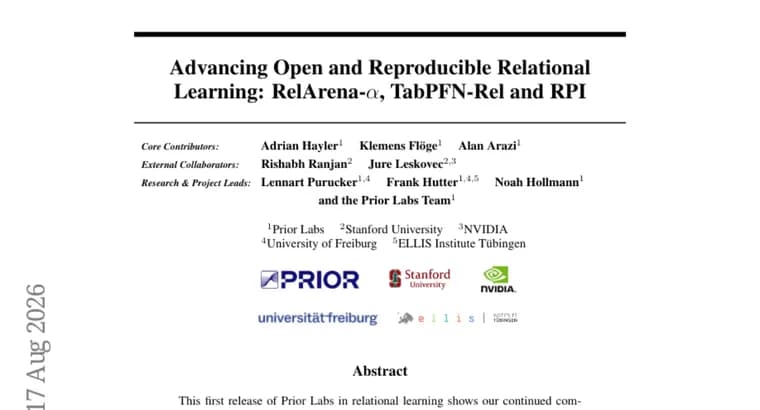
Prior Labs has put out its first release in relational learning, three open-source pieces of software the company frames as a step toward reproducible, real-world-relevant research in the field. The company describes it as an alpha release aimed at researchers and early-adopting practitioners rather than production users, and says it wants further development to be steered by feedback from, and collaboration with, the community.
The first piece is RelArena-α, a unified framework for running and comparing baselines on RelBench v1. Prior Labs says the field has accumulated a variety of datasets and tasks for relational learning over the past years, but the community has never converged on a reliable, reproducible way to compare different methods against each other. RelArena-α standardizes data loading, evaluation protocols and tuning regimes, and supports systems with custom tuning; it takes its cue from established tabular-benchmark projects such as TabArena. Prior Labs says it plans to keep developing RelArena-α with the research community as a catalyst for progress in the field.
The second piece is TabPFN-Rel, a relational harness built for TabPFN-3. It is currently ranked first among the models on RelArena-α and, according to Prior Labs, makes key improvements over a system called RDBLearn (the text does not describe what RDBLearn is or how it works). Beyond its ranking, the company presents TabPFN-Rel as a strong baseline that adds to a growing body of evidence that flattening a relational database into a single table remains competitive with specialized relational architectures on real-world tasks.
The third piece is RPI, the Relational Predictive Interface: an open-source, model-agnostic interface meant to help researchers and practitioners adopt relational-learning methods. It lets early adopters define problems on new databases and apply any model implemented in RelArena-α, including TabPFN-Rel, to those problems.
Key facts
- Prior Labs released three open-source alpha tools in one go: RelArena-α, TabPFN-Rel and RPI.
- RelArena-α is a unified framework for running and comparing baselines on RelBench v1, standardizing data loading, evaluation protocols and tuning regimes; it takes inspiration from the TabArena tabular benchmark.
- TabPFN-Rel, a relational harness for TabPFN-3, is currently ranked first among models on RelArena-α and is said to improve on a prior system called RDBLearn.
- Prior Labs says TabPFN-Rel adds to evidence that flattening a relational database into a single table remains competitive with specialized relational architectures on real-world tasks.
- RPI, the Relational Predictive Interface, is a model-agnostic tool that lets users define problems on new databases and apply any RelArena-α model, including TabPFN-Rel, to them.
Why it matters
Relational learning, training models directly on data spread across multiple linked database tables rather than one flat table, has lacked a shared, reproducible way to compare methods, according to Prior Labs. Datasets and tasks for the field have accumulated over the years without the community converging on common evaluation protocols. RelArena-α is pitched as infrastructure to close that gap: a standardized harness for data loading, evaluation and tuning that other teams can build baselines against, rather than a new model result to marvel at on its own.
Who it affects
The release targets researchers and early-adopting practitioners working on relational learning and tabular machine learning, not production users. Prior Labs frames this explicitly as an early-stage, alpha-level release meant to gather community feedback and collaboration rather than to be deployed as-is.
How to use it
All three pieces are open source. RPI is the entry point for hands-on use: it lets a researcher define a problem on a new relational database and then apply any model already implemented in RelArena-α, including TabPFN-Rel, to that problem without writing model-specific glue code. The source text gives no license terms, no release date beyond the current alpha, and no roadmap for subsequent versions.
How solid is it
The claims come entirely from Prior Labs' own release notes; there is no independent evaluation in the source. No performance numbers, accuracy scores, or other benchmark metrics are given to substantiate TabPFN-Rel's first-place ranking on RelArena-α, and the source names no individual authors or institutional affiliations beyond "Prior Labs." The comparison to RDBLearn is likewise asserted rather than quantified, and RDBLearn itself is not described.
Risks and caveats
This is a self-reported alpha release with no third-party verification available yet: the ranking claim for TabPFN-Rel, the improvement over RDBLearn, and the broader claim that flattened single-table representations rival specialized relational architectures all rest on unpublished internal comparisons. The composition and size of the RelBench v1 benchmark itself are not described in the source, and no license terms are stated for any of the three released tools.