Procedural Graph gives LLM agents step-by-step guidance that rewrites itself
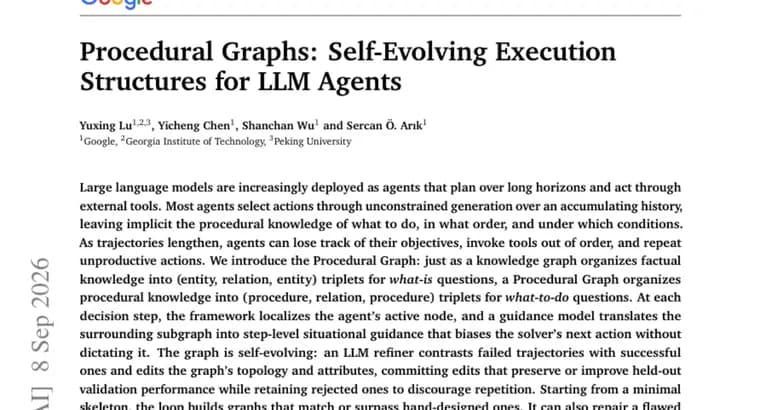
The authors describe a problem with today's LLM agents: most pick their next action through unconstrained generation over an accumulating history, which leaves the procedural knowledge of what to do, in what order, and under which conditions entirely implicit. As a trajectory gets longer, the agent can lose track of its objective, call tools out of order, or repeat actions that already failed. The authors' fix is what they call a Procedural Graph. Where a knowledge graph organizes facts as (entity, relation, entity) triplets to answer what-is questions, the Procedural Graph organizes procedural knowledge as (procedure, relation, procedure) triplets to answer what-to-do questions. At every decision step, the framework locates the agent's current position in the graph, and a separate guidance model reads the surrounding subgraph and turns it into step-level situational guidance. That guidance biases the solver's next move without dictating it outright, so the agent keeps its own discretion while getting structural steering. The graph is not fixed: it is self-evolving. An LLM refiner compares failed trajectories against successful ones and edits the graph's topology and attributes on that basis, committing an edit only when it preserves or improves performance on a held-out validation set, and keeping a record of rejected edits so the same unproductive change is not tried again. Starting from a minimal skeleton, this loop builds graphs the authors say match or surpass hand-designed ones, and the same self-evolution process can also repair a flawed expert-authored prior graph rather than requiring a fresh one. Across multiple datasets, task types, and underlying LLMs, the authors report that the Procedural Graph delivers consistent gains over memory-based baselines, and that letting the graph self-evolve further improves performance without additional manual engineering. The abstract does not give numeric results, name the specific datasets, task types, or LLMs used in evaluation, or state a publication venue or timeframe.
Key facts
- The Procedural Graph organizes procedural knowledge as (procedure, relation, procedure) triplets, mirroring how a knowledge graph organizes facts as (entity, relation, entity) triplets.
- At each decision step, a guidance model translates the agent's local subgraph into situational guidance that biases, but does not dictate, the next action.
- The graph self-evolves: an LLM refiner contrasts failed and successful trajectories, edits topology and attributes, and only commits edits that preserve or improve held-out validation performance, while tracking rejected edits to avoid repeating them.
- Starting from a minimal skeleton, the method builds graphs the authors say match or surpass hand-designed ones, and can repair a flawed expert-authored prior graph.
- The authors report consistent gains over memory-based baselines across multiple datasets, task types, and LLMs, with self-evolution adding further improvement without manual engineering.
Why it matters
Long-horizon LLM agents tend to degrade the longer a trajectory runs: without explicit procedural knowledge, they lose track of the objective, call tools in the wrong order, or repeat actions that already failed. The Procedural Graph targets that specific failure mode by making the how-to-proceed knowledge an explicit, structured object rather than something the model has to reconstruct from raw history each time, and by letting that structure improve itself from experience instead of staying fixed at whatever a human designer wrote down first.
Who it affects
The work speaks to anyone building or researching LLM agents that plan over long horizons and act through external tools: agent framework developers, researchers working on agent memory and planning, and teams whose agents currently rely on unconstrained generation over accumulating history or on hand-designed procedural scaffolding that cannot adapt.
How to use it
The abstract describes an architecture, not a released tool or product: a decision-time component that localizes an agent's active node in the graph and a guidance model that turns the local subgraph into step-level guidance, plus an offline refinement loop that edits the graph using an LLM refiner and held-out validation. It can bootstrap from a minimal skeleton or take an existing hand-designed procedural graph as a starting prior and repair its flaws. No price, license, or availability details are given.
How solid is it
The claims come from the paper's own abstract: the authors report gains over memory-based baselines across multiple datasets, task types, and LLMs, and further gains from letting the graph self-evolve, plus graphs that match or surpass hand-designed ones. The abstract itself gives no numeric results, no names for the specific datasets, task types, or LLMs used, and no publication venue or timeframe, so the size and generality of the reported gains cannot be independently assessed from this text alone.
Risks and caveats
Because the abstract omits concrete benchmark numbers and evaluation specifics, the strength of the reported improvement is not verifiable from this source. The self-evolution loop depends on an LLM refiner correctly interpreting failed-versus-successful trajectory contrasts and on a held-out validation set that must generalize; neither the robustness of that process nor its computational cost is addressed here.